
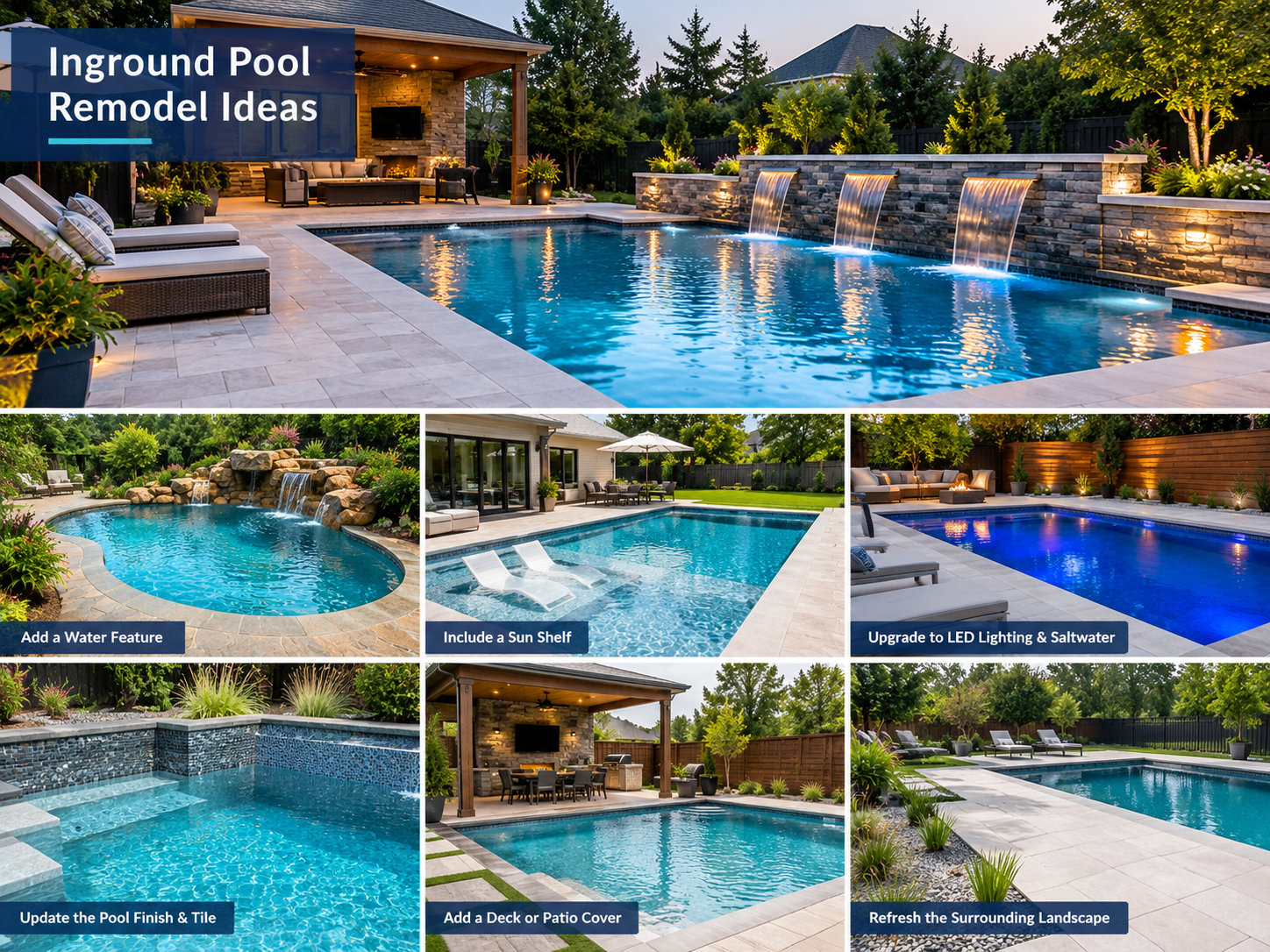
Most inground pool remodels cost between $6,000 and $30,000, but the number depends on what you change. A resurface alone runs roughly $5,000 to $12,000 on a typical 1,000 sq ft pool. Add a spa, a waterfall and a new deck and you can pass $40,000 fast. Start with the surface, tile, coping and equipment. Add the fun features second.
Your pool still holds water, so why does the backyard feel tired? Maybe the plaster is stained, the tile is chipped, the pump sounds like a leaf blower, or you just never use the thing anymore. A remodel can fix all of that without building a new pool, and that is usually the smarter money.
This guide gives you 15 inground pool remodel ideas, but it does something most “ideas” articles skip. For every idea, we check the price against published cost data, run the math, and tell you whether the number is actually fair. If a cost site says one thing and the physics says another, we point it out.
What a Pool Remodel Really Costs in 2026
Here is the honest problem with pool remodel pricing online. The headline numbers are all over the place, because they mix tiny repairs with full backyard rebuilds. Look at what three big cost sites say:
| Source | Headline number | What it really means | Our read |
|---|---|---|---|
| HomeAdvisor | Average $10,110, most projects $5,353 to $14,872 | Blends above-ground and inground jobs, plus small fixes | Too low for a typical inground remodel |
| HomeGuide | $5,000 to $30,000 for a major remodel, inground $6,000 to $50,000 | Reasonable spread, but still scope-dependent | Useful as an outer boundary |
| Fixr | National average $15,000, but a full range of $2,500 to $150,000 for inground | Range is so wide it cannot guide a budget | Ignore the extremes, look at project-level prices |
So what should you trust? Price by scope, not by “average remodel.” A resurface is one budget. A resurface plus tile plus coping is another. A full redesign is a different conversation entirely. The rest of this article is built that way.
One more thing before the numbers. Remodel prices depend on your region, your pool’s condition, access to your backyard, and what is hiding under the old deck. Blue Haven does not publish remodel prices online for that reason, and we think that is the honest approach. Treat every number below as a planning range, then get a real quote from your local team.
The quick cost table for all 15 ideas
| # | Remodel idea | Typical cost range | Quick verdict |
|---|---|---|---|
| 1 | Resurface the interior | $5,000 to $12,000 (about 1,000 sq ft) | Fair, and often urgent |
| 2 | Replace waterline tile | $2,400 to $2,900 (96 ft of tile line) | Best visual upgrade per dollar |
| 3 | Replace the coping | $2,900 to $4,800 (96 ft) | Fair if the old coping is failing |
| 4 | Add a tanning ledge | About $4,000 to $10,000 | Thin public data, get quotes |
| 5 | Shallow the deep end | Quote only | No reliable public benchmark |
| 6 | Add a built-in spa | $15,000 to $20,000 and up | Fair, retrofits can run higher |
| 7 | Add a water feature | $1,000 to $4,600 (sheer descent), $4,000 to $20,000 (rock) | Wide range, scope is everything |
| 8 | Variable-speed pump | $1,200 to $2,000 installed | Best payback on the list |
| 9 | Heater or heat pump | $1,500 to $6,000 (gas), $2,500 to $7,500 (heat pump) | Depends on climate and hookups |
| 10 | Automation and smarter sanitizing | $1,500 to $3,500 (automation) | Convenience buy, not a money saver |
| 11 | LED lighting | $700 to $1,500 per light | Fair, watch what is included |
| 12 | Deck resurface or replace | $3 to $12 per sq ft (resurface), $5 to $40 per sq ft (replace) | Do it while the pool is torn up |
| 13 | Fire features | $1,000 to $4,000 (bowls only), $5,000 to $8,000 installed | Gas line is the swing factor |
| 14 | Automatic or safety cover | $7,000 to $25,000 (automatic), $1,000 to $3,600 (safety) | Big price gap, pick by need |
| 15 | Full redesign or reshape | $50,000 to $100,000 | Only when the layout truly fails |
Cost ranges are national ballparks assembled from published sources linked in each section. The tile, coping and resurfacing totals use an example 16 x 32 ft pool with a 96 ft perimeter, about 19,000 gallons and roughly 990 sq ft of interior surface.
Remodel vs Renovation: What Is the Difference?
People use the words interchangeably, and that is fine in conversation. But the difference matters when you compare quotes.
- A renovation restores what you already have. New plaster, new tile, new coping, new equipment.
- A remodel changes how the pool looks or works. A spa, a tanning ledge, water features, new decking, a different depth, new lighting.
Blue Haven explains the same split on its remodeling page. Most real projects are a mix of both, which is why bundling the work usually saves money. The pool is already drained, the crew is already on site, and the deck is already open.
Is your pool due for a remodel? Watch for these signs:
- Rough, stained or chipping plaster (see why plaster problems happen)
- Cracked or missing waterline tile
- Coping that wobbles or lets water behind the shell
- A pump that is loud, old or running all day
- Deck cracks, trip hazards or standing water
- A pool nobody uses because of how it is laid out
The 15 Inground Pool Remodel Ideas
1. Resurface the interior with a better finish
Plaster wears out. It roughens, stains and eventually starts to chip. When that happens, a new finish is the single most important remodel you can do, because the finish protects the concrete shell underneath.
Most people replace white plaster with something tougher. Blue Haven recommends upgrading from basic white plaster to a more advanced finish such as SmartBrite® ColorQuartz®, which resists chipping, etching and staining better. Pebble is the premium step up. Here is how the options compare using Angi’s resurfacing data and the pool size we used above:
| Finish | Cost per sq ft | Total for about 1,000 sq ft | Typical lifespan | Cost per year of life |
|---|---|---|---|---|
| Standard plaster | $5 to $6 | $5,000 to $6,000 | About 10 years | $500 to $600 |
| Quartz aggregate | Between plaster and pebble | About $7,000 to $9,000 | Longer than plaster | Often lower than plaster |
| Pebble | About $8 to $12 (Angi cites $10) | $8,000 to $12,000 | 20+ years | About $400 to $600 |
Is that a good price? Yes, and here’s the part less articles mention, it really matters. When you divide the price by lifespan, plaster and pebble land in the same neighborhood per year. Pebble just costs more up front and saves you one drain, one chip-out and one week of downtime. If you plan to stay in the house ten years or more, the premium finish is usually the better deal.
Technical note: Interior surface area is roughly floor area plus perimeter times average depth. For a 16 x 32 pool at 5 ft average depth that is 512 + (96 x 5) = about 992 sq ft. Use that formula to sanity check any quote. If a contractor prices a pebble finish on that pool at $5,000, ask what is missing. If it is $25,000, ask what extras are bundled in.
Learn more: Pebble finish pros and cons | Pool resurfacing service
2. Replace the waterline tile
Waterline tile is the first thing people see, whether they are in the water or standing on the deck. New tile makes the whole pool look newer for a fraction of a full remodel. You can also add accent tile on steps or a mosaic while the pool is empty.
- Typical cost: About $25 to $30 per linear foot installed, based on contractor price guides.
- On our example pool: 96 ft of tile line works out to roughly $2,400 to $2,900.
- Is that a good price? Fair. Be careful with “per square foot” tile quotes, since waterline tile is a narrow band and is normally priced by the linear foot. Premium glass or mosaic tile can cost several times more.
Learn more: Waterline tile 101
3. Replace cracked or crumbling coping
Coping is the cap along the edge of the pool. It sheds water away from the shell and frames the whole pool. When it cracks or loosens, water can get behind it and cause bigger problems.
- Typical cost: Angi puts installed coping at about $30 to $50 per linear foot, or roughly $1,800 to $6,000 for most pools.
- On our example pool: 96 ft x $30 to $50 equals $2,880 to $4,800, which lands right inside Angi’s range.
- Is that a good price? Fair. Natural stone like travertine sits at the top. Poured concrete coping is the budget option.
Technical note: If your deck lip curls over the water’s edge, you may not have separate coping at all, so this idea may not apply. Ask your builder to confirm. Here is a photo guide to pool coping.
4. Add a tanning ledge (sun shelf)
A tanning ledge is a shallow, flat shelf, usually 6 to 12 inches deep, where you can put in-water loungers, let toddlers splash, or just sit and cool off. It is one of the most requested upgrades because it makes the pool useful for people who do not swim laps. Browse real examples in the tanning ledge gallery.
- Typical cost: About $4,000 to $10,000 for a retrofit.
- Is that a good price? This one needs a warning. We could not find a solid national source. We found homeowner reports (one paid $3,600 for a wavy 6 x 13 ft shelf built off existing stairs) and contractor blogs in the $5,000 to $10,000 range. Treat the range as soft and get at least two quotes.
Technical note: In a gunite pool the new ledge is built out from the wall and tied into the existing shell. Deeper pools need more concrete and support. Some builders also charge by perimeter length, so a long skinny ledge can cost more than a compact one.
5. Shallow the deep end
An 8 ft deep end looks impressive but few people use it. Lowering it to 4.5 or 6 ft gives kids, teens and shorter adults more usable water. Blue Haven notes that depth changes are possible in some remodels, depending on the existing structure, and covers it in shallowing the deep end.
- Typical cost: Quote only. We found no reliable public price benchmark, which is itself a useful finding. Anyone quoting a flat number without seeing the pool is guessing.
- Is that a good price? Ask for it as a separate line item, and ask whether it can be bundled with resurfacing, since the pool is empty anyway.
Technical note: Less depth means less water to heat and treat. On a 16 x 32 pool, dropping average depth from 5 ft to 4.5 ft cuts volume by roughly 10 percent, about 1,900 gallons. But most heat loss happens at the surface, not from volume, so do not expect a big heating bill drop. The real wins are usability and slightly lower chemical use.
6. Add a built-in spa
A spa turns a summer pool into a year-round retreat. Blue Haven notes that an interior spa built within the pool footprint can significantly minimize costs compared to a freestanding addition. You can browse interior spas, raised gunite spas and rim-flow spas.
- Typical cost: Angi lists a built-in spa at $15,000 to $20,000, compared with $5,000 to $8,000 for a separate hot tub.
- Is that a good price? Fair, with a catch. Angi’s figure is written around adding a spa to a new pool. Cutting a spa into an existing shell, tying in plumbing and adding heating can run higher. Budget a cushion.
Technical note: Decide early whether the spa shares equipment with the pool or gets its own heating and controls. Independent heating is what lets you run the spa hot while the pool stays cool.
7. Add a water feature
Water features change the sound and feel of the whole yard. Options include cascade waterfalls, rock waterfalls, bubblers, deck jets and scuppers and spillways. For design styles, see our guide to pool cascade waterfalls.
| Feature | Typical installed cost | Source |
|---|---|---|
| Sheet fall or sheer descent | $400 to $4,600 | HomeGuide |
| Standard rock waterfall | $1,500 to $17,600 | HomeGuide |
| Waterfall, most projects | $4,000 to $20,000 (average about $9,000) | Angi |
| Grotto with waterfall | $7,500 to $40,000 | HomeGuide |
Is that a good price? The two big cost sites disagree (HomeGuide’s overall average is far lower than Angi’s) because they define “waterfall” differently. A simple sheer descent on a raised wall is a small job. A rock waterfall with a grotto is a construction project. Always compare quotes for the same feature.
Technical note: Bigger features often need a dedicated pump, not a tie-in to your main circulation pump. Water volume, height and width all drive pump size. This is also why timing matters: if the deck is already open, running plumbing is easier and cheaper.
8. Swap to a variable-speed pump
This is the best payback on the list, and the one a lot of homeowner’s put off for years. A single-speed pump runs at full power all day. A variable-speed pump runs only as fast as the job needs.
- Typical cost: Roughly $1,200 to $2,000 installed, based on several equipment retailer and contractor guides.
- Savings: Vendors claim 50 to 80 percent. See the physics check below.
Technical check (why it saves so much): Pump power rises roughly with the cube of speed. Run a pump at half speed and flow drops to half, but power drops to about one eighth. To move the same water you run twice as long, so energy use is about one quarter. That is up to roughly 75 percent savings in theory, so claims in the 50 to 80 percent range are believable. Blue Haven’s own guidance of roughly half is the conservative end. The U.S. Department of Energy covers the method in its measure guideline for replacing single-speed pumps.
Quick math with real assumptions: A 1.5 HP single-speed pump draws about 1.8 kW. At 10 hours a day and $0.14 per kWh, that is about $76 a month. A variable-speed pump at about 200 watts for 12 hours costs about $10 a month. That is roughly $800 a year in savings and a payback of 1.5 to 2.5 years on a $1,200 to $2,000 install.
Learn more: Ditching single-speed pumps
9. Replace the heater (or add a heat pump)
Old heaters burn money slowly. Your two main choices are gas and heat pump.
| Heater type | Typical installed cost | Running cost | Best for |
|---|---|---|---|
| Gas or propane | $1,500 to $6,000 | Higher, heats fast | Cooler climates, occasional heating |
| Heat pump | $2,500 to $7,500 | Lower, heats slowly | Warm and mild climates, steady heating |
Cost ranges are from Angi’s pool heater guide. Utility work is the hidden extra: Angi lists $500 to $2,000 for a new gas line and $250 to $2,100 for a new electrical circuit.
Is that a good price? Judge the whole job, not just the unit. A fair-looking heater quote can balloon when the gas line or the 240V circuit is added. Ask the contractor to itemize the utility work.
Technical note: Heat pumps pull heat from the air, so they work best in warm weather and lose capacity in cold air. If you want to swim in cool months, size and climate matter more than brand. See how to choose a replacement heater and the heat pump guide.
10. Add automation and a smarter sanitizer
Nobody wants to climb out of a warm spa to change the temperature. Automation puts lights, heat, filtration and features on your phone. SmartControls™ pool automation is Blue Haven’s version. A modern sanitizer such as SmartPure® systems cuts back on chlorine tablets and jugs.
- Typical cost: About $1,500 to $3,500 installed for a standard automation retrofit. Fully integrated systems can climb well past that. Salt systems commonly run about $1,500 to $3,000 installed.
- Is that a good price? Fair, but be realistic about payback. Automation mostly buys convenience. A salt system’s chemical savings alone can take 10 years or more to pay back. Buy these for comfort and ease, not to get your money back.
11. Upgrade to LED lighting
If your pool light looks like an old headlight, it is time. LED lights last much longer than incandescent bulbs and use less power. See the SmartLight® multicolor LED and the pool lighting gallery.
- Typical cost: Angi lists LED pool lights at $700 to $1,500 per fixture, against $450 to $650 for incandescent.
- Lifespan: HomeAdvisor says LED options run 20,000 to 30,000 hours, versus 1,000 to 5,000 hours for incandescent bulbs.
- Is that a good price? A quote of $1,300 or more per light is on the high side. It can still be fair if it includes new conduit, a transformer or a controller. Ask what is included before you decide.
12. Resurface or replace the pool deck
The deck is where you actually live. Cracked, stained or too small, it drags down the whole yard. You have two paths: resurface the slab you have, or tear it out and start over. Ideas and materials are covered in our 10 most unique pool deck designs and the guide to concrete pavers for pool decks.
| Option | Installed cost per sq ft | On a 600 sq ft deck |
|---|---|---|
| Overlay or resurfacing | $3 to $12 | $1,800 to $7,200 |
| Poured concrete (replace) | $5 to $15 | $3,000 to $9,000 |
| Pavers (replace) | $12 to $20 | $7,200 to $12,000 |
| Travertine (replace) | $15 to $30 | $9,000 to $18,000 |
Ranges are from contractor price guides and Fixr’s pool deck costs. Removal of the old deck can add about $2 to $6 per sq ft.
Is that a good price? Resurfacing costs about half of a full replacement, but only works if the slab underneath is sound. If it is heaving or cracking, an overlay tends to copy the cracks within a season or two. Ask your builder to inspect the base first.
Technical note: Heat matters in sunny states. Pavers and stone stay cooler underfoot than bare concrete. If you are replacing the deck, this is also the best time to resize it. Almost nobody regrets a bigger deck.
13. Add fire features
Fire bowls make evenings usable far into the cooler months. They also pair well with outdoor kitchen layouts.
- Typical cost: Retail guides quote $1,000 to $4,000 for a bowl installation. Contractor-installed projects with proper gas work often land at $5,000 to $8,000 or more.
- Is that a good price? The low numbers usually leave out the gas line. That is the real swing factor, and long runs get expensive fast.
Technical note: Fire features need a gas line sized for the burner’s BTU demand, safe clearances from the water and from anything flammable, and usually a permit. This is not a DIY job.
14. Add an automatic or safety cover
A cover cuts evaporation, keeps debris out and adds safety. There are five main types, and the price spread is huge. See our full guide to types of pool covers.
| Cover type | Typical installed cost | Source |
|---|---|---|
| Automatic | $7,000 to $25,000 (average about $15,000) | Angi |
| Automatic (another view) | $8,000 to $20,000 | HomeGuide |
| Solid safety | $1,500 to $3,600 | HomeGuide |
| Mesh safety | $1,000 to $3,000 | HomeGuide |
Is that a good price? Both sites agree an automatic cover lands in five figures. If you want one with a hidden in-deck track, do it while the deck is open, because retrofitting is harder. If safety is the main goal and the budget is tight, a safety cover costs a fraction as much.
15. Do a full redesign or reshape
Sometimes a refresh is not enough because the layout itself is the problem. A full redesign changes how the pool looks, feels and functions, often without a new footprint. Blue Haven offers 3D renderings for full redesign projects so you can see the result first.
- Typical cost: Published ranges for reshaping an existing concrete pool run about $50,000 to $100,000, and bigger scopes with water features and a new deck can go well beyond that.
- Is that a good price? It can be, but only after you have ruled out cheaper fixes. Many of the first 14 ideas deliver most of the change for far less. If the shell is sound, a stack of smaller upgrades often beats a full reshape.
Sample Remodel Budgets
To make the numbers easier to use, here are four example packages on the same sample pool (16 x 32 ft, about 19,000 gallons, 600 sq ft deck). Totals are simple sums of the ranges above.
| Package | What is included | Estimated range |
|---|---|---|
| A. Refresh | Quartz or pebble resurface ($8,000 to $12,000), waterline tile ($2,400 to $2,900), coping ($2,900 to $4,800) | $13,300 to $19,700 |
| B. Refresh + smart upgrades | Package A, plus variable-speed pump ($1,200 to $2,000), automation ($1,500 to $3,500), two LED lights ($1,400 to $3,000) | $17,400 to $28,200 |
| C. Backyard upgrade | Package B, plus deck resurface ($1,800 to $7,200) and a sheer descent ($1,000 to $4,600) | $20,200 to $40,000 |
| D. Full remodel | Package C, plus tanning ledge ($4,000 to $10,000), built-in spa ($15,000 to $20,000) and heat pump ($2,500 to $7,500) | $41,700 to $77,500 |
These are national planning ranges built from third-party data, not Blue Haven quotes. A real quote depends on your pool’s condition, your region and your site. For typical timelines, Blue Haven’s remodel page lists simple resurfacing at 1 to 2 weeks, mid-level renovations at 2 to 4 weeks, and full redesigns at 4 to 8 weeks or more.
How to Fact-Check Any Pool Cost Article
Here is the method we used to check every price in this article. You can use it on any pool cost article, including this one.
Step 1: Check what the number includes
Does the price cover the unit only, or the full install with electrical, gas, permits, removal and disposal? A $1,000 fire bowl is not a $1,000 fire feature.
Step 2: Do the quick math
Convert the price to something you can test. Per sq ft of surface, per linear foot of edge, or per year of lifespan.
Example: a pump savings claim that does not add up
One equipment blog claims a variable-speed pump drops a pool’s electric bill from $300 a month to $70 and pays itself back in under a year. At about $0.15 per kWh, a $300 monthly bill means roughly 2,000 kWh a month, or a pump pulling close to 2.8 kW around the clock. That is far above a typical single pump, so the example is mixing in other loads or an oversized setup.
Takeaway
Our math for a normal pump shows about $800 a year in savings and a 1.5 to 2.5 year payback. That is still excellent, just not magic.
Step 3: Compare at least three sources
When two sources disagree by a factor of three, find out why. Usually they define the project differently.
Step 4: Match the price to the scope
A good price for the wrong scope is not a good price. Always compare quotes line by line.
Step 5: Be skeptical of “national averages”
Blue Haven’s pricing guide is blunt about this: the variables are too local for one national number to mean much. We agree. Use averages to get oriented, then get a local quote.
Where to Start: A Simple Order of Operations
You do not need all 15 ideas. Most backyards need three or four. Here is a sensible order:
- Fix the shell and surface first. Leaks, cracks, coping and resurfacing come before anything pretty.
- Bundle everything that needs an empty pool or an open deck. Tile, depth changes, ledges, water feature plumbing, fire line trenching and cover tracks.
- Upgrade equipment next. A pump and heater swap is easy to do and starts saving money right away.
- Add features last. Spas, waterfalls and fire bowls are the reward, not the foundation.
Timing helps too. Fall is often the sweet spot because crews are less slammed and your pool is ready by the first warm weekend. Read why in fall is the best time to remodel a pool. And if you want more ideas before you decide, our companion post has 15 more pool remodel ideas and our gunite pool feature guide covers what to prioritize. Also worth a read: 7 swimming pool design mistakes to avoid.
How Blue Haven Helps With Your Inground Pool Remodel
Remodeling is not simpler than building new. Many pool pros will tell you it takes more expertise, because you are working around an existing shell, existing plumbing and an existing yard. That is where experience matters.
Blue Haven positions itself as America’s #1 pool remodeler, and the track record behind that claim is easy to see:
- 70+ years of legacy, with the company founded in 1954 (about Blue Haven)
- 300,000+ pools built nationwide
- 4.8 out of 5 stars across 10,000+ verified reviews on Google, Yelp and Trustpilot
- 60+ locations, with remodel specialists working across 30+ states (find your local office)
- Industry credentials shown on the About page, including BBB and PHTA membership
Six remodel service categories
Blue Haven’s remodel services cover the six areas most homeowners ask about:
- Tile and coping: new waterline tile and coping for a sharper, more modern edge
- Deck renovation: replace, resurface or redesign the space around the pool
- Pool resurfacing: from classic plaster to premium pebble and aggregate finishes
- Full pool redesign: reimagine the pool without starting from scratch, with 3D renderings available
- Equipment upgrades: quieter, more efficient pumps, heaters, filters and controls
- Water features and enhancements: custom features added to your existing pool
How a Blue Haven remodel works
- Free remodel consultation. A local specialist evaluates your structure, surface, equipment and deck, and listens to your goals.
- Custom renovation plan and design. You get a detailed plan with materials, features and equipment, so you know what it will look like and cost before work starts.
- Permits and approvals. Blue Haven handles the required permits and approvals.
- Renovation begins. Crews keep you updated at each milestone and protect your property.
- Final walkthrough and reveal. You get a full walkthrough, a demo of any new equipment, and a chance to ask every question.
SmartFeatures® that cut effort and running costs
Blue Haven’s exclusive SmartFeatures® include SmartLight® LED lighting, SmartPure® sanitizing, SmartControls™ automation and the SmartBrite® ColorQuartz® interior finish. They are built to save time, water and energy.
Financing for your remodel
Yes, you can finance a remodel. Blue Haven’s finance specialists work with a network of lenders for new pools and remodels, including resurfacing, deck renovation, equipment upgrades, water features and full redesigns. A free credit pre-approval carries no obligation, and unsecured loan options are available in many states, so you may not need to use home equity. Learn more on the financing page. Financing is subject to credit approval, and rates and terms vary.
See what is possible first
Browse the inspiration gallery for real Blue Haven pools by style (Estate, Retreat, Family, Entertain, Active and Courtyard), or order a free brochure.
Ready to price your own remodel? Get your free remodel quote, request a free estimate and 3D design, or call 1-800-BLUE-HAVEN.
Questions Homeowners Ask About Remodeling an Inground Pool
Can you remodel an inground pool without draining it?
Partly. Equipment swaps, automation, lighting controls and covers usually do not need a drained pool. Resurfacing, tile work near the waterline, depth changes and most structural work do. That is why bundling jobs saves time.
How long does an inground pool remodel take?
According to Blue Haven’s remodel page, simple resurfacing takes about 1 to 2 weeks, a mid-level renovation 2 to 4 weeks, and a full redesign 4 to 8 weeks or more. Permits, weather and material availability can stretch any of those.
Is it cheaper to remodel a pool or build a new one?
A remodel is nearly always cheaper. Blue Haven’s site puts most new inground gunite pools at $60,000 to $100,000 or more, while even Package D above tops out near $78,000 for a big feature stack. And if the shell is sound, most pools do not need replacing, they need reimagining.
What should I remodel first?
Start with anything structural or protective: surface, coping, tile and leaks. Then equipment. Then features. See the order of operations above.
Does a pool remodel add home value?
It depends on your market, and we found no reliable national figure, so we will not invent one. A pool that works and looks good is easier to sell than a tired one. Ask a local real estate agent what remodeled pools are doing in your neighborhood.
Do I need a permit to remodel a pool?
Often yes, especially for structural work, gas lines, electrical changes, fire features and anything that changes the footprint. Requirements vary by location and scope. Blue Haven handles permits and approvals for its remodel projects.
Can I change the shape or depth of my pool?
Sometimes. Feasibility depends on the shell and what you want. A gunite pool can usually be modified more easily than a fiberglass shell, because it is formed on site. Your remodel specialist will check the structure first.
Plaster, quartz or pebble: which finish is best?
For most owners staying 10+ years, quartz or pebble beat standard plaster on durability and cost per year. Plaster is the lowest up-front price. See the comparison table above.
FAQ
How much does it cost to remodel an inground pool?
Most inground remodels land between $6,000 and $30,000, per published cost guides. A resurface alone often runs $5,000 to $12,000, while a full backyard remodel with a spa, ledge and new deck can exceed $40,000. See the sample budgets.
How much does it cost to resurface an inground pool?
Roughly $5,000 to $12,000 for a typical 1,000 sq ft pool. Standard plaster runs about $5 to $6 per sq ft, and pebble about $8 to $12 per sq ft. Pool size, finish and prep work drive the total.
How often should a gunite pool be resurfaced?
Plaster typically lasts about 10 years, while pebble finishes often last 20 years or more. Chemistry, climate and installation quality affect real-world life.
What is the difference between pool renovation and pool remodeling?
A renovation restores what you have, like new plaster, tile or equipment. A remodel changes the look, layout or features, such as adding a spa, waterfall, new decking or lighting.
Is a variable-speed pump worth it?
Usually, yes. Pump power rises with the cube of speed, so running slower saves a lot of energy. Real-world savings of 50 to 80 percent are common, and payback is often 1.5 to 3 years on a $1,200 to $2,000 install.
Heat pump or gas heater for a remodel?
Heat pumps cost more up front and less to run, but heat slowly and work best in warm climates. Gas heaters are cheaper to install and heat fast but cost more per month. Hookup costs can change the math, so get the electrical or gas work itemized.
Can you add a spa to an existing pool?
Yes. A built-in spa often costs $15,000 to $20,000 or more, and an interior spa within the pool footprint is typically more economical than a freestanding addition. Cutting into an existing shell can add cost.
Can you add a waterfall to an existing pool?
In most cases, yes. Costs range from about $1,000 for a simple sheer descent to $20,000 or more for a large rock waterfall, and bigger features often need a dedicated pump.
What is a tanning ledge?
A tanning ledge, or sun shelf, is a shallow platform in the pool, usually 6 to 12 inches deep, used for in-water loungers, sitting or toddler play. It can be added to a concrete pool in many cases.
What is the best time of year to remodel a pool?
Fall is often best. Pool use drops, crews are less busy, and your pool can be ready for the first warm weekend. Read more about why fall wins.
How do I compare pool remodel quotes?
Ask for line-item pricing, the same scope from every contractor, what is included (permits, electrical, gas, removal), the finish and equipment brands, the timeline and the warranty terms. A lower total is not a better deal if it leaves things out.
Can I finance a pool remodel?
Yes. Blue Haven offers financing for both new pools and remodels through a network of lenders, starting with a free pre-approval. Approval and terms depend on credit and location.