
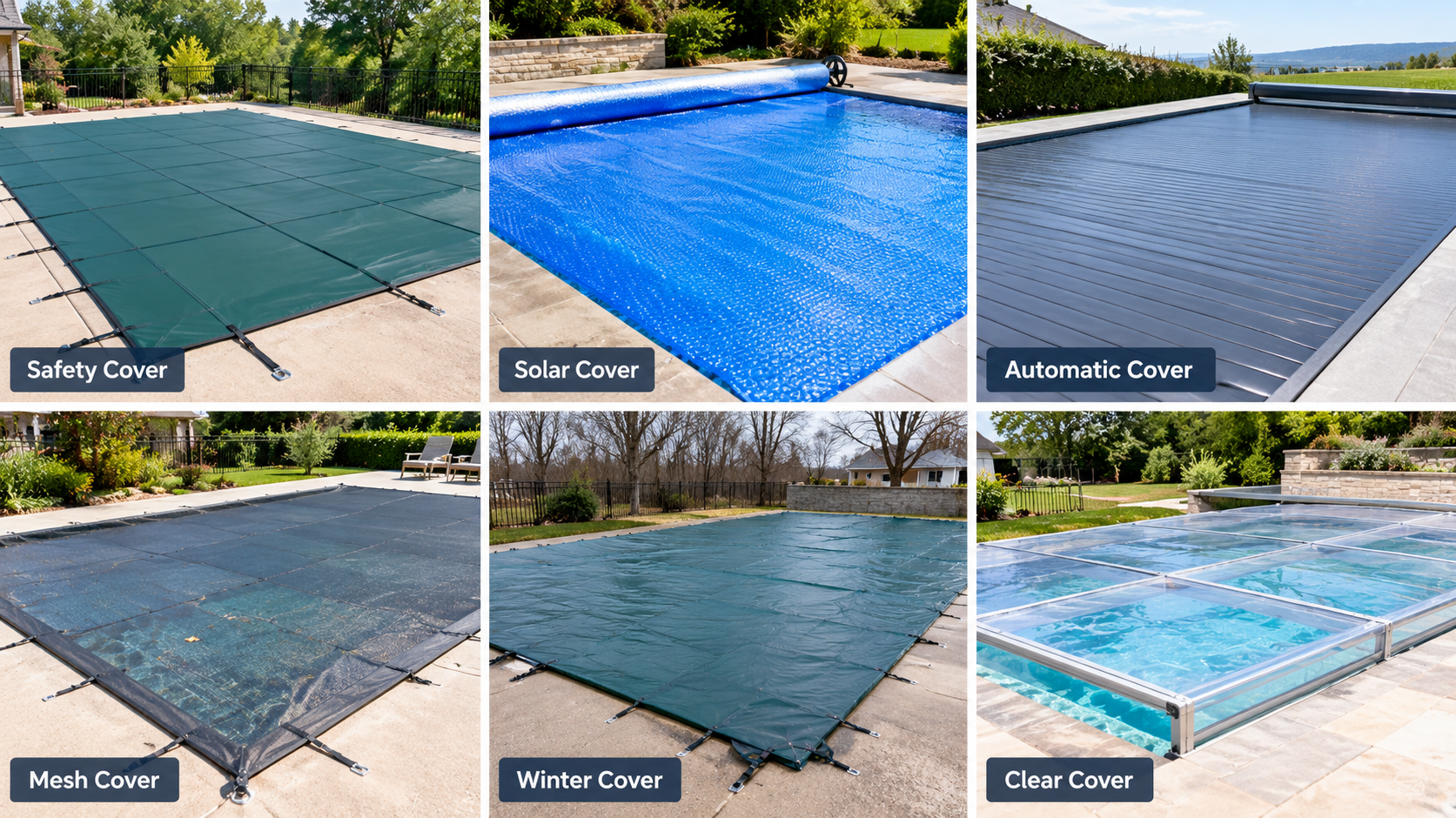
There are five main types of pool covers: solar (bubble), winter, mesh safety, solid safety and automatic. Solar covers ($30 to $150) hold heat and cut evaporation. Winter covers ($75 to $250) keep debris out in the off-season. Safety covers ($1,200 to $3,600) block access to the water and are built to the ASTM F1346 standard. Automatic covers ($7,000 to $25,000) do all of it at the push of a button. Choose by safety need first, then climate, then budget.
Key Takeaways
- Only safety covers are safety covers. Solar covers and winter tarps do not keep kids or pets out of the water.
- Mesh safety covers are the best value for safety. Expect $1,200 to $3,000 for most pools.
- Automatic covers cost the most but are the easiest to live with. Typical total is $7,000 to $25,000, and a standard rectangular pool usually lands between $10,000 and $20,000.
- The U.S. Department of Energy says a cover can cut pool heating costs by 50% to 70%. It only works if you actually use it, every time.
- Installing an automatic cover during a new pool build is cheaper than retrofitting one later.
- Don’t trust a price you haven’t cross-checked. We compare three sources below.
Types of Pool Covers at a Glance
| Cover type | Best for | Safety cover? | Typical cost (2026) | Typical lifespan |
|---|---|---|---|---|
| Solar (bubble) | Warming water, cutting evaporation | No | $30 to $150 | 1 to 5 years, depends on UV exposure |
| Winter (tarp style) | Closing the pool for the off-season | No | $75 to $250 | A few seasons with care |
| Mesh safety | Winter closing plus child and pet protection | Yes, if ASTM F1346 compliant | $1,200 to $3,000 | 7 to 10 years |
| Solid safety | Blocking light and debris, better heat retention | Yes, if ASTM F1346 compliant | $1,800 to $3,600 | 7 to 10 years |
| Automatic | Daily use, year-round safety, convenience | Yes, when built to safety standards | $7,000 to $25,000 | 10+ years with regular service |
Cost sources are listed at the bottom. Automatic cover costs are mostly totals with installation. Labor is broken out separately in the cost section.
What Does a Pool Cover Actually Do?
A pool cover sits on or over the water and does one or more of these jobs:
- Keeps debris out. Leaves, bugs and dirt stay on top instead of in your filter.
- Cuts evaporation. The Department of Energy says evaporation is the biggest source of heat loss for a pool.
- Saves water and chemicals. The same agency reports covers can reduce make-up water by 30% to 50% and chemical use by 35% to 60%.
- Holds heat. That’s where the 50% to 70% heating savings comes from.
- Blocks access. This is the safety job, and only certain covers can do it.
No single cover does all five equally well. That’s why there are so many types, and why picking one feels harder than it should.
The Main Types of Pool Covers, Explained
1. Solar (Bubble) Pool Covers
A solar cover is the plastic bubble sheet you’ve probably seen floating on a neighbor’s pool. It lets sunlight through, traps heat, and slows evaporation.
Best for: Pool owners who want to stretch the swim season on a small budget.
Pros
- The cheapest cover that makes a real difference
- Easy to handle and easy to replace
- Helps hold heat and reduces water loss
Cons
- Not a safety cover. A child or pet can fall right through it.
- Wears out fast in strong sun
- A clear bubble cover still reduces solar heat gain by about 5% to 15%, per the Department of Energy, so take it off right before you swim and put it back right after
Cost: $30 to $150 for most pools. Heavier, UV-stabilized covers sit at the top of that range.
Liquid solar covers
These are chemical products you add to the water to form a thin film that slows evaporation. They run about $10 to $20 per month according to one regional pool guide. They help a little, but they are a supplement, not a replacement for a physical cover.
2. Winter Pool Covers (Tarp Style)
A winter cover is a solid sheet, usually tough polyethylene, that goes over the pool when you close it for the cold months. Inground versions are typically held down with water bags.
Best for: Closing the pool for the off-season on a budget.
Pros
- Very low cost
- Keeps leaves and dirt out all winter
- Simple to store
Cons
- Not a safety cover, even though it looks solid
- Water can pool on top, which makes removal messy
- Needs to be re-secured after storms
Cost: $75 to $250 is the common range. Some regional installers quote up to $400 for heavier, larger covers.
If you’re closing your pool for winter, our guide on how to winterize an inground pool walks through the steps, and how to keep your pool warm in winter covers the other option, which is staying open.
3. Mesh Safety Covers
A mesh safety cover is a woven fabric stretched tight across the pool and anchored into the deck with straps and springs. Water drains through, so rain doesn’t pile up on top. These are sometimes called net covers.
Best for: Families with kids or pets who close the pool for winter.
Pros
- Lets rain and melted snow drain through
- Lighter and easier to handle than solid covers
- Strong enough to support weight when properly installed
- Usually less expensive than a solid safety cover
Cons
- Lets in some light, so algae can still grow underneath
- Fine debris can sift through
- Not designed for daily open and close use
Cost: $1,200 to $3,000 per Angi and HomeAdvisor. A regional installer quoted $1,500 to $4,000 installed, so the final number depends on your market.
4. Solid Safety Covers
Solid safety covers use a heavier, non-porous material. They block almost all light, which means less algae and a cleaner pool in spring. To be certified, a solid cover has to include a pump or a drain panel so water doesn’t collect on the surface.
Best for: Pool owners who want the cleanest possible pool at opening time and better heat retention.
Pros
- Blocks sunlight, which cuts algae growth
- Keeps out nearly all debris
- Holds heat better than mesh
Cons
- Heavier and harder to handle
- Needs a pump or drain panel to remove standing water
- Costs more than mesh
Cost: $1,800 to $3,600 per Angi and HomeAdvisor, and up to about $6,000 in some regional installed quotes.
5. Automatic Pool Covers
An automatic cover is a motor-driven cover that rolls across the pool on tracks and stores in a housing at one end. You turn a key or push a button, and the pool is open or closed in a minute or two.
Best for: Homeowners who want year-round safety and don’t want to wrestle a cover every day. Also great for pools used lightly, since you will actually use a cover that takes 60 seconds.
Pros
- The most convenient option by far
- Acts as a locking safety barrier when closed
- Cuts evaporation, heat loss and chemical use every single day
- Doubles as a winter cover in many climates
- In warm states like Texas and Florida, it can provide protection all year
Cons
- Highest upfront cost
- Works best on rectangular and simple shapes
- Needs regular professional service to stay safe and aligned
- Retrofitting costs far more than building it in
Cost: $7,000 to $25,000 depending on pool size, track type and site work. We dig into whether that’s a good price below.
6. Sliding Deck and Retractable Hardtop Covers
These are the premium end of the market. A rigid deck panel slides over the pool, and in some designs you can even walk or lounge on it. Reliable public pricing is thin, but published guides put them at $20,000 and up. If this is on your wish list, get written quotes from at least two builders.
Is It a Safety Cover? What ASTM F1346 Means
You’ll see “ASTM F1346” in a lot of cover marketing. It’s the published performance specification for pool, spa and hot tub safety covers, and it also sets labeling rules for all covers. Older versions of the standard describe the goal as reducing drowning risk by keeping children under five away from the water when the cover is correctly installed and used.
Here’s what that means in practice:
- Solar covers and winter tarps are not safety covers. They are made to hold heat or keep out debris, and they don’t pass strength tests.
- Ask for proof. A safety cover should be labeled as compliant with ASTM F1346.
- Installation matters as much as the product. A good cover installed badly is not a safe cover.
- A cover is one layer of protection. It does not replace fences, door alarms or adult supervision.
How Much Do Pool Covers Cost in 2026?
Lets start with the headline numbers and then work toward the honest ones.
Cost by Cover Type: Three Sources Compared
| Cover type | Angi (updated Sept 2026) | HomeAdvisor | Regional installer (installed) | Our read |
|---|---|---|---|---|
| Solar | $30 to $150 | Not listed separately | Not listed | Fair. Pay more only for thicker, UV-stabilized material |
| Winter | $75 to $250 | $75 to $250 | $75 to $400 | Fair. The high end is for heavy or oversized covers |
| Mesh safety | $1,200 to $3,000 | $1,200 to $3,000 | $1,500 to $4,000 | Good value for what it protects |
| Solid safety | $1,800 to $3,600 | $1,800 to $3,600 | $2,500 to $6,000 | Fair. You pay extra for light blocking and heat retention |
| Automatic | $7,000 to $25,000 | $10,000 to $20,000 | $10,000 to $25,000+ | Believable. Be suspicious of anything far below $7,000 |
Installation and Repair Costs
| Item | Typical cost | Notes |
|---|---|---|
| Manual cover installation labor | $400 to $1,500 | Safety covers need anchors set in the deck |
| Automatic cover installation labor | $2,000 to $10,000 | Depends on track type, deck work and electrical |
| Professional repair labor | $50 to $100 per hour | Minor repairs often start near $100 |
| DIY patch kit | $10 to $20 | Fine for solar and winter covers only |
Track Type Changes the Price
Automatic covers run on tracks, and the type you choose changes both cost and looks.
- Top-track systems: Cheapest, but they sit above the deck and can be a trip hazard.
- Recessed systems: Cost more because they are built into the deck.
- Undertrack systems: Usually cost the most and are nearly invisible when the cover is open.
Recessed tracks are easiest to put in while the deck is being built. Adding them later can mean pulling up the patio and replacing it, which is where retrofit costs jump.
What Do Covers Cost Per Year of Use?
Upfront price only tells part of the story. Here’s a rough cost per year using the lifespans above. This is our own illustration, not a published figure.
| Cover type | Price range | Lifespan used | Approx. cost per year |
|---|---|---|---|
| Solar | $30 to $150 | 2 years | $15 to $75 |
| Mesh safety | $1,200 to $3,000 | 7 to 10 years | $120 to $430 |
| Solid safety | $1,800 to $3,600 | 7 to 10 years | $180 to $515 |
| Automatic | $7,000 to $25,000 | 10 years | $700 to $2,500 |
Is That Pricing Actually Good? Our Technical Reality Check
Plenty of articles list a price and move on. A price only means something if you ask whether it makes sense. Here’s what we found when we compared sources, and where we’d push back.
Claim 1: “Pool covers cost $149 to $4,600”
That headline range is real, but it’s an average across mostly cheaper covers. Angi’s own table shows automatic covers running up to $25,000, and its national average of $1,825 comes from a mix of project types. If you’re pricing an automatic cover for an inground pool, that headline doesn’t apply to you.
Claim 2: “Automatic covers cost $3,000 to $8,000”
You’ll find this on a few low-quality pages. We don’t buy it. The established sources put the floor around $7,000 and the typical installed total between $10,000 and $20,000. A quote far below that either leaves out the track, electrical or deck work, or uses a cover that isn’t a true safety-rated system. Always ask what’s included.
Claim 3: “A cover saves 50% to 70% on heating”
This comes from the Department of Energy, and it’s real, but it says savings of that size are possible. Those numbers assume the cover is on whenever the pool isn’t in use. If you leave it off half the time, you get roughly half the benefit. If your pool isn’t heated at all, you get no heating savings, only water, chemical and cleaning savings.
Quick math: does an automatic cover pay for itself?
Let’s say your pool heating runs $300 a month for six months, or $1,800 per year. A cover that saves 50% to 70% puts $900 to $1,260 back in your pocket yearly.
- A $100 solar cover: pays for itself in about the first month of the heating season.
- A $12,000 automatic cover: takes roughly 9.5 to 13 years to pay back on heating alone.
Water and chemical savings shorten that somewhat, but not by a huge amount. So the honest answer is this: buy an automatic cover for safety and convenience, and treat the energy savings as a bonus. If a salesperson sells it purely as an energy investment, push back.
Price note
All figures here are third-party market ranges. They are not Blue Haven quotes. Pool and cover pricing depends on your site, size, shape and region, so a local in-person estimate is the only way to get your actual number.
Red Flags in a Pool Cover Quote
- The quote doesn’t say whether installation, anchors or electrical work are included
- No mention of ASTM F1346 on a cover sold as a “safety” cover
- A price far below the ranges above for an automatic system
- No warranty details in writing
- Pressure to sign the same day
How to Choose the Right Pool Cover
Start with the question that matters most: who could get into this pool when you’re not watching? Then work through climate, heating, shape and budget.
| Your situation | Best cover | Why |
|---|---|---|
| Young kids or pets, closing for winter | Mesh or solid safety cover | Strong, anchored barrier at a reasonable price |
| Young kids or pets, year-round use | Automatic safety cover | Closes in a minute, so it actually gets used |
| Want warmer water on a tight budget | Solar cover | Cheapest way to hold heat |
| Cold winters, no kids at home | Winter cover or mesh safety cover | Low cost, solid protection from debris |
| Hate leaves and daily skimming | Solid or automatic cover | Blocks nearly all debris |
| Warm climate, pool open most of the year | Automatic cover | Daily use is where the savings and safety add up |
| Freeform or very irregular shape | Custom-cut safety cover | Automatic tracks work best on simple shapes |
| Building a new pool | Plan an automatic cover now | Cheaper to build in than to retrofit |
Think About Your Climate
In cold states, a seasonal mesh or solid safety cover protects the pool through the coldest months, and an automatic cover lets you keep opening and closing it until the snow actually falls. In warmer places like Texas, Florida and the Southwest, an automatic cover can provide protection all year.
Think About Pool Shape
Automatic covers like straight tracks, so rectangular and geometric pools are the easiest. Freeform pools can be done, but cost more and sometimes aren’t a good fit. If you love a curvy design, a custom-cut safety cover may make more sense.
Think About Your Real Habits
Your going to want to be honest here. The best cover is the one that actually gets put on. A $100 solar cover that sits in the garage saves nothing. A $15,000 automatic cover that you use every night saves a lot of stress. If a cover feels like a chore, you’ll skip it.
Planning a New Pool? Decide on the Cover First
If you’re building a new pool, the cover decision is easier and cheaper now than later. Here’s why:
- Tracks can be recessed into the deck while it’s being built, instead of cutting into finished concrete or pavers.
- The pool shape can be planned around the cover. Straight edges at the cover end make everything simpler.
- Electrical and housing space are easy to plan at the design stage.
- Retrofit costs add up. Pulling up a deck to add tracks is real money.
This is one reason custom design matters. A custom gunite pool can be shaped around the cover, the sun and your yard from day one. If you already own a pool and want to upgrade the equipment, a pool remodel is the best time to add a cover system. Our post on the best time to remodel a pool explains the timing.
How to Use, Maintain and Store Your Pool Cover
Use It Right
- Take solar covers off before swimming, and put them back right after
- Never let anyone swim or play under or on a cover that isn’t built for it
- Remove standing water from solid covers so it doesn’t collect on the surface
- Keep keys and remotes for automatic covers away from children
Keep It Clean
- Rinse off dirt and debris regularly
- Let covers dry fully before folding and storing
- Store in an airtight bag, off the ground, away from rodents
Service Automatic Covers Regularly
Automatic covers have motors, tracks and moving parts. Have a professional check alignment and hardware on a regular schedule so the safety features keep working. It’s cheaper than a big repair.
How Blue Haven Helps
Choosing a cover is one decision inside a bigger project, and that’s where we come in. Blue Haven has been building pools since 1954, and we’re proud to be known as America’s #1 pool builder. We’ve designed and built more than 300,000 custom inground pools across the country, and homeowners have left over 10,000 verified reviews averaging 4.8 out of 5 stars.
Here’s what that experience means for you and your cover decision:
- Custom gunite design. We specialize in custom inground gunite pools, so your pool can be shaped around your yard, your sun and the cover you want. If you’re comparing materials, read our guides on gunite vs fiberglass pools and fiberglass vs concrete pools.
- Efficiency built into the plan. Automatic pool covers are one of the energy-efficient options we list for new pool designs, alongside variable-speed pumps, efficient heaters and smart automation. Ask your designer to price a cover into your design from the start.
- SmartFeatures. Our SmartFeatures equipment is designed to cut energy use and make pool care easier.
- A free in-home consultation and 3D design. A local designer comes to your home, looks at your yard, and shows you a 3D rendering before anything is built. Get your free estimate and 3D design.
- Real numbers, not internet guesses. Pool and cover costs depend on size, finishes, equipment, site conditions and local costs. That’s why we price your actual project instead of quoting a national average. See what drives cost on our pool pricing page.
- We handle the paperwork. Permits, inspections and code compliance are managed by your builder. Most pools are finished in 8 to 14 weeks once construction starts, not counting design, permitting and site prep.
- Financing for qualified buyers. We offer 100% financing for qualified buyers, so upgrades like a safety cover don’t have to wait. You can also use the loan pre-approval form.
- Local teams, national backing. We have 50+ local offices, so your team knows your soil, climate and permitting rules. Find your local office.
- Industry recognition. Blue Haven carries a BBB Trust badge, is a PHTA member and is recognized among the Top 50 Builders.
- Lifestyle-first design. Whether you want a family pool, an entertaining pool, a quiet retreat, an active pool, an estate pool or a courtyard pool, your layout can be planned with a cover in mind. Not sure where to start? Take our pool style quiz.
Want to see real backyards and hear from real families? Browse our pool inspiration gallery and read customer stories on our About Blue Haven page.
Related reading: how pool temperature affects your energy bill, pool deck ideas and inground pools for small backyards.
People Also Ask: Pool Cover Questions Answered
What is the best type of pool cover?
It depends on what you need. For safety and winter closing, a mesh or solid safety cover is the best value. For daily convenience and year-round safety, an automatic cover wins. For warming the water on a budget, a solar cover is the cheapest.
What is the safest type of pool cover?
An automatic safety cover or a properly installed mesh or solid safety cover built to ASTM F1346. Solar covers and winter tarps are not safe to walk on or rely on.
Are automatic pool covers worth it?
For safety and convenience, usually yes. For energy savings alone, not really. The payback on heating can take around 10 years or more. Think of the energy savings as a bonus.
How much does an automatic pool cover cost?
Most sources put it at $7,000 to $25,000, and a standard rectangular pool commonly lands between $10,000 and $20,000.
Do solar pool covers really work?
Yes, for heat and evaporation. They are not safety covers, and they only work if you put them on consistently.
Can you swim with a solar cover on?
No. Take it off before you swim and put it back on right after.
Can you walk on a pool cover?
Only on a safety cover built for it. Never on a solar cover or winter tarp.
How long do pool covers last?
Cheap solar covers can last one to two years in strong sun. Safety covers usually last 7 to 10 years. Automatic covers can last 10 years or more with regular service.
Is a mesh or solid safety cover better?
Mesh drains water and costs less. Solid blocks light, which reduces algae, and holds heat better, but needs a pump or drain panel. Pick mesh for lower cost and easy drainage, solid for a cleaner pool at opening.
Do pool covers reduce chemical use?
Yes. The Department of Energy reports reductions of 35% to 60% in chemical consumption.
Do pool covers save water?
Yes. The same agency says covers can cut make-up water by 30% to 50% by reducing evaporation.
Do I need a pool cover for an inground pool?
You don’t need one to have a working pool, but a cover makes cleaning, heating and safety much easier.
Can you add an automatic cover to an existing pool?
Yes, but it costs more than building it in, especially if the deck has to be cut or lifted for tracks.
Should I cover my pool in winter?
In cold climates, yes. A safety cover keeps debris out and protects against accidents while the pool is closed.
FAQ: Types of Pool Covers
What are the main types of pool covers?
Solar (bubble) covers, winter covers, mesh safety covers, solid safety covers and automatic covers. Premium options include sliding deck and retractable hardtop covers.
How much does a pool cover cost on average?
Angi reports a 2026 national average of about $1,825, but that average blends many cheap covers. Your cost depends on type: $30 to $150 for solar, $75 to $250 for winter, $1,200 to $3,600 for safety covers, and $7,000 to $25,000 for automatic.
Which pool cover is best for kids and pets?
A safety cover that meets ASTM F1346, either mesh, solid or automatic. Remember that a cover works best alongside fences, alarms and supervision.
Which pool cover saves the most money?
For low cost, a solar cover pays back fastest. For total yearly savings, an automatic cover wins because you’ll use it every day. The Department of Energy says covers can cut heating costs 50% to 70%.
Does a pool cover work on a freeform pool?
Yes, but automatic covers work best on simple, rectangular shapes. Freeform pools often use custom-cut safety covers.
Can I install a pool cover myself?
Solar covers are an easy DIY job. Safety covers and automatic covers need anchors, tracks and precise tensioning, so hire a professional.
What should I ask before buying an automatic cover?
Ask what’s included in the price (tracks, electrical, deck work), what type of track is used, what the warranty covers, whether it meets safety standards, and who services it afterward.
How do I get an accurate price for my pool?
Prices vary by size, shape, site and region, so the best way is an in-person consultation. Schedule a free estimate with your local Blue Haven team and ask them to include a cover in the plan.
Final Thoughts
If you remember three things from this guide, make them these:
- Safety comes first. If kids or pets could reach your pool, choose a true safety cover, not a solar sheet or tarp.
- Cross-check every price. Compare at least three sources and ask what’s included in any quote.
- Buy the cover you’ll actually use. Convenience is what turns a cover from an expense into a savings.
Planning a new pool or a remodel? Decide on the cover at the design stage and save yourself money later.