
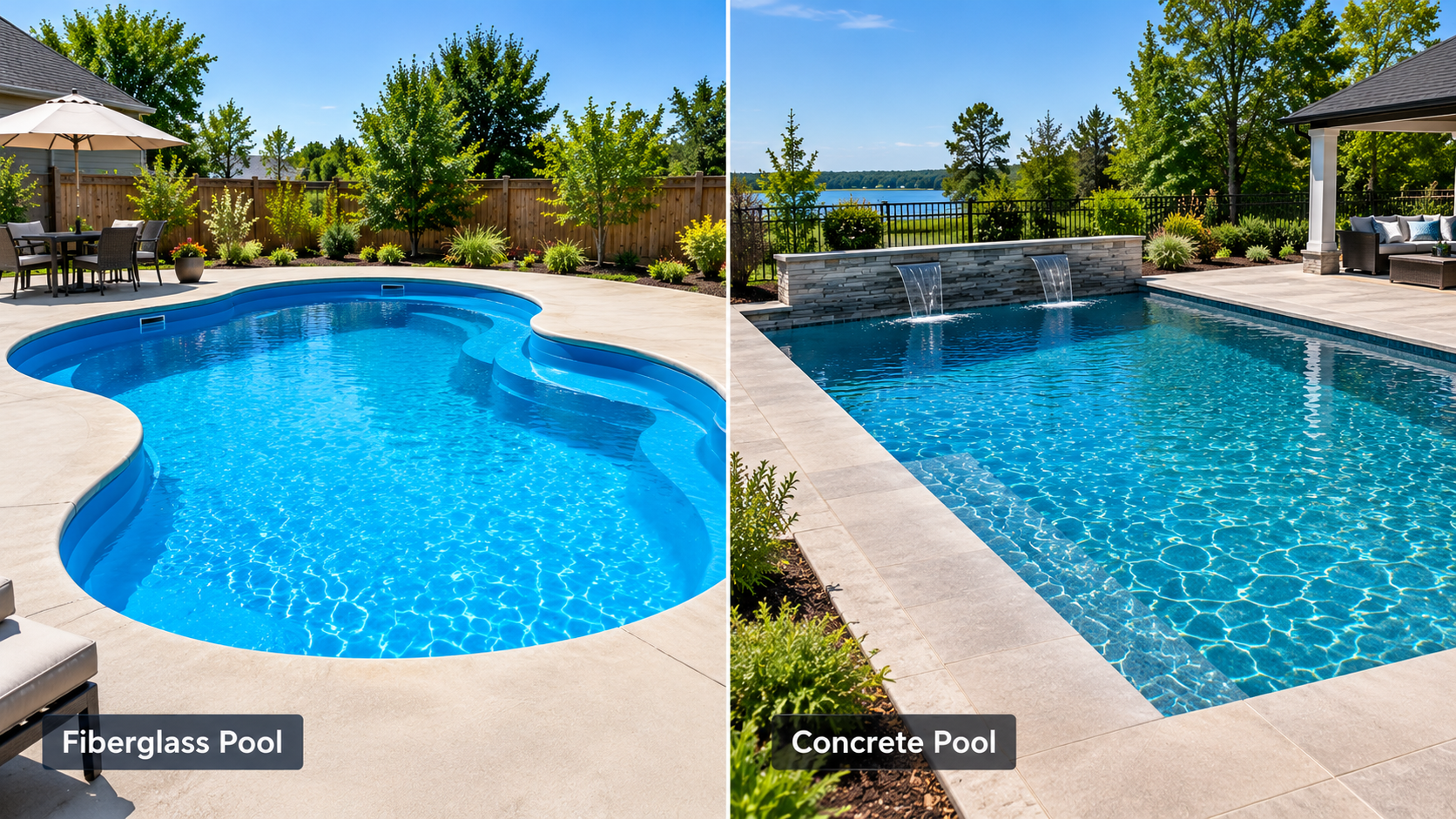
Fiberglass pools usually cost less up front and less to maintain. Concrete pools (gunite) cost more but give you any shape, any size and a structure that can last 50 years or more. If you want a simple rectangle or oval, a faster install and a smaller budget, fiberglass is hard to beat. If you want a custom design, a pool wider than about 16 feet, or a build that fits a tricky yard, concrete is the better fit.
Key Takeaways
- Upfront cost: Fiberglass typically runs about $45,000 to $100,000 installed. Concrete runs about $50,000 to $120,000, and custom builds go well past that.
- Install time: Fiberglass shell goes in within days, though the full project (deck, equipment, landscaping) still takes several weeks. Concrete is commonly quoted at 3 to 6 months.
- Lifespan: Fiberglass is generally quoted at 20 to 30 years or more. A well built concrete shell is commonly quoted at 50 years or more.
- Upkeep: Fiberglass is smoother and resists algae. Concrete needs resurfacing about every 10 to 15 years, usually $8,000 to $15,000 each time.
- Design freedom: Concrete wins, by a lot. Fiberglass comes from factory molds and is usually limited to about 16 feet wide because of road transport.
- Over 30 years: In my cost model fiberglass came out cheaper in every scenario for a standard pool. Concrete earns its price through design, size and longevity, not through lower cost. More on that below.
Fiberglass vs Concrete Pools at a Glance
| Factor | Fiberglass pool | Concrete (gunite) pool |
|---|---|---|
| Typical installed cost | About $45,000 to $100,000 | About $50,000 to $120,000, custom builds higher |
| Cost per square foot (one source) | About $150 to $250 | Varies widely with design |
| How it’s built | One-piece shell made in a factory, shipped, lowered in by crane | Steel rebar frame, concrete sprayed on site |
| Install time | Shell set in days, full project several weeks | Commonly 3 to 6 months |
| Shapes and sizes | Pick from manufacturer molds, usually up to about 16 ft wide | Any shape, any depth, any size |
| Interior surface | Smooth gel coat | Plaster, quartz or pebble |
| Expected lifespan | About 20 to 30+ years | About 50+ years for the structure |
| Resurfacing | No regular resurfacing, but gel coat can fade, stain or blister | Every 10 to 15 years, depending on finish |
| Algae resistance | Very good, non-porous surface | Good with modern finishes, porous with old plaster |
| Chemical use | Lower | Higher |
| Best for | Simple shapes, quick builds, tighter budgets | Custom designs, larger pools, tough lots |
What Is the Difference Between a Fiberglass Pool and a Concrete Pool?
Both are inground pools. The difference is how the shell gets made, and that one difference drives almost everything else, from cost to design to repairs.
What Is a Fiberglass Pool?
A fiberglass pool is a one-piece shell molded in a factory. A truck hauls it to your home, a crane sets it in an excavated hole, and the crew backfills around it and installs the plumbing and deck. Because it’s made in a mold, you choose from the shapes and sizes the manufacturer offers.
What Is a Concrete Pool?
When people say “concrete pool” in the United States they usually mean gunite, a mix of sand and cement sprayed under pressure over a steel rebar frame. The pool is built on your property, so the shape is limited only by the yard and the budget. After it cures, the crew adds tile, coping, plumbing and an interior finish like plaster, quartz or pebble. You may also hear “shotcrete” (a very similar sprayed method) and “poured concrete” (less common for residential pools today).
A Quick Note on Who’s Writing This
Blue Haven builds gunite pools. We don’t install fiberglass shells. So yes, we have a point of view. To keep this fair, we used published costs from fiberglass makers, cost-guide sites and builders who sell both, and we tested the numbers ourselves in the section below. Where fiberglass wins, we say so.
How Much Does Each Pool Type Cost in 2026?
Every pool is different, so any number you read online is a range at best. There’s a few big sources worth comparing, so here is what they report, side by side.
Table: Installed Cost Claims From Major Sources
| Source | Fiberglass | Concrete / gunite | Who’s behind it |
|---|---|---|---|
| HomeGuide (2026 guide) | $45,000 to $100,000 | $50,000 to $120,000 | Cost-guide website |
| Latham Pool | Starts around $50,000 | Starts at $60,000 or more | Fiberglass pool manufacturer |
| River Pools | Base package from $55,000 (about 10 x 20 ft), turn-key $85,000 to $200,000 | Base package from $65,000 | Fiberglass pool manufacturer |
| Angi | Average about $31,000 | Average about $100,000 | Home services marketplace |
| Shasta Pools (outside Arizona) | About $100,000 to $115,000 | About $130,000 to $175,000 | Builder that sells both types |
Notice the spread. One source says concrete costs 3 times more, another says about 15 to 30 percent more. That’s a big gap, and it’s why we checked the math in the next section.
What Is Usually Included in These Prices?
This is where people get tripped up. A “base package” or a shell price often leaves out some of the biggest line items.
- Often not included in a base price: final grading, decking or patio, fencing, electrical work, landscaping, heater, automation, and sometimes the crane
- Usually included in a turn-key price: the pool, plumbing, equipment, basic decking, permits and cleanup
- Always extra: upgrades like water features, spas, lighting, specialty finishes and outdoor living space
Why the Ranges Are So Wide
- Size and depth: more surface and more volume means more material and labor
- Site access: a crane needs room and a clear path, and concrete crews need space for equipment
- Soil and slope: rock, high water tables and slopes add excavation and engineering cost
- Local labor and permits: these differ a lot by state and even by county
- Finishes and features: a quartz finish, spa and waterfall can move a budget quickly
Realistic Budget Ranges
Based on the sources above, a family-size pool with a deck, equipment and permits (turn-key) most often lands around $65,000 to $100,000 for fiberglass and $75,000 to $120,000 or more for concrete. That’s our reading of the sources, not a quote. Blue Haven doesn’t publish a national average because soil, access, labor and permits change the number too much. A real estimate needs your yard.
Heads Up on Running Costs
Operating costs like heating depend more on surface area, cover use and your target temperature than on shell type. See our guide on the most efficient and comfortable pool temperature and how to keep your pool warm in winter.
Are the Costs You Read Online Actually Good? A Technical Check
Most comparison articles quote a price and move on. A number with no math behind it is hard to trust, so we checked the common claims against each other and then built a simple 30-year model.
Step 1: Do the Price Claims Agree With Each Other?
| Claim | Does it hold up? | Why |
|---|---|---|
| Fiberglass averages $31,000, gunite averages $100,000 (Angi) | Not a fair comparison | River Pools says you are unlikely to find a fiberglass turn-key project below $85,000, and HomeGuide’s fiberglass turn-key tier starts at $65,000. The $31,000 figure looks like a shell and basic install, while the $100,000 figure looks like a full project. |
| Fiberglass plunge pool for as little as $5,000 | Not realistic | A shell alone, plus crane, excavation, plumbing and equipment, costs far more than that. |
| Fiberglass starts at $50,000, concrete at $60,000+ (Latham) | Plausible | Matches River Pools’ $55,000 vs $65,000 base prices. But these are starting prices without decking or extras. |
| Concrete $130,000 to $175,000, fiberglass $100,000 to $115,000 (Shasta) | Plausible for high-end projects | These are bigger, fully loaded builds. The gap of $15,000 to $60,000 is real but not typical for a mid-range pool. |
| Fiberglass costs 5 to 7 percent more than concrete in Arizona (Shasta) | Plausible locally | Cheap local concrete labor plus shipping and crane costs for fiberglass can close the gap. It shows why location matters. |
| Fiberglass saves 70 percent on chemicals | Overstated | Chemicals run about $175 to $750 a year for any pool type. Even a full 70 percent saving on $750 is about $525 a year. |
| 10-year upkeep: fiberglass about $4,000, concrete $15,000 to $27,000 (Latham) | Only true if a resurfacing falls inside the 10 years | Chemical savings alone can’t create an $11,000 to $23,000 gap. A resurfacing at the 10 to 12 year mark can. |
| Gunite lasts 100 years (Angi) | Too optimistic | The shell can last many decades, but finishes, tile and coping wear out much sooner. 50+ years is the more defensible number. |
Bottom line: the fair upfront gap for a similar pool is probably $10,000 to $30,000, with fiberglass cheaper. The giant gaps (3x cheaper, 70 percent savings) come from mixing shell prices with full-project prices or from marketing math.
Step 2: A 30-Year Ownership Model
Let’s go beyond sticker price. This model compares the extra cost of owning a concrete pool over a similar fiberglass pool for 30 years.
Assumptions (swap in your own quotes):
- Pool size: about 14 x 30 ft, same deck, equipment and features for both
- Chemicals: $460 a year midpoint, based on a $175 to $750 range
- Concrete resurfacing: $8,000 to $15,000 each time, every 10 to 15 years
- Fiberglass: one possible gel coat refinish late in life, from $0 to $6,500
- No inflation, no discounting, and no value assigned to resale or design
| Scenario | Upfront gap | Resurfacing (30 yrs) | Chemical savings with fiberglass (30 yrs) | Fiberglass refinish | Extra cost of concrete over 30 years |
|---|---|---|---|---|---|
| Concrete-friendly | $10,000 | 1 time, $8,000 | 30% saved, about $4,100 | $6,500 | About $15,600 |
| Middle | $20,000 | 2 times, $23,000 | 50% saved, about $6,900 | $3,000 | About $46,900 |
| Fiberglass-friendly | $35,000 | 3 times, $45,000 | 70% saved, about $9,700 | $0 | About $89,700 |
If you apply a 3 percent discount rate (money spent later is worth less today), the numbers drop by roughly 5 to 25 percent, but fiberglass still comes out ahead in all three.
What This Tells Us
- On pure cost, fiberglass wins for a standard pool. We don’t love saying it as a concrete builder, but the math is the math.
- Resurfacing is the real swing factor. The more times you resurface, and the more it costs, the bigger the gap. Choosing a longer lasting finish matters.
- The model leaves out things that matter. A custom shape, a larger footprint, a spa that blends into the pool, or a yard that can’t take a fiberglass shell may only be possible with concrete. And at year 30, a concrete shell may still have decades left, while a fiberglass shell is nearer the end of the typical 20 to 30+ year range. We didn’t price a replacement.
- Your local numbers can flip this. In places with cheap concrete labor and costly shipping, the upfront gap shrinks or disappears.
Is a Cheaper Pool the Better Deal?
Not always. A pool is a long-term outdoor living space. A cheaper pool that doesn’t fit your yard, your kids’ ages or your plans for a spa and ledge will cost you more in the end. Buy for how you’ll use it, then compare prices.
Lifespan and Durability
How Long Does a Fiberglass Pool Last?
Most sources say 20 to 30 years or more with proper care. The shell is flexible and strong, and the smooth gel coat resists staining. But it isn’t indestructible. Ground movement or a poor installation can cause cracks, and the gel coat can fade, stain or blister. Repairs often need a professional.
How Long Does a Concrete Pool Last?
A well built concrete pool is a reinforced concrete and steel structure. Sources generally put it at 50 years or more with proper maintenance. Some claims go to 100 years, but we’d treat that as best case. The shell lasts, while the finish, tile and coping get refreshed along the way. Concrete pools can crack too, which is why engineering, rebar and a good crew matter.
Durability Check
| Question | Fiberglass | Concrete |
|---|---|---|
| Can it crack? | Yes, from ground movement or poor installation | Yes, from settling or poor construction |
| What wears out first? | Gel coat finish | Interior finish, tile, coping |
| Can it be repaired? | Yes, usually by a specialist | Yes, by a pool builder |
| Does the shape limit repair or remodel options? | Yes, a fixed shell is hard to reshape | No, concrete can be reshaped and updated |
That last row is worth thinking about. A concrete pool can be remodeled to a new look later. A fiberglass shell is basically what it is for life.
Maintenance, Chemicals and Resurfacing
Is a Fiberglass Pool Lower Maintenance?
Yes, in general. The surface is smooth and non-porous, so algae has a harder time holding on. You’ll typically use less chemicals and brush less. Professional service typically runs about $80 to $150 a month for any pool type, and chemicals about $175 to $750 a year.
Is a Concrete Pool High Maintenance?
Older plaster surfaces are rough and porous, so algae sticks and you brush more. Modern finishes like quartz and pebble are tougher and smoother, and automation (in-floor cleaning, chemical dispensers, good filtration) cuts the workload. It’s still more upkeep than fiberglass, but the gap is smaller than it used to be.
How Much Does Resurfacing Cost?
| Finish | Typical cost (per 1,000 sq ft) | Typical life |
|---|---|---|
| Plaster | About $5,500 | About 10 years |
| Quartz aggregate | About $6,500 | About 12 years |
| Pebble aggregate | About $6,500 | About 10 to 20 years |
| Whole-pool resurfacing project (builder estimate) | $8,000 to $15,000 | Plaster 10 to 12 years, pebble 15 to 18 years |
Blue Haven’s SmartBrite ColorQuartz finish is designed to resist chipping, etching and staining, and can often provide 10 to 15 years of service under normal conditions, depending on water chemistry and care. Learn more on the SmartBrite ColorQuartz page.
Cheap Ways to Cut Upkeep on Either Pool
- Test water weekly and fix small chemistry swings fast
- Use a cover to cut debris, evaporation and chemical loss
- Add automation so pumps and chemical feeders run on a schedule
- Keep calcium and pH in range to protect finishes
Design Freedom and Size Limits
This is the biggest non-cost difference, and for many families it decides the whole thing.
Fiberglass Design Limits
- Shapes come from manufacturer molds, mostly rectangles, ovals and a few freeform styles
- Width is usually capped at about 16 feet because the shell has to travel on public roads
- Common sizes run from plunge pools around 9 x 17 ft to large shells around 16 x 35 ft
- Depths and ledges are fixed by the mold
Concrete Design Freedom
- Any shape, size and depth
- Spas, tanning ledges, swim-outs, grottos, infinity edges and rim-flow spas built right into the pool
- Works around trees, slopes and odd lot shapes
- Interior finishes from classic plaster to color quartz and pebble
If you’re picturing a pool with a sun shelf, a built-in spa and a deep end for diving, you’ll likely end up with concrete. Browse real examples in the Inspiration Gallery, including geometric pools, grotto pools, infinity edge pools and gunite spas. Not sure what you want? Our 10 gunite pool features post is a good start.
Short on space? Smaller pools can be great, and our small backyard guide walks through the options.
Installation Time
| Stage | Fiberglass | Concrete (gunite) |
|---|---|---|
| Design and permits | Shorter, fewer design decisions | Longer, custom design and engineering |
| Excavation and shell | Shell set in as little as 2 days under ideal conditions | Excavation, rebar, gunite spray, then curing |
| Curing | None for the shell | About 28 to 30 days before filling |
| Deck, equipment and finishing | Several more weeks | Weeks |
| Whole project (commonly quoted) | A few weeks to a few months | 3 to 6 months |
Fiberglass is faster, no question. But the “pool in a few days” line is only about the shell The deck, equipment and landscape still take time, and permits can take weeks in some counties.
For comparison, Blue Haven says most pools are finished in about 8 to 14 weeks once construction begins, and some in as little as 70 days. Permits and design come before that.
Soil, Climate and Site Conditions
Your yard can make the decision for you. Here’s what to check.
- Access for a crane: a fiberglass shell has to be trucked in and lifted over the house or through a wide gate. Overhead power lines, narrow side yards and tight streets can make that hard or costly.
- Slopes and uneven lots: concrete is built in place, so it adapts to grade changes more easily.
- High water table: a high water table can push on an empty pool shell. Both types need a plan, such as proper drainage and care when draining. Ask your builder how they handle it.
- Expansive clay or unstable soil: soil that moves can stress any shell. Engineering matters, and a good builder will talk about soil before design.
- Freeze and thaw climates: some finishes and tile don’t love freezing. For example, glass tile is less suitable in freeze and thaw areas. Ask about materials that fit your climate.
- Shipping distance: fiberglass shells are made in a plant, so freight adds cost the farther you are from the factory.
Resale Value
There isn’t solid, universal data showing one pool type adds more value than the other. What buyers care about tends to be condition, design and how well the pool fits the home. A well-designed custom concrete pool is often viewed as a premium feature in higher-end homes, while fiberglass adds practical value and appeals to buyers who want low upkeep. Pools can also raise homeowners insurance by roughly $50 to $100 a year, whatever the type.
How to Choose
Pick Fiberglass If
- Your budget is firm and you’d like the lowest upfront cost
- A simple rectangle, oval or standard freeform shape works for you
- You want the shortest possible build
- Low chemical use and less brushing matter a lot
- Your yard has easy crane access
Pick Concrete (Gunite) If
- You want a custom shape, depth or a pool wider than about 16 feet
- You’re adding a spa, sun shelf, swim-out, waterfalls or an infinity edge
- Your lot is sloped, irregular or has trees to design around
- You want a structure built to last 50 years or more, and you’re ready to resurface along the way
- You may want to remodel the pool later
Quick Decision Table
| If this sounds like you | Lean toward |
|---|---|
| “I want a clean, simple pool, fast.” | Fiberglass |
| “I want a pool nobody else on the street has.” | Concrete |
| “I have kids and need a large shallow ledge.” | Concrete, or a fiberglass model with a built-in ledge |
| “I want the lowest upkeep.” | Fiberglass |
| “I’d like a lap pool and a spa in one design.” | Concrete |
| “My yard is tight and hard to access.” | Depends on the site, get both assessed |
What About Vinyl Liner Pools?
Vinyl is the third option. It’s usually the lowest upfront cost (about $35,000 to $80,000), but the liner has to be replaced about every 7 to 10 years for roughly $2,000 to $7,500. It’s worth a look if budget is the top priority, though we don’t build them.
Questions to Ask Any Pool Builder
Before you sign anything, ask these.
- Is this price turn-key? What is not included?
- Who handles permits and inspections?
- What is the crane, excavation and site prep cost, and is it in the quote?
- What will my finish cost to replace, and when?
- What’s the warranty on the structure, the finish and the equipment, in writing?
- Can I see pools you built 10 or more years ago?
- How do you handle my soil and water table?
- What does a typical year of upkeep cost for this exact pool?
A builder who answers these clearly is usually a builder who stands behind their work.
How Blue Haven Helps
Reading comparisons is useful. But the right answer depends on your yard, your family and your budget, and that’s where a real builder earns its keep. Here’s what Blue Haven brings.
Experience and Track Record
- 70+ years of building pools in America (founded in 1954)
- 300,000+ custom inground pools built nationwide
- 4.8 out of 5 stars from 10,000+ verified reviews across Trustpilot, Yelp and Google
- Presented nationally as America’s #1-ranked pool builder
- Recognized in the PSN Top 50 Builders, with a BBB Trust badge and membership in the PHTA (Pool & Hot Tub Alliance), all shown on our About page
- 50+ local locations with teams who know your climate, soil and permitting. Find your local team.
An Honest Word on Fiberglass
Blue Haven specializes in custom gunite pools. If a fiberglass shell is truly the best fit for your budget and your yard, we’ll tell you straight. Our goal is a pool you still love in 20 years, not a sale. For a side-by-side look at the two materials, read our post on gunite vs fiberglass pools and our explainer on what a gunite swimming pool is.
What We Do for Concrete Pool Owners
- Custom design with 3D renderings: you see the pool before we break ground. Start on our new pools page.
- Permits and approvals handled for you, with updates at each milestone through final walkthrough
- Finishes built to last: from plaster to SmartBrite ColorQuartz
- SmartFeatures: our exclusive line of smart pool equipment, including SmartControls automation, SmartLight LED and SmartPure sanitizing. See all SmartFeatures.
- Pool styles for how you live: Family, Active, Retreat, Estate, Entertain and Courtyard designs
- Faster than the usual concrete timeline: most pools are finished in 8 to 14 weeks once construction begins
Already Have a Concrete Pool?
If your plaster is faded or your equipment is old, our remodel team can help. Services include pool resurfacing, tile and coping, deck renovation, equipment upgrades, water features and full pool redesign. See our pool remodeling page, and read why fall is the best time to remodel a pool.
Customer Stories
Homeowners like the Reyes family in Tampa (Family pool), Marcus and Diana in Scottsdale (Estate pool) and Christine in Charleston (Retreat pool) shared their experiences with us. Read them on our About page. Every pool and every yard is different so your result will be it’s own.
An Honest Word on Pricing
We don’t publish a national average price for a custom pool, because it would be misleading. Size, finish, equipment, water features, decking, soil, access, labor and permits all change the number. What we can do is build an estimate around your yard. Read our pool pricing guide, then get a free estimate and 3D design.
Financing Made Simple
Financing is available for qualified buyers, up to 100 percent in many cases, subject to credit approval. Explore pool financing, run numbers with the pool loan calculator or start a loan pre-approval.
Ready to Talk to a Pool Pro?
- Get a free estimate
- Find your local Blue Haven team
- Contact us
- Call 1-800-BLUE-HAVEN
- Not sure what style fits? Take the 2-minute pool style quiz
Questions People Ask About Fiberglass and Concrete Pools
Which is better, a fiberglass pool or a concrete pool?
Neither wins everywhere. Fiberglass is better for a lower upfront cost, a faster install and less upkeep. Concrete is better for custom shapes, bigger pools and a structure that can last 50 years or more. Pick based on your yard, budget and how you’ll use the pool.
Is a fiberglass pool cheaper than concrete?
Usually yes, upfront and over time for a standard pool. Most sources put the fair gap at about $10,000 to $30,000 for a similar full project. In some markets, such as Arizona, the gap can shrink or even reverse.
Why are fiberglass pools so expensive now?
Shell prices are only part of it. Freight, crane time, excavation, backfill, plumbing, decking and equipment add up fast, and a turn-key fiberglass project often runs $65,000 to $100,000 or more. Labor and material costs have also risen across the building trades.
Do fiberglass pools last longer than concrete?
Usually no. Fiberglass is commonly quoted at 20 to 30+ years, while a well built concrete shell is commonly quoted at 50+ years. Concrete’s finish wears out sooner than its shell, though, so plan for resurfacing.
Are fiberglass pools better than gunite?
They’re better at some things, such as speed, smoothness and low chemical use. Gunite is better at design freedom, size, and long-term flexibility. Whether either is better for you depends on your priorities.
What are the disadvantages of a fiberglass pool?
Limited shapes and sizes, a width cap near 16 feet, crane access needs, possible gel coat fading, staining or blistering, and costly specialist repairs. Fixed shells also can’t be reshaped later.
What are the disadvantages of a concrete pool?
Higher upfront cost, a longer build, more chemical use, and resurfacing every 10 to 15 years. Older plaster is also rougher and more prone to algae.
How often does a concrete pool need resurfacing?
About every 10 to 15 years, depending on finish. Plaster tends to be around 10 to 12 years, quartz about 12 years, and pebble 15 to 18 years or more with good care.
Can you put a fiberglass pool in any yard?
No. You need crane access, enough space to lift the shell in, and soil and drainage that suit it. Tight lots, overhead lines and slopes can make it hard or expensive.
Is a concrete pool worth it?
If you want a custom design, a larger pool or a long-lived structure, yes. If you just want a simple pool at the lowest cost, fiberglass may be the better value.
Which pool type adds more value to a home?
There’s no hard universal data. A well designed custom pool is often seen as a premium feature, and a low-maintenance fiberglass pool appeals to practical buyers. Condition and design matter most.
Can I convert a concrete pool to fiberglass?
Sometimes, by installing a fiberglass shell inside an old concrete pool, but it depends on the pool’s shape and condition. Ask a pool pro to look at it first. Many owners find resurfacing and a remodel cost less.
FAQ
How much does a fiberglass pool cost?
Most sources put a fiberglass pool at about $45,000 to $100,000 installed. Base packages start near $50,000 to $55,000, but a turn-key project is commonly $65,000 to $100,000 or more once decking, equipment and permits are in.
How much does a concrete pool cost?
Typically about $50,000 to $120,000, with custom designs well above that. Base packages start around $60,000 to $65,000. Size, finish, features and local labor change the number a lot.
How long does it take to build each pool?
A fiberglass shell can be set in days, and the whole project often takes several weeks to a few months. A concrete pool is commonly quoted at 3 to 6 months, though Blue Haven says most pools are done in about 8 to 14 weeks once construction begins.
Do fiberglass pools need resurfacing?
Not on a regular schedule. The gel coat can fade, stain or blister over time, and repairs or refinishing may be needed late in the pool’s life.
Do concrete pools crack?
They can, from settling, soil movement or poor construction. Proper engineering, steel reinforcement and an experienced crew reduce the risk.
Do fiberglass pools use fewer chemicals?
Yes, usually. The smooth, non-porous surface resists algae. Claims of 30 to 70 percent savings are hard to verify, so treat them as best case.
Are concrete pools good for saltwater?
Many are built for it, and finish choice matters. Some fiberglass makers say concrete isn’t a good match for salt, while others say both handle it well. Ask your builder which finish and equipment they recommend.
Can a concrete pool be remodeled later?
Yes. You can update the finish, tile, coping, deck, equipment and even the look of the pool. A fiberglass shell is much harder to change.
What size pool can I get in fiberglass?
Usually up to about 16 feet wide and 35 feet long, because of transport limits. Concrete has no such cap.
What is the cheapest type of inground pool?
Vinyl liner pools usually cost the least upfront, then fiberglass, then concrete. But the liner needs replacing every 7 to 10 years, so the cheapest option on day one isn’t always cheapest over time.
Can Blue Haven help me pick the right pool?
Yes. Your local Blue Haven team will look at your yard, goals and budget and help you decide. Contact us or get a free estimate.