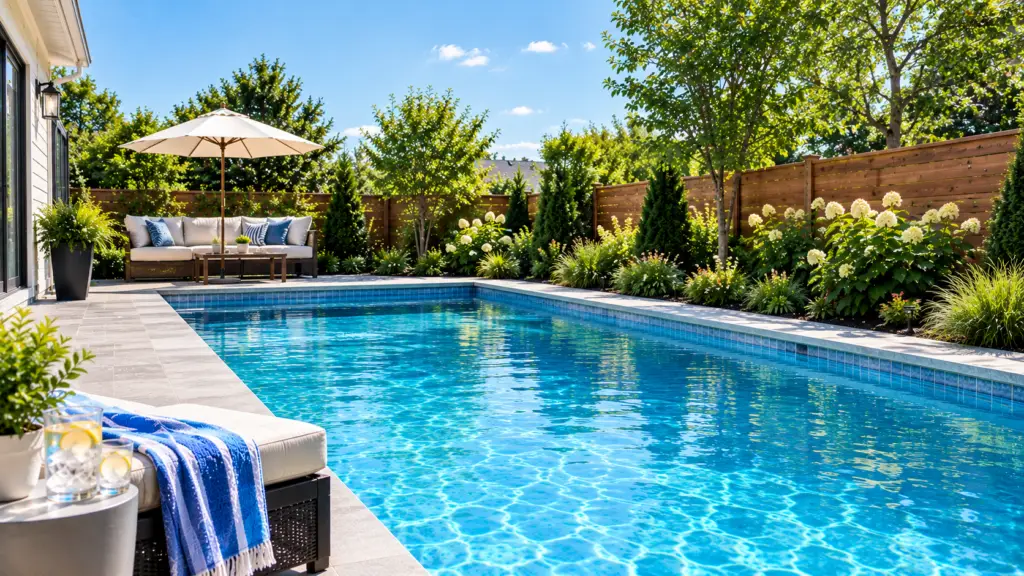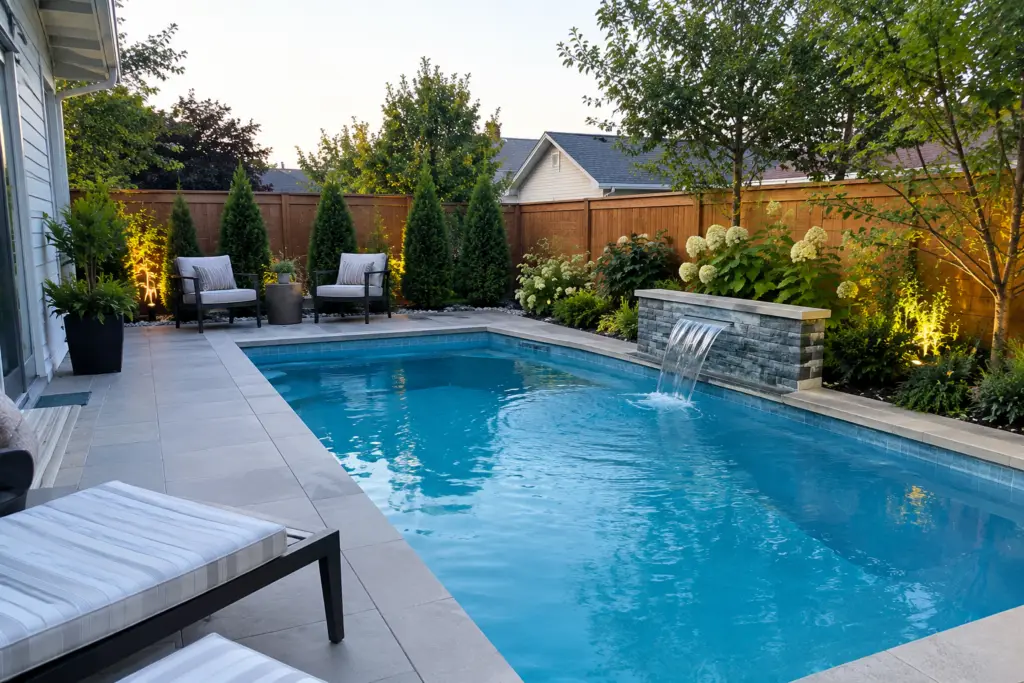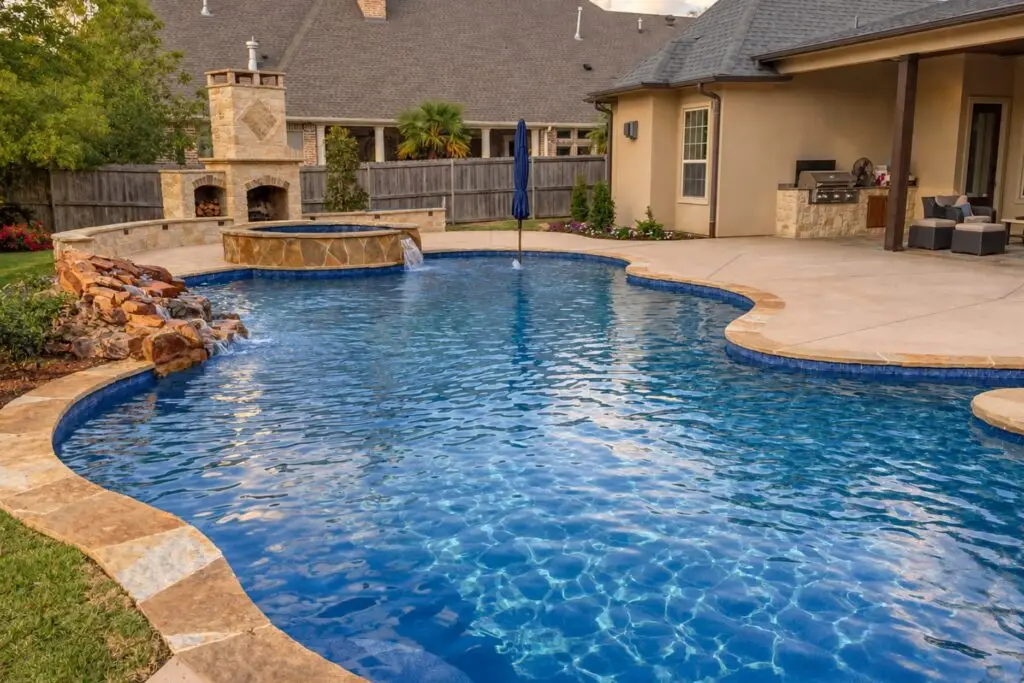

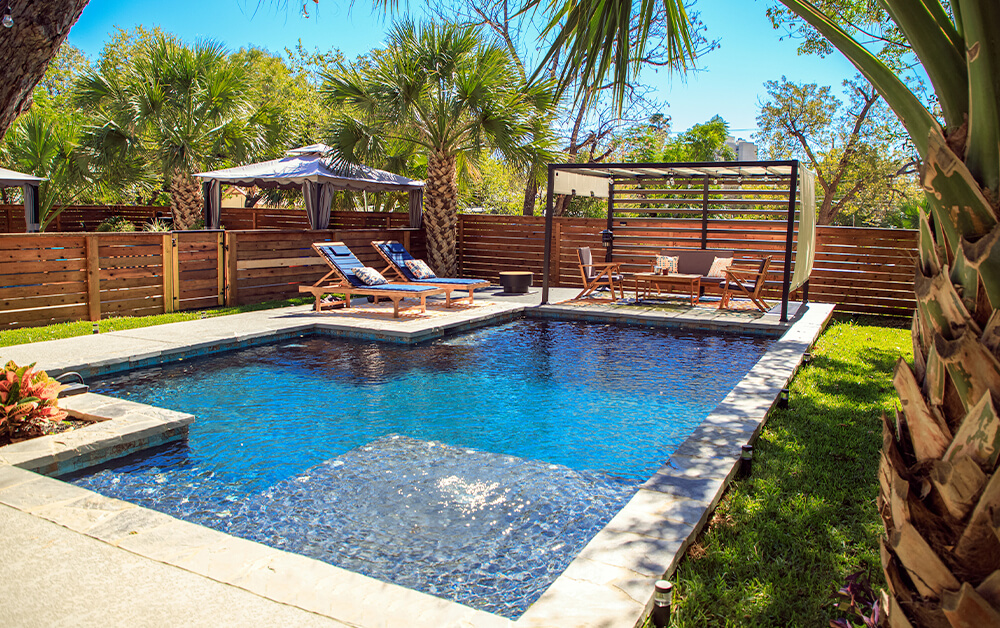
Your pool gets all the attention, but the deck is where you actually live. It’s where the towels go, where the kids run (even when you said no running), where dinner happens. A boring deck makes a great pool feel flat. A smart one makes a simple pool feel like a resort.
This guide covers 10 unique pool deck ideas for inground pools, what each one really costs, where each one goes wrong, and how to pick the right one for your yard and climate. We also fact-checked the cost numbers floating around the internet, because a lot of them don’t hold up.
What Are the Most Unique Pool Deck Ideas?
The 10 most unique pool deck ideas are:
- Mixed-material deck with turf or gravel joints
- Sunken fire pit lounge deck
- Tanning ledge and sun deck combo
- Large-format porcelain pavers
- Geometric patterned travertine
- Custom-color cool deck with scored borders and inlays
- Raised spa terrace with spillover
- Water feature and lighting deck
- Outdoor kitchen and pergola entertaining deck
- Wood-look accent platform
Typical installed cost in 2026: about $8 to $14 per square foot for basic poured concrete, and $16 to $45+ per square foot for pavers, travertine, porcelain, or natural stone. For a 600 square foot deck, that’s roughly $4,800 to $30,000 for the deck surface alone, before coping, drainage fixes, or extras.
How to Choose a Pool Deck Before You Fall in Love With a Look
Pinterest is great at making everything look easy. Real backyards have slopes, sun, freeze cycles, and chlorine. Run every idea below through these six checks first.
1. Heat Underfoot
Dark concrete and dark porcelain can get uncomfortably hot in direct sun. Light-colored travertine and cool-deck coatings stay noticeably more comfortable on bare feet. If you live in the Southwest or Florida, this check matters more than the pattern.
2. Slip Resistance
Wet feet plus smooth surface equals a bad day. Look for brushed, tumbled, honed, or textured finishes. Stamped concrete can be slick when wet, so ask for a non-slip additive in the sealer.
3. Climate and Freeze-Thaw
If your winters freeze, you need materials rated for freeze-thaw cycles. Stamped concrete can crack and heave in freeze-thaw regions. Pavers tolerate movement better because individual pieces flex and can be replaced.
4. Salt Water Compatibility
Running a salt system? Natural limestone products like travertine can be damaged by salt splash over time if they’re not sealed and rinsed. It’s not a deal-breaker, just a maintenance reality. Porcelain and well-sealed concrete handle it better.
5. Drainage and Slope
Every deck should slope away from the pool and house. A common rule of thumb is roughly 1/8 to 1/4 inch per foot, but your builder and local code decide the exact number. Pretty decks with bad drainage hold water, grow algae, and cause foundation headaches.
6. Safety Code and Electrical Bonding
Pools have barrier, fence, and electrical bonding requirements that vary by city and state. Metal in and around the deck may need to be bonded. This is a permitting job for your builder, not a DIY guess.
Pro Tip
Design the deck and the pool together. Coping, steps, ledges, and deck height all connect. Changing one later usually means tearing up another.
10 Unique Swimming Pool Deck Ideas
1. Mixed-Material Deck With Turf or Gravel Joints
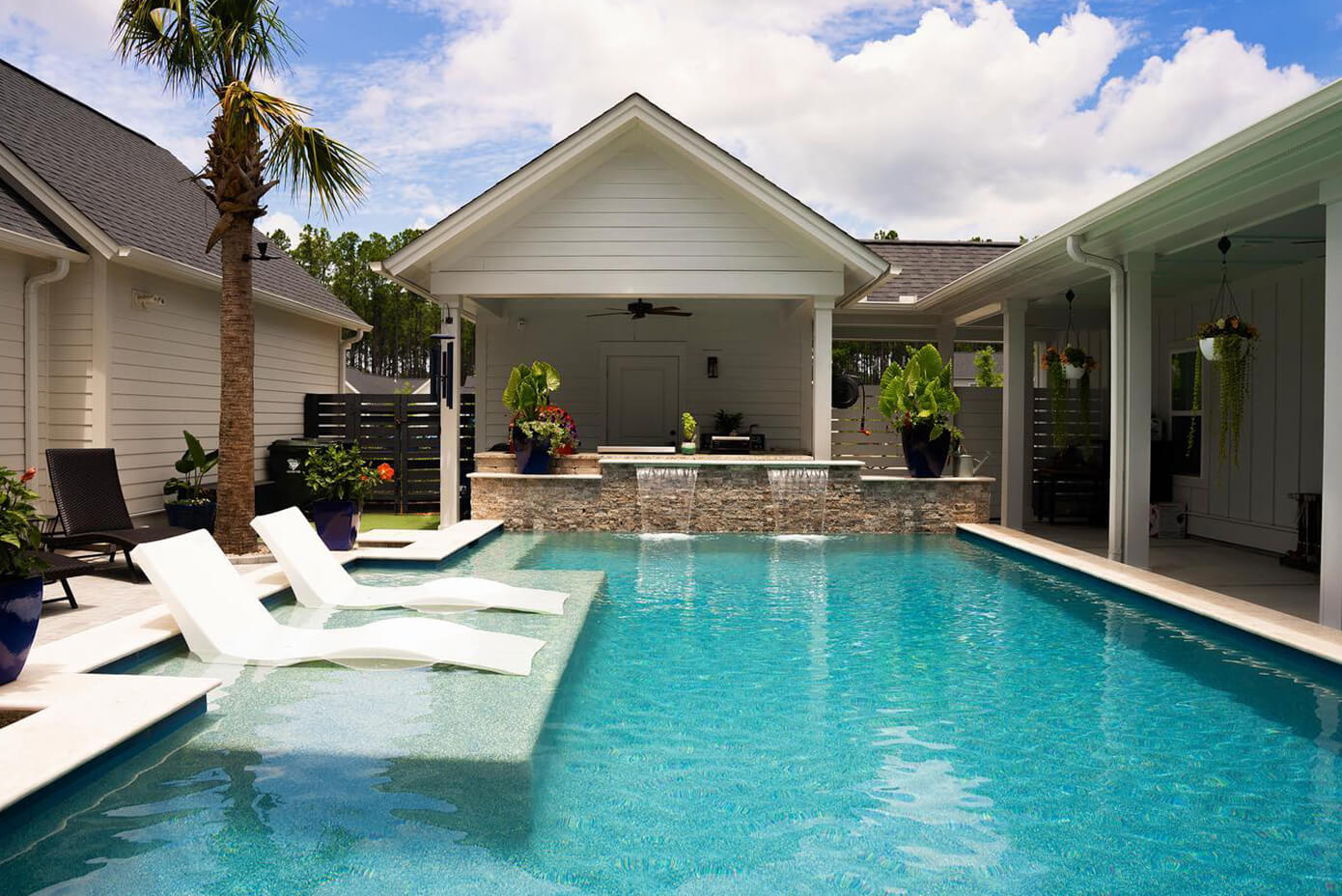
Blue Haven Retreat-style pool design. Browse more in the Retreat gallery.
Instead of one material wall to wall, you blend two or three. Think travertine squares with synthetic turf or small gravel joints between them, or poured concrete bands that frame paver panels. The result looks custom because it is.
- Best for: Small to mid-size yards, modern homes, and anyone who wants visual interest without a huge price jump
- Why it works: Turf or gravel joints soften the surface and cut down on radiant heat
- Watch out for: Turf near pools collects debris and needs rinsing; gravel migrates into the water if not edged properly
Cost and Reality Check
Costs track the most expensive material you use, plus extra labor for cutting and edging. Expect it to land between standard pavers and travertine pricing.
2. Sunken Fire Pit Lounge Deck
https://www.bluehaven.com/wp-content/uploads/2026/05/Family_pool.jpg
Drop a seating area 12 to 18 inches below the main deck level and build a fire pit in the middle. It becomes a natural conversation pit, and it breaks up a flat yard.
- Best for: Entertaining, cooler climates, and yards with a little natural grade
- Why it works: Steps down create separation from the splash zone, so guests stay dry
- Watch out for: Drainage. A sunken area collects water unless a drain is designed in from day one. Gas line and clearance rules also apply
Pro Tip
Use a gas fire feature rather than wood. It’s cleaner, safer near a pool, and easier to permit in many areas.
3. Tanning Ledge and Sun Deck Combo
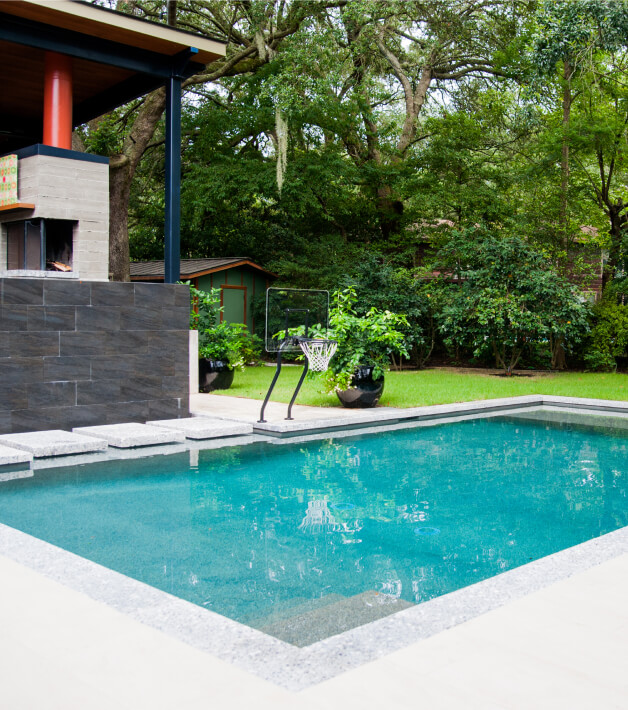
Blue Haven Family-style pool design. See more in the Family pool gallery.
A tanning ledge is a shallow shelf inside the pool, usually 6 to 12 inches deep, built for lounge chairs and toddlers. When the deck flows straight into it at the same visual level, the line between “in” and “out” disappears.
- Best for: Families, hot climates, and anyone who’d rather sit in water than on a chair
- Why it works: It adds usable square footage without enlarging the deck
- Watch out for: Shallow water heats up fast and needs sun and shade planning
Blue Haven’s own project descriptions mention tanning ledges as a common feature on gunite pools, and gunite makes shaping them easy since the shell is formed to nearly any design.
4. Large-Format Porcelain Pavers
Big, thin, clean-edged porcelain slabs (often 24 by 48 inches or larger) give a modern, almost indoor look. They come in stone, concrete, and wood-look styles.
- Best for: Contemporary homes, anyone who hates sealing stone
- Why it works: Porcelain is dense, stain resistant, and doesn’t need regular sealing the way natural stone does
- Watch out for: Dark colors can run hot. Installation needs a flat, well-built base because large slabs show every mistake
Cost and Reality Check
This is one of the pricier surfaces. Local contractor pricing in 2026 commonly lands in the low $20s to mid $40s per square foot installed, depending on the market.
5. Geometric Patterned Travertine
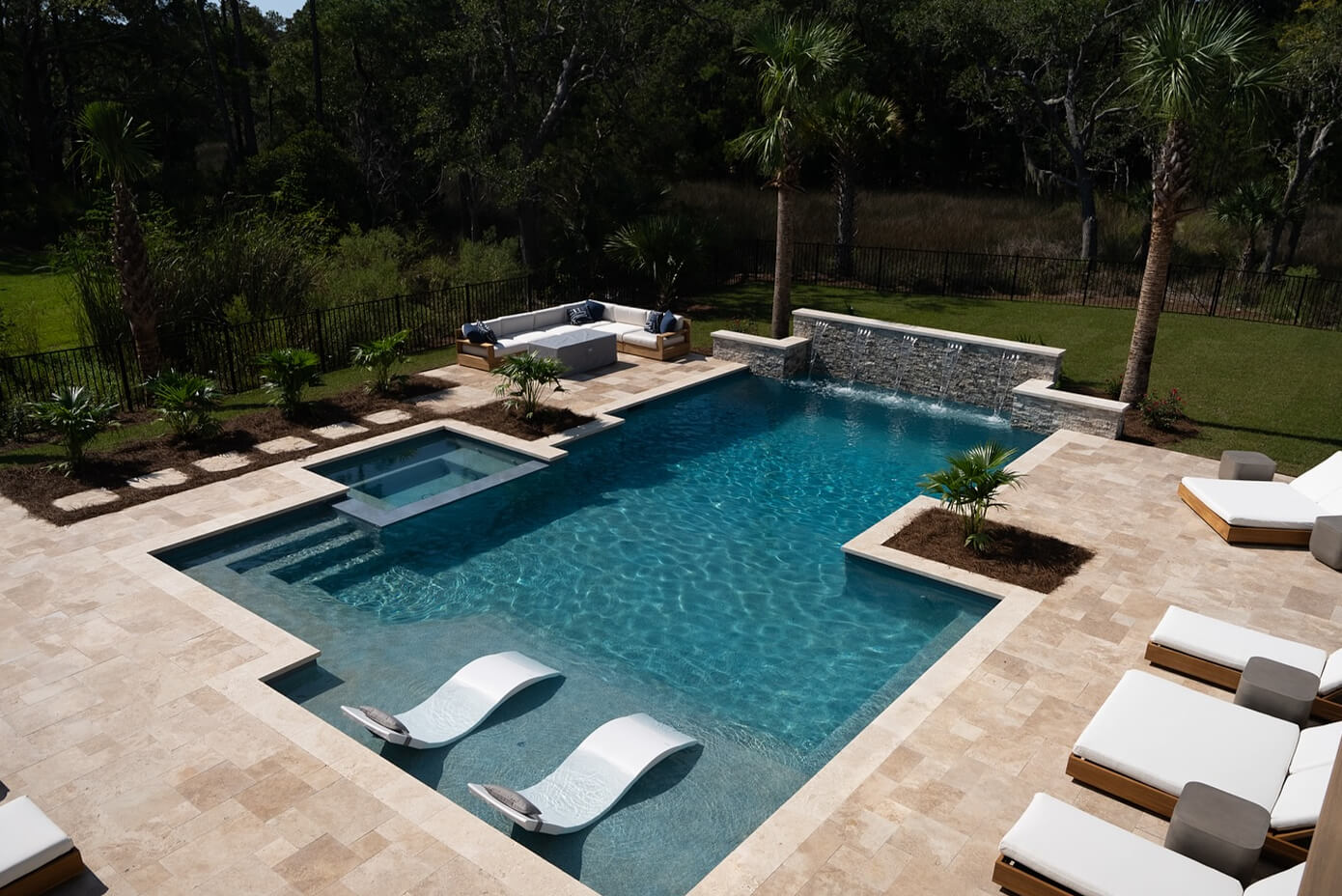
Blue Haven Estate-style pool and outdoor living design. Explore the Estate gallery.
Travertine is the classic cool-underfoot stone. The unique move is the pattern: French pattern with mixed sizes, a diagonal grid rotated 45 degrees to the pool, or two-tone borders that frame the water.
- Best for: Hot climates, traditional or Mediterranean homes, and anyone who wants high-end curb appeal
- Why it works: Light natural stone stays cooler than concrete and has a built-in drainage-friendly texture
- Watch out for: Sealing every couple of years, and care with salt water
Cost and Reality Check
Verified sources put installed travertine at roughly $13 to $30 per square foot nationally, with some high-cost markets higher. See the cost section below for what that means in dollars.
6. Custom-Color Cool Deck With Scored Borders and Inlays
Cool-deck coatings are spray or trowel-on surfaces that reflect heat. The unique twist is designing them: custom colors, saw-cut borders, and inlaid patterns or medallions that echo the pool tile.
- Best for: Budget-conscious projects that still want personality, and resurfacing an old concrete deck
- Why it works: It can be applied over sound existing concrete, which saves demolition
- Watch out for: The surface won’t fix a cracked or sinking slab underneath. Fix the base first
Blue Haven lists decorative and stamped concrete and Sundeck® among the decking options some offices offer, so ask your local team what’s available in your area.
7. Raised Spa Terrace With Spillover
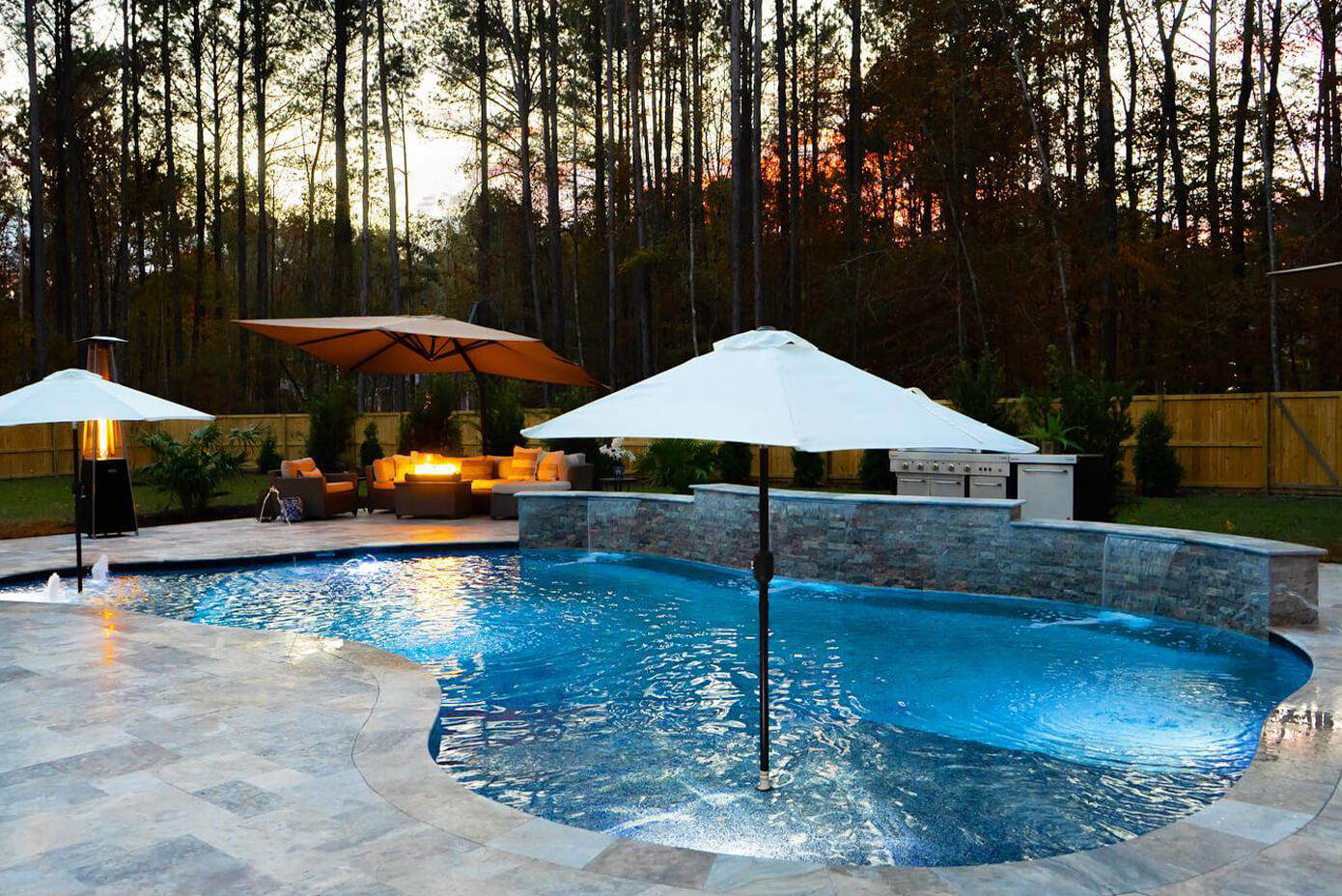
Blue Haven Entertain-style design. See more in the Entertaining gallery.
Raise the spa 12 to 30 inches above the pool and let it spill into the main water. Surround it with a terrace deck that steps up to meet it. You get a focal point, a built-in bench, and the sound of moving water.
- Best for: Sloped yards, estate-style projects, and four-season use
- Why it works: Elevation creates drama without adding a separate structure
- Watch out for: Structural engineering. Raised spas are heavy, and the deck around them needs proper footings
8. Water Feature and Lighting Deck
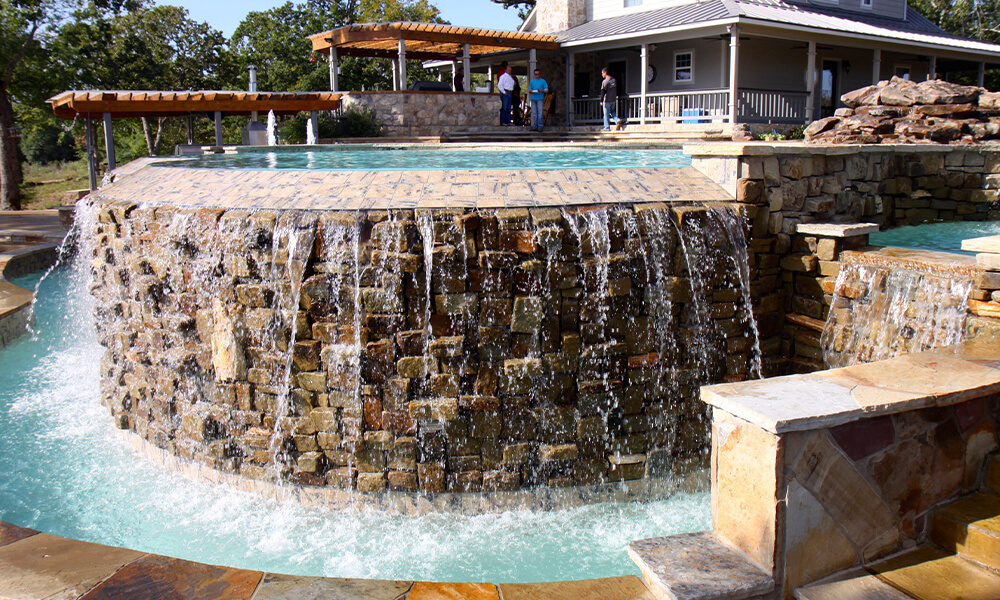
Build the deck around the water show. Think scuppers, laminar jets, a stone-faced wall fountain, and fire bowls on the coping, then add LED lighting in steps, risers, and planters so the deck glows at night.
- Best for: Evening entertaining and homes where the pool is visible from inside
- Why it works: Lighting extends deck use by hours and adds a safety margin on steps
- Watch out for: Run conduit before pouring or paving. Adding electrical after the fact means cutting finished surfaces
Blue Haven’s new pool designs regularly pair gunite shells with stone grotto waterfalls, scupper fountains, and illuminated laminar arcs, so these builds are well within their wheelhouse.
9. Outdoor Kitchen and Pergola Entertaining Deck
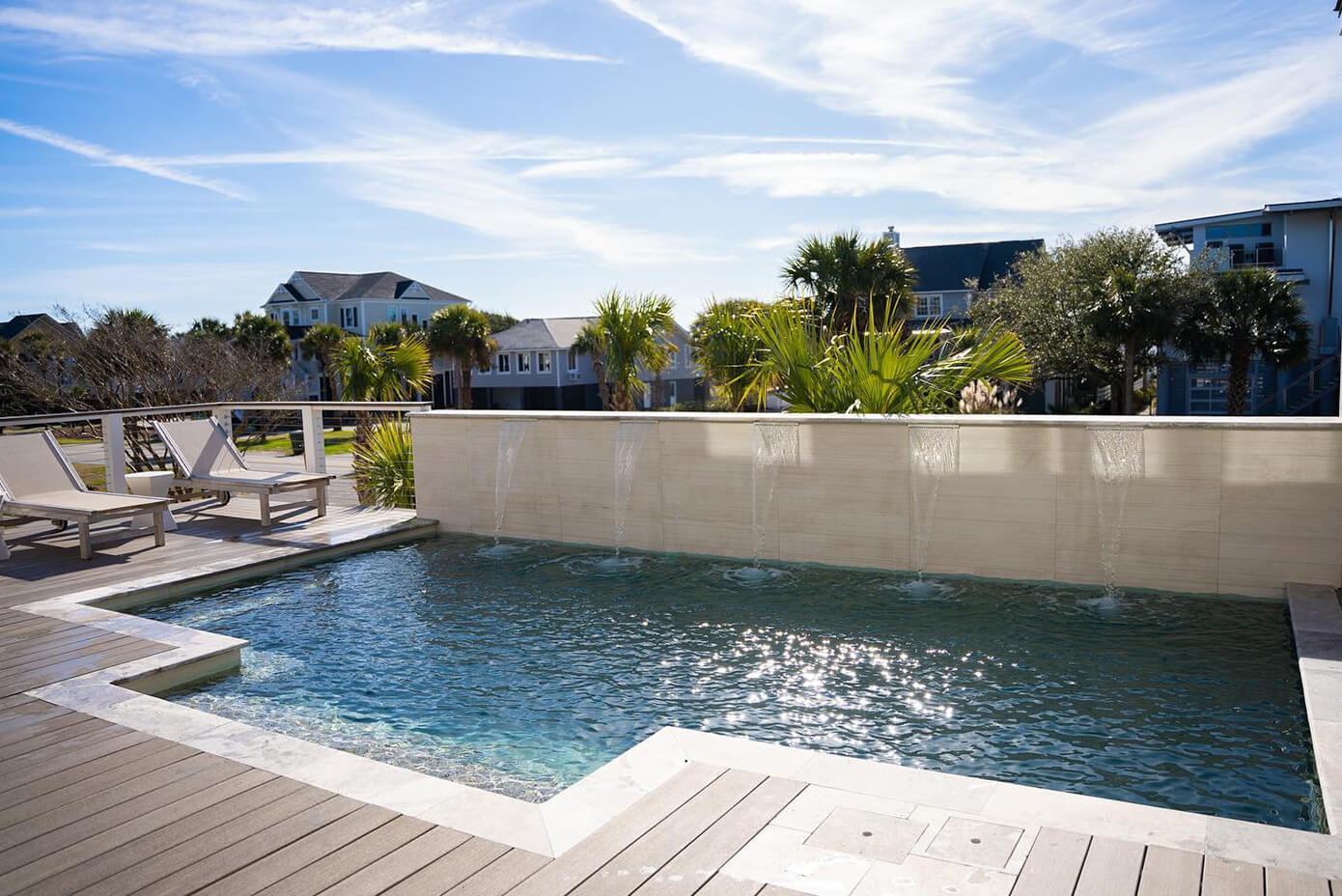
Blue Haven pool design for active, daily-use living. See the Active gallery.
Split the deck into zones: a wet zone around the pool, a lounge zone with shade (pergola, shade sail, or cabana), and a cooking zone with a built-in grill and counter. Each zone gets its own flooring or level so the yard feels planned.
- Best for: Hosts, large families, and homes where the backyard is the main living space
- Why it works: Shade is the most underrated pool upgrade. It makes the deck usable at noon
- Watch out for: Utility runs (gas, water, power) and setbacks from the pool edge
10. Wood-Look Accent Platform
A raised platform in hardwood (like ipe) or composite, placed away from the water’s edge, adds warmth against stone and concrete. The unique version floats a wood lounge deck beside a stone pool surround.
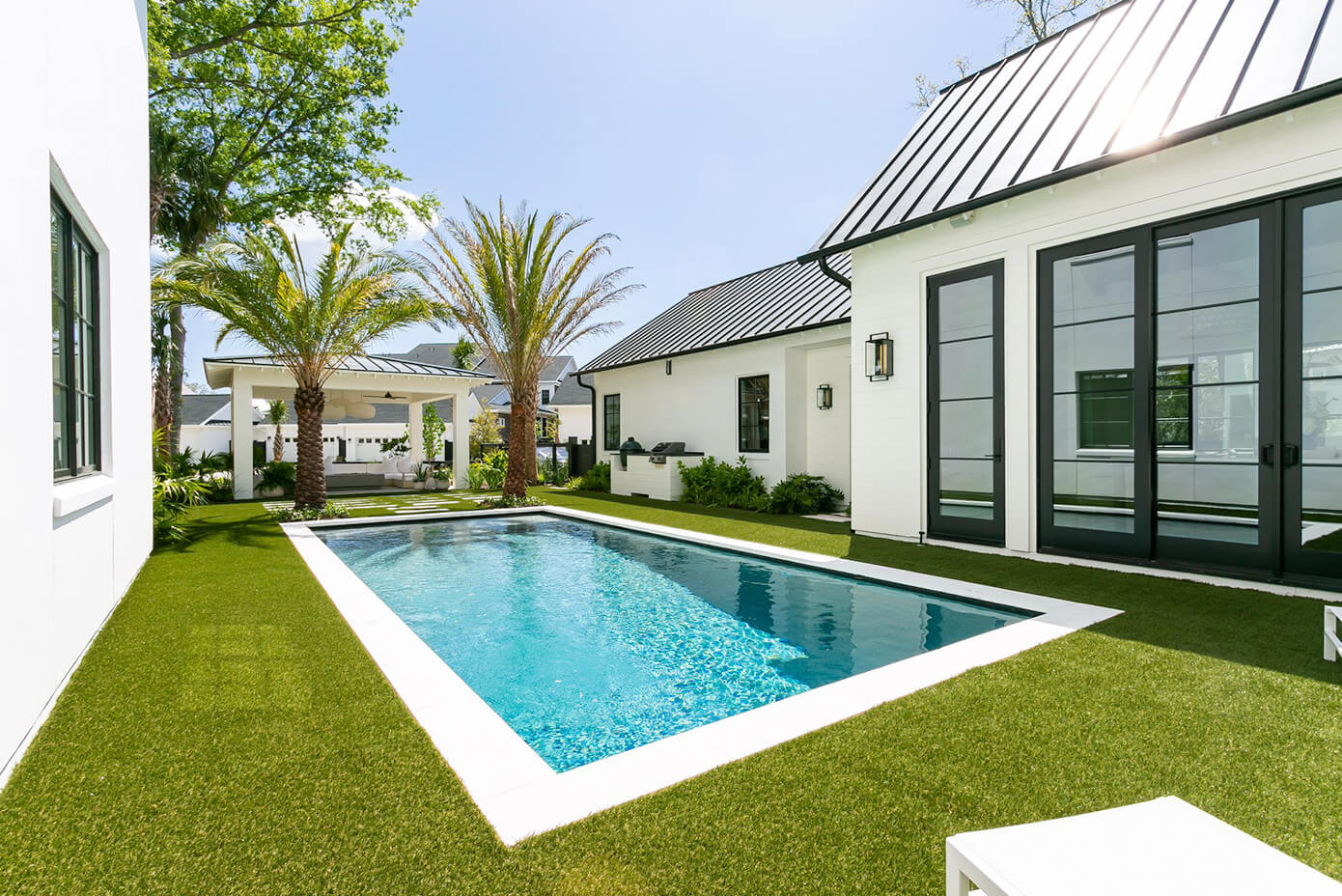
Blue Haven Courtyard-style design. Browse the Courtyard gallery.
- Best for: Pairing with stone for contrast, and cabana or daybed zones
- Why it works: Wood and composite stay more comfortable underfoot than dark concrete in many settings
- Watch out for: Real wood needs regular sealing or staining. Composite is lower maintenance but can still get warm in full sun
Cost and Reality Check
Wood and composite prices vary hugely by product and by whether you need a framed, raised structure. Treat any single number you read online as a rough guide and get a written quote.
Pool Deck Materials Compared
Here’s a quick side-by-side so you can scan it. Heat and slip notes are general, and the exact product and color always matter.
| Material | Look | Heat Underfoot | Slip Resistance | Maintenance | Best Climate |
|---|---|---|---|---|---|
| Broom-finish concrete | Simple, clean | Warm | Good | Low | Most climates |
| Exposed aggregate | Textured, natural | Moderate | Very good | Low | Most climates |
| Stamped concrete | Mimics stone or brick | Warm to hot | Fair (add non-slip sealer) | Reseal periodically | Mild climates |
| Cool-deck overlay | Smooth, colorful | Cool | Good | Recoat every several years | Hot climates |
| Concrete pavers | Modular, many patterns | Moderate | Very good | Low to moderate | Most, including freeze-thaw |
| Travertine | High-end, natural | Cool | Very good | Seal every 2 to 3 years | Hot or mild, caution with salt |
| Porcelain pavers | Modern, clean | Moderate (dark = hot) | Very good (textured) | Very low | Most climates |
| Natural stone (flagstone, bluestone) | Rustic or classic | Varies by color | Good | Seal as needed | Most climates |
| Wood or composite | Warm, raised | Moderate | Good | Low (composite) to high (wood) | Most climates |
Pool Deck Cost: What’s Fair and What’s a Red Flag
This is where most articles get lazy, so let’s slow down.
What the Internet Says (and Why It’s All Over the Place)
When we checked current 2026 sources, the numbers contradicted each other badly:
- One large home-services site lists pool decks anywhere from $3 to $40 per square foot, with pavers as low as $3 to $7 and poured concrete at $4 to $8.
- A national poolscape guide puts installed decking at $8 to $28 per square foot.
- A deck cost calculator claims $25 to $50 per square foot.
- Local contractor pages show concrete around $9 to $14 in Phoenix, travertine around $18 to $26 in Phoenix, and $25 to $40 for travertine in Los Angeles.
- A travertine pricing guide dated April 2026 says pool deck installs run $13 to $30 per square foot installed, and that a 1,000 square foot deck can come in cheaper per square foot than a 200 square foot patio.
Our Technical Read: Which Numbers Are Believable?
The $3 to $8 numbers are not realistic for a full installed deck in 2026. Those are usually material-only prices, older pricing, or a deck with no base prep, drainage, or finishing. A proper pool deck needs excavation, compacted base, forms, rebar or reinforcement, drainage slope, expansion joints, and finishing. That alone usually pushes basic concrete above $8 per square foot.
The $25 to $50 numbers look inflated for ordinary decks. They tend to bundle coping, drains, demo, and premium finishes into one number, or come from lead-generation calculators with no real project behind them.
The believable middle: Most reliable installed ranges cluster as shown below.
Installed Cost Per Square Foot (2026 Planning Ranges)
| Deck Surface | Typical Installed Cost per Sq Ft | Is It a Fair Price? |
|---|---|---|
| Broom-finish concrete | $8 to $14 | Fair. Below $8 means ask what’s left out |
| Exposed aggregate | $9 to $16 | Fair for the durability and traction |
| Stamped concrete | $12 to $22 | Fair, but weigh crack risk in freeze-thaw areas |
| Cool-deck overlay (on sound slab) | $4 to $12 | Good value if your slab is solid |
| Concrete pavers | $14 to $25 | Good value long term, easy to repair |
| Travertine | $16 to $30 | Fair in most markets, high end in LA-type markets |
| Porcelain pavers | $22 to $45 | Premium. Worth it for low maintenance and modern look |
| Natural stone (flagstone, bluestone) | $25 to $50+ | Premium. Labor-heavy, so ask about installers |
These are reconciled planning ranges based on multiple 2026 contractor and cost-guide sources, not Blue Haven prices. Labor rates, access, soil, and local material costs shift them.
What a 600 Square Foot Deck Costs
A 600 square foot deck is a common size for a mid-size pool. Here’s the math from the ranges above.
| Deck Surface | Estimated Total (Surface Only) |
|---|---|
| Broom-finish concrete | $4,800 to $8,400 |
| Stamped concrete | $7,200 to $13,200 |
| Concrete pavers | $8,400 to $15,000 |
| Travertine | $9,600 to $18,000 |
| Porcelain pavers | $13,200 to $27,000 |
| Natural stone | $15,000 to $30,000 |
Sanity check: Independent guides show a 600 square foot travertine pool deck at around $9,000 to $16,200 in some sources and up to $40,000 in LA-style markets. Our $9,600 to $18,000 range sits comfortably inside the mainstream and leaves room for regional swings.
Costs That Get Missed
- Demolition of an old deck: often $2 to $6 per square foot extra
- Coping: priced per linear foot, and one 2026 Phoenix guide shows $35 to $120 per linear foot depending on material
- Drainage and grading: can be a surprise if your yard slopes toward the house
- Electrical and gas runs: needed for lighting, fire features, and outdoor kitchens
- Permits and inspections: vary by city
About Those “Blue Haven Price” Articles
You’ll find third-party sites listing Blue Haven pools at specific dollar ranges. Those aren’t published Blue Haven price lists, and some openly say so. Blue Haven’s own position is that national average prices for custom inground pools are misleading, since every project is designed for the specific yard, and pricing comes after an in-home consultation. That’s honest, and it’s also just how custom concrete construction works. For your numbers, see the Blue Haven pool pricing page and request a local quote.
Where to Save and Where Not To
- Save: Keep the footprint simple, pick standard finishes before premium ones, and resurface a sound slab instead of replacing it
- Don’t cut: Base prep, drainage, expansion joints, and slip resistance. Those are the things you can’t fix cheaply later
How Blue Haven Helps You Design and Build Your Pool Deck
If you want the deck and the pool to look like they belong together (and not like two separate projects), the builder matters. Here’s what Blue Haven brings to the table.
A Legacy of Pool Building
Blue Haven has been building pools under the Diving Lady symbol since 1954. The company reports 70+ years of experience, 300,000+ pools built nationwide, 60+ offices across the U.S., and a 4.8 out of 5 rating across 10,000+ verified reviews on Trustpilot, Yelp, and Google. It’s recognized as a top-ranked inground pool builder in America, and you can read more on the About Blue Haven page.
Custom Gunite Construction
Blue Haven specializes in gunite pools and spas, which means the shell can be formed in nearly any shape, depth, or feature. That freedom matters for deck ideas like tanning ledges, raised spas, and spillovers. Explore the full range on the new pools page.
Deck and Pool Designed as One Space
Blue Haven offices can plan and build the surrounding deck, patio, and hardscape alongside the pool. Depending on your local office, material options can include brick, flagstone, travertine, poured concrete, stamped or decorative concrete, Sundeck®, and decorative pavers. One team means one plan, matched coping and deck, and fewer finger-pointing moments.
Design Around How You Live
Blue Haven starts with how you’ll use your backyard, not with a catalog. Their design styles map nicely onto the deck ideas in this article:
- Estate for large, architectural outdoor living
- Retreat for private, calm spaces
- Family for everyday play and long-term use
- Entertain for dining, seating, and gatherings
- Active for exercise and wellness
- Courtyard for smart use of tighter spaces
Browse the full Inspiration Gallery to see real backyards and decks.
See It Before You Build It
Blue Haven offers a visualization tool that shows a custom pool in your own yard from your address, in under 60 seconds. It’s a quick way to test whether a fire pit lounge or a raised spa actually fits your space.
Smart Features That Lower Ownership Costs
Blue Haven pools offer SmartFeatures® that automate pool care and help save time, water, and energy. Over years of ownership, that’s often worth more than a fancy deck border.
Remodeling an Existing Pool and Deck
Already have a pool with a tired deck? Blue Haven also handles upgrades. See the remodeling and renovation page for new decking, coping, tile, and surface updates.
Financing and Timeline
- Financing: 100% financing is available for qualified buyers. Details are on the financing page
- Timeline: Most pools are completed in 8 to 14 weeks once construction begins, and some projects get you swimming in as little as 70 days. That excludes design, permitting, and site prep
- Permits: Your builder handles permitting, inspections, and local code compliance
Local Offices, Local Knowledge
Every region has its own soil, climate, and code quirks. Blue Haven’s 60+ offices know theirs. Find your local Blue Haven office or get a free design and quote. For more reading, visit the Blue Haven blog.
Tip: ask your local office to put deck material, coping, warranty terms, and exclusions in writing. Offices are locally run, so details can differ.
Questions Homeowners Ask Most
These are the questions people search before they hire anyone. Short, direct answers.
What Is the Best Material for a Pool Deck?
There’s no single best. For cool feet and a high-end look, travertine. For lowest maintenance, porcelain or concrete pavers. For tight budgets, poured concrete with a cool-deck coating. Match the material to your climate first and your Pinterest board second.
What Is the Cheapest Pool Deck Option?
Broom-finish poured concrete is usually the cheapest new deck, and a cool-deck overlay on a sound existing slab is cheaper still. In 2026, expect roughly $8 to $14 per square foot for new concrete and $4 to $12 for overlay resurfacing.
What Is the Best Pool Deck for Hot Climates?
Light-colored travertine, cool-deck coatings, and light pavers stay the most comfortable. Avoid dark colors in full sun. Shade structures also help more than most people expect.
What Is the Most Low-Maintenance Pool Deck?
Porcelain pavers and well-installed concrete pavers need the least regular care. Natural stone needs periodic sealing. Real wood needs the most work.
How Wide Should a Pool Deck Be?
A good rule is at least 3 to 4 feet for a walkway and around 8 to 10 feet where you want lounge chairs plus walking room. Chairs run 6 to 7 feet long, and you still need to pass behind them.
Can You Build a Pool Deck Over Existing Concrete?
Often, yes, if the slab is structurally sound, level, and draining properly. Overlays and some paver systems can go on top. If the slab is cracked or sinking, fix or replace it first.
How Much Does a Pool Deck Add to the Cost of a Pool?
It varies by size and surface. A typical 600 to 900 square foot deck adds several thousand dollars, and premium surfaces push it into five figures. Ask for the deck priced as its own line item so you can compare options.
Do Pavers or Concrete Last Longer Around a Pool?
Both can last decades when installed correctly. Pavers handle ground movement better and individual pieces can be swapped. Poured concrete is a single slab, so one crack can affect a larger area.
Common Pool Deck Mistakes
- Choosing a dark surface for a full-sun yard
- Skipping drainage planning to save money
- Picking smooth stamped finishes without a non-slip sealer
- Using travertine with salt water and never sealing it
- Forgetting conduit and gas lines before paving
- Designing the deck after the pool is built, instead of together
- Comparing prices without comparing what’s included
Pool Deck FAQ
How much does a pool deck cost per square foot in 2026?
Most installed pool decks fall between about $8 and $45 per square foot. Basic concrete is at the low end, pavers and travertine in the middle, and porcelain or natural stone at the top. Always confirm the quote includes base prep, drainage, and finishing.
How much does a 600 square foot pool deck cost?
Roughly $4,800 to $8,400 for basic concrete, $8,400 to $15,000 for concrete pavers, $9,600 to $18,000 for travertine, and $13,200 to $30,000 for porcelain or natural stone. Coping, demolition, and extras are separate.
What is the coolest pool deck material?
Light-colored travertine and cool-deck coatings are generally the coolest underfoot. Light concrete pavers are a close next. Dark surfaces of any material run hottest.
Is travertine good for salt water pools?
It can work, but salt splash may damage unsealed limestone-based stone over time. Seal it, rinse it, and follow your installer’s maintenance plan. If you want zero worry, porcelain is the safer pick.
What is the best non-slip pool deck?
Brushed concrete, exposed aggregate, tumbled travertine, and textured porcelain or pavers all perform well. Smooth stamped concrete is the one to watch, so ask for a non-slip additive.
Should I build the deck at the same time as the pool?
Yes, in most cases. Building together keeps coping, steps, and deck heights aligned, avoids tearing up finished work, and often simplifies scheduling and permitting.
Can I add a fire pit or outdoor kitchen to my pool deck?
Usually yes, with proper planning for gas, power, drainage, and setbacks. Plan these before paving so lines run under the finished surface.
How long does it take to build a pool and deck?
Blue Haven says most pools finish in 8 to 14 weeks after construction starts, with design, permitting, and site prep on top. Some projects get you swimming in as little as 70 days.
Does Blue Haven build pool decks?
Yes. Blue Haven offices design and build pools, spas, and the surrounding decks and patios, and they also remodel existing pools. Material options vary by local office, so check what’s offered near you on the locations page.
How do I get a real price for my pool and deck?
Schedule a free in-home consultation. Because every yard is different, accurate pricing needs a site evaluation. Contact your local Blue Haven office to get started.
Final Thoughts
The best pool deck isn’t the one with the most trendy material. It’s the one that fits your climate, your budget, and how your family really uses the yard. Pick one or two ideas from this list, not all ten, and let the design team help you make them work together.
Ready to see what your backyard could look like? Get your free design from Blue Haven, explore the Inspiration Gallery, or check financing options.