
Pool pH matters because it controls how well your sanitizer works, how comfortable the water feels, and how fast your pool finish, heater and plumbing wear out. Keep pH between 7.2 and 7.8, and aim for 7.4 to 7.6. Outside that window you pay more in chemicals, repairs and eventually resurfacing.
If you have ever tested your water, seen a number you did not like and wondered “does this really matter?”, this guide is for you. We build and remodel gunite pools for a living, so we see what happens when pH is ignored for a season. We also see how little effort it takes to prevent it.
Key takeaways
- The ideal swimming pool pH range is 7.4 to 7.6. The widely accepted safe window is 7.2 to 7.8.
- pH is logarithmic. A reading of 8.4 is not “a bit” higher than 7.4. It is ten times further from neutral.
- Low pH is corrosive. It etches plaster and eats metal parts like heater components.
- High pH causes scale, cloudy water and weaker sanitizing, especially when stabilizer (CYA) is low.
- Test weekly, and again after heavy rain, big parties or heat waves.
- Fixing pH costs very little. Fixing the damage from ignoring pH can cost thousands.
What is pool pH, in plain English?
pH measures how acidic or basic (alkaline) your water is on a scale of 0 to 14. Seven is neutral. Below 7 is acidic. Above 7 is basic.
Pools sit slightly on the basic side on purpose. Human eyes and tears sit around 7.4, so water close to that number feels comfortable. It also happens to be a sweet spot for sanitizer performance and for protecting surfaces.
Here is the part most articles skip. The scale is logarithmic, so each whole number is a tenfold change. That is why a pool can go from “fine” to “cloudy and itchy” faster than people expect.
What is the ideal pH level for a swimming pool?
The ideal pool pH is 7.4 to 7.6. The acceptable range is 7.2 to 7.8.
Different sources quote slightly different targets (some pros aim for 7.2 to 7.4, others are fine at 7.6). That is normal, because the best number depends on your finish, your sanitizer and your water balance. Use this table as a practical guide.
| pH reading | What it means | What you will usually notice | What to do |
|---|---|---|---|
| Below 7.0 | Acidic and corrosive | Stinging eyes, etched plaster, metal staining, faster chlorine loss | Raise pH, check total alkalinity first |
| 7.0 to 7.1 | Low | Mild irritation, early surface wear | Raise pH slowly and retest |
| 7.2 to 7.8 | Acceptable | Comfortable water, stable sanitizer | Keep testing weekly |
| 7.4 to 7.6 | Ideal | Best balance of comfort, clarity and surface protection | Hold steady |
| 7.9 to 8.2 | High | Haze, early scale on tile and waterline, weaker sanitizing | Lower pH, check alkalinity |
| Above 8.2 | Very high | Cloudy water, heavy scale, salt cell and heater scaling | Lower pH and re-balance the full set |
Why pH matters: 5 reasons that actually affect your wallet
1. pH changes how well your chlorine works
Chlorine is only as good as the portion that is “active” (hypochlorous acid). pH controls that portion. On a chart for pools with no stabilizer, roughly 65 percent of chlorine is active at pH 7.2, and only about 22 percent at pH 8.0.
But here is where we want to be honest, because many competitor articles repeat that chart without context.
Stabilized vs unstabilized pools
Most backyard pools use cyanuric acid (CYA) to protect chlorine from the sun. Pool chemistry researchers point out that once CYA is in the water, pH has a much smaller effect on chlorine strength, and CYA level matters more. One widely shared analysis puts the drop in active chlorine from pH 7.5 to 8.0 at about 50 percent without CYA, but only about 15 percent with CYA.
So what does that mean for you?
- pH still matters for sanitizing, but it is not the only lever.
- High CYA can hurt you more than a slightly high pH can.
- Do not “fix” a sanitizer problem by dumping in more chlorine until you have checked pH, CYA and alkalinity together.
If you want to read the technical debate yourself, see Aqua Magazine’s piece on pH 8.0 to 8.5 and Orenda’s explanation of the ideal pH.
2. pH decides how comfortable the water feels
Swimmers often blame “chlorine” for red eyes and itchy skin. In reality, the stinging smell most people complain about comes from chloramines, which form when chlorine reacts with sweat, sunscreen and body oils. We break that down in our common pool myths guide.
pH still plays a part. Very low or very high pH can irritate eyes and skin, but the more common culprit is under-sanitized water. If your eyes sting, test pH and free chlorine together before you change anything.
3. pH protects your pool finish and equipment
This is the reason that costs the most when ignored.
- Low pH (acidic water) is aggressive. It can etch plaster and aggregate finishes, dissolve metals and corrode parts of your heater and plumbing fittings.
- High pH pushes calcium out of the water. That shows up as white scale on tile, rough patches on the finish and crusty buildup inside heaters and salt cells.
For a gunite pool, the interior finish is the first thing to show it. That is one reason we recommend upgrading from basic white plaster to a more durable finish like SmartBrite® ColorQuartz® during a remodel, since it resists chipping, etching and staining better under normal chemical exposure.
4. pH affects water clarity and scaling
Cloudy water is rarely just a “filter problem”. When pH and calcium hardness are both high, calcium carbonate scale forms and the water looks dull or hazy. Cranking up chlorine does not fix that. Balancing the water does.
Your pool’s overall balance is a combination of pH, total alkalinity, calcium hardness, temperature and dissolved solids. Warmer water scales more easily, which is one reason heated pools and spas need closer attention. Our guide on the most efficient and comfortable pool temperature covers the heating side.
5. Bad pH makes every other chemical cost more
Algaecides, clarifiers and shock all work best inside a normal pH window. When pH is off you tend to use more chemicals to get the same result. Balance pH first and you spend less on everything else. Honestly, it’s the cheapest “upgrade” in pool care.
What are the symptoms of high and low pool pH?
| Symptom | Likely cause | First thing to test |
|---|---|---|
| Cloudy or hazy water | High pH, high calcium, filter issues | pH, alkalinity, calcium hardness |
| White crust on tile or waterline | High pH and high calcium (scale) | pH, calcium hardness |
| Stinging eyes and strong smell | Chloramines, or very low/high pH | Free chlorine, pH |
| Rough or etched plaster | Low pH, aggressive water | pH, alkalinity, calcium hardness |
| Metal stains (brown, green, black) | Low pH dissolving metals | pH, metals test |
| Chlorine “disappears” fast | Low pH, sun without enough CYA | pH, CYA, free chlorine |
| Algae returns after shocking | Weak sanitizing, high pH, high CYA | pH, CYA, free chlorine |
Why does pool pH keep changing?
Honest answer: pH wants to drift upward in almost every pool. Here are the usual reasons.
- Aeration and water features. Waterfalls, spillways, spa jets and bubblers release carbon dioxide from the water, which pushes pH up. Beautiful features, but they do affect your chemistry.
- High total alkalinity. Alkalinity acts as a buffer. When it is high, pH tends to climb and resist your attempts to lower it. When it is too low, pH swings around.
- Your sanitizer. Calcium hypochlorite and salt chlorine generators tend to raise pH. Trichlor tablets pull it down (and add CYA over time). The effect of liquid chlorine is smaller than most people think.
- New plaster or finish. Fresh cementitious finishes release alkaline compounds while curing, so pH can run high for the first weeks.
- Rain, fill water and heavy use. Rain dilutes alkalinity. Source water can arrive with its own pH and hardness. Big pool parties add sweat, sunscreen and oils.
Why you should test alkalinity before pH
Total alkalinity (commonly kept around 80 to 120 ppm) is the stabilizer for pH. If you adjust pH first and alkalinity is the real issue, the number snaps right back and you waste product. The usual order is alkalinity, then pH, then calcium hardness, then CYA, then chlorine.
Ideal pool chemistry ranges at a glance
Ranges vary by finish and sanitizer type, so treat these as common targets for a residential chlorine pool and confirm yours with your builder.
| Parameter | Common target range |
|---|---|
| pH | 7.4 to 7.6 (acceptable 7.2 to 7.8) |
| Total alkalinity | 80 to 120 ppm |
| Calcium hardness (plaster or gunite) | about 200 to 400 ppm |
| Cyanuric acid (CYA) | 30 to 50 ppm for many pools |
| Free chlorine | 1 to 3 ppm (adjusted for CYA) |
How to fix pool pH, step by step
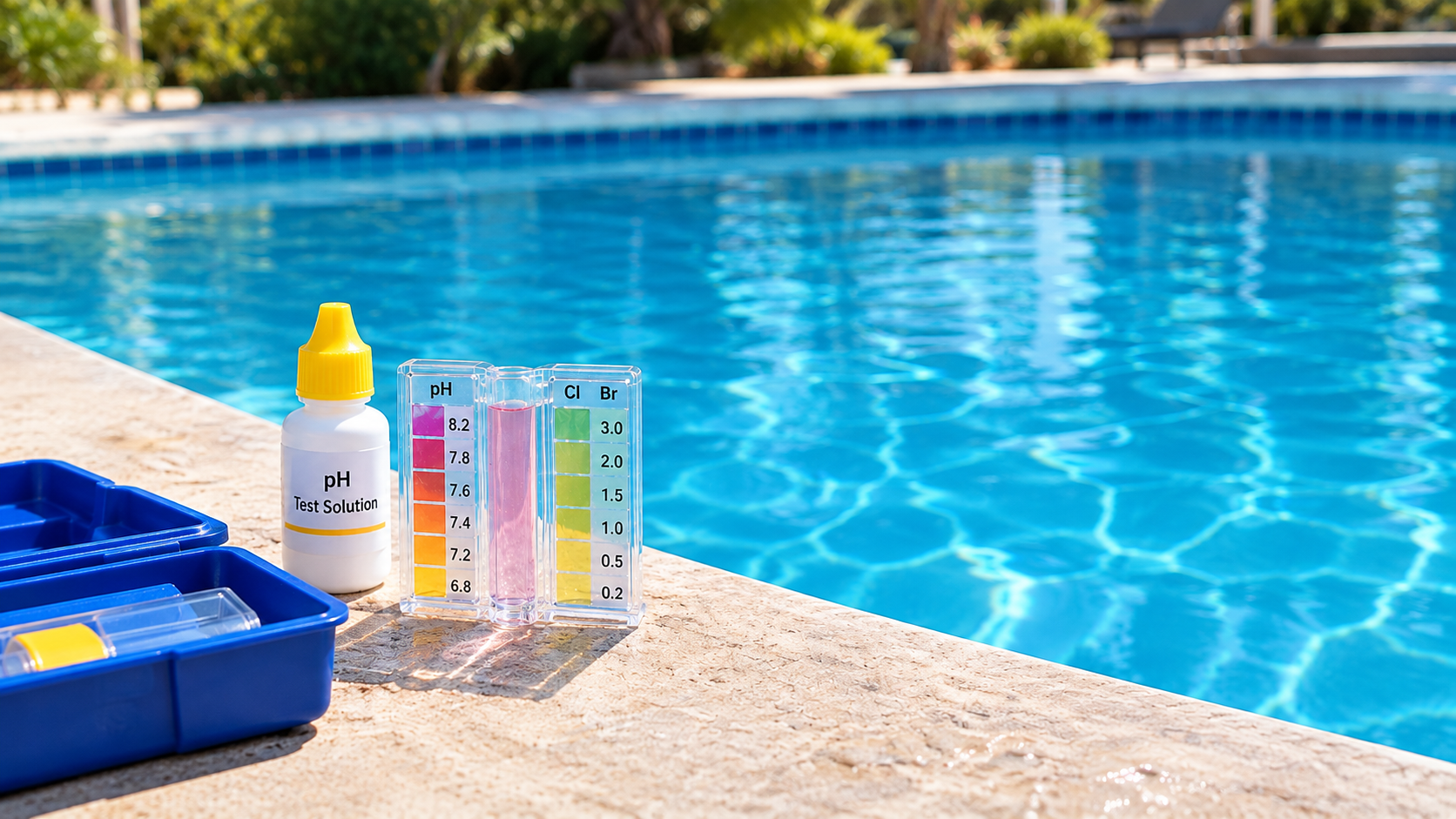
- Test with a reliable method. Test strips are quick and cheap, but a drop-based kit or a digital reader is better for pH precision.
- Test total alkalinity too. Decide whether alkalinity or pH is the real problem.
- Dose in small portions. Follow the product label for your pool volume, add part of the dose, circulate, then retest.
- Retest and repeat. Small corrections beat big swings.
- Log your numbers. Patterns (for example, pH always climbing after the waterfall runs) tell you what to fix permanently.
How to lower high pH
Use a pH reducer such as dry acid (sodium bisulfate) or muriatic acid, according to the label. If both pH and alkalinity are high, lowering with acid usually brings both down.
How to raise low pH
Use a pH increaser (soda ash). If alkalinity is also low, raise alkalinity first with baking soda (sodium bicarbonate) and recheck, since pH often rises along with it.
Acid safety
Always add chemicals to water, never water to chemicals. Wear splash-proof eye protection and gloves, and keep the pump running while you dose.
Never mix acid and chlorine products
Mixing them can release toxic gas. Store them apart, keep containers sealed and never combine products in a bucket.
How often should you test pool pH?
- Weekly during swim season, as a baseline.
- After heavy rain, big parties, heat waves or adding fresh water.
- More often if your pool is brand new, newly resurfaced or has several water features running.
Our maintenance checklist in the myths guide boils the weekly routine down to testing pH, free chlorine and total alkalinity, running the filter daily, brushing and emptying baskets.
What does it cost to keep pool pH right? (And is that price actually good?)
Most online articles throw out a monthly number and move on. We checked several current 2026 sources, compared them against each other, and then asked a simple technical question: does the price match the work involved? Here is what we found.
| Item | Typical price found online | Is it a fair price? |
|---|---|---|
| Test strips (100 count, retail listing) | About $20 | Yes for screening, about 20 cents a test. Fine for routine checks, less precise than a drop kit for pH. |
| DIY chemicals (liquid chlorine and acid) | About $20 to $50 per month | Realistic for a well-balanced pool, if you do the testing. Other guides quote $50 to $150 for DIY because they include shock, algaecide and extras. |
| Chemical-only service (tech tests and doses) | About $80 to $150 per month; one Arizona company lists $100 to $130 | Fair, if you get written readings for pH, alkalinity and CYA. Poor value if they just drop tablets. |
| Full weekly service | About $150 to $300 per month; Arizona lists $130 to $230; another guide lists $150 to $350 | Reasonable. That is roughly $35 to $70 per visit for testing, brushing, baskets and an equipment check. |
| Salt cell replacement | About $1,000 to $1,800 | Fair for the part, but scale from high pH can shorten its life. |
| Pool resurfacing | Often $6,000 to $15,000, with roughly $11,000 as a common average | Consistent across sources. Plaster is at the low end, pebble and tile at the high end. |
How we double-checked these numbers
- Cross-checking. The $150 to $300 weekly service range shows up across independent sources, including a pool-care reviewer and a regional Arizona pool company. That agreement is a good sign.
- Outliers. A few sites list weekly service at $420 to $860 per month or $300 to $440 for mid-range plans. Those figures do not match what actual service companies publish, and several of those pages look auto-generated, so we ignored them.
- Regional swings. Prices vary a lot by city, pool size and what is included. High-cost metros can run above these ranges.
Sources: The Pool Nerd service cost guide, Shasta Pools (AZ), Swimply service guide and Swimply resurfacing guide.
The technical verdict: what is a good price?
Here is the math, using the ranges above.
| Approach | Yearly cost (approx.) |
|---|---|
| DIY chemicals | $240 to $600 |
| Chemical-only service | $960 to $1,800 |
| Full weekly service | $1,800 to $3,600 |
| One resurfacing job | $6,000 to $15,000 |
The chemistry itself is cheap. What you are really paying a service for is time and consistent testing. A chemical-only plan at the low end of the range is a fair deal if the company logs numbers and corrects pH, alkalinity and CYA. A “cheap” plan that skips CYA and relies on tablets can cost you more later, because stabilizer builds up and weakens your chlorine.
Does ignoring pH really cost more than paying for care? Not every year. A well-kept plaster finish can last roughly 7 to 10 years, and a neglected one can wear out sooner then planned. Spread a $9,000 resurface over 10 years and it is about $900 a year. If bad water cuts that to 6 years, it becomes about $1,500 a year. The bigger risk is that you also add scale on heaters, a shorter salt cell life and stained or rough surfaces. Cheap prevention beats expensive repair, even if the break-even point is not the same for every pool.
What about the cost of the pool itself?
We do not publish a “national average” price for a custom inground pool, because site conditions, soil, access, finish, equipment and local permits change the number too much. The honest way to get a real figure is a free in-home consultation. See our pool pricing guide and financing options, where 100% financing is available for qualified buyers.
Does your pool type change the pH rules?
- Saltwater pools. Salt systems make chlorine and usually push pH upward, so they often need regular acid adjustments. They still need testing. (Yes, salt pools still contain chlorine.)
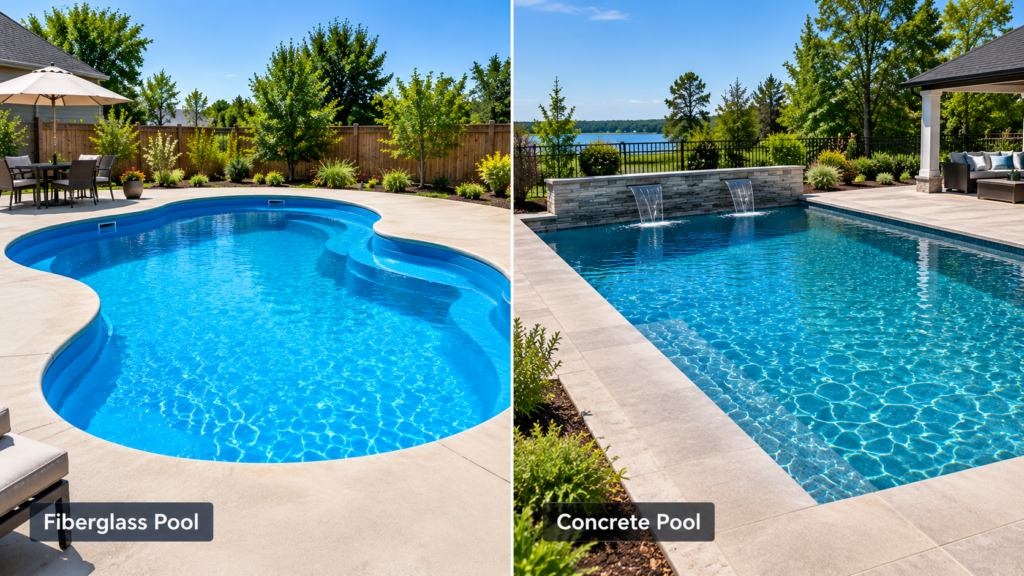
- Gunite (concrete) pools. The finish is more reactive to water balance than fiberglass, which is why steady pH and calcium matter. Our comparison of gunite vs fiberglass pools and fiberglass vs concrete pools explains the tradeoffs.
- Pools with AOP or ozone. Advanced oxidation and ozone reduce how much chlorine you need, and they can make chemistry steadier. You still test weekly.
How Blue Haven helps you keep pH stable
Blue Haven has been building pools since 1954. We have designed and built more than 300,000 custom inground pools across America, and we are recognized as America’s #1 pool remodeler and among the nation’s top pool builders. Our customers rate us 4.8 out of 5 across more than 10,000 verified reviews. That experience matters for water chemistry, because most pH problems are easier to prevent in the design stage than to fix after the build.
Designed for stable water from day one
- Custom gunite construction. Every pool is designed around your yard, soil and how you live. Our designers account for water features and equipment that affect chemistry. See our new pool designs and inspiration gallery.
- SmartPure® sanitizing systems. Our SmartPure® OxiPro and Ozonator systems cut chlorine needs dramatically, and ozone helps keep chemistry steadier so it needs less pH adjustment. You should still test regularly and follow the manufacturer’s instructions. Learn more in our posts on advanced oxidation (AOP) and ozone as a chlorine alternative.
- SmartControls™ automation. SmartControls™ lets you schedule filtration and other equipment, and monitor and adjust from your phone, tablet or voice assistant. Good circulation helps chemicals mix evenly, which makes correcting pH easier.
- SmartBrite® ColorQuartz® finish. A tougher interior finish that stands up to chemical exposure better than basic plaster.
- All our SmartFeatures®. Browse the full SmartFeatures® lineup, and see our guide to pool equipment technology options.
Already have a pool? We remodel and repair
If pH problems have left your finish rough, stained or scaled, our pool remodeling team can help with:
- Pool resurfacing (plaster, aggregate, ColorQuartz® and pebble options)
- Tile and coping replacement
- Equipment upgrades (pumps, heaters, filters, automation)
- Water features and full pool redesigns
A simple resurfacing is typically a 1 to 2 week project. Read why fall is a smart time to remodel.
Homeowner stories
- Tom and Alicia B., Phoenix, AZ: their 18-year-old pool was resurfaced in under two weeks and, in their words, looked better than the day it was installed.
- David K., Orlando, FL: an equipment upgrade made the pool easier to manage from his phone, and his energy bill dropped right away.
- The Okonkwo Family, Houston, TX: a neglected pool became a full redesign with a new surface, deck and water features.
See more on our remodel page and about page.
Local help, national backing
You get a local team that knows your climate, soil and permitting rules, backed by a national company. Find your nearest office on our locations page, then request a free quote and 3D design. You can also order a free brochure or shop pool supplies.
Quick answers to questions people ask about pool pH
What happens if pool pH is too high? Chlorine gets less effective in some conditions, water turns cloudy, and calcium scale forms on tile, heaters and salt cells.
What happens if pool pH is too low? The water becomes corrosive. It can etch plaster, corrode metal parts and irritate eyes and skin.
Is pH 7.8 okay for a pool? Yes, it is the top of the accepted range. Aim a bit lower, around 7.4 to 7.6, if you can.
Is pH 8.0 bad for a pool? It is high. It is not an emergency in a stabilized pool, but you should lower it to prevent scale and cloudiness.
Why does my pool pH keep going up? Usually aeration from water features, high alkalinity, salt chlorine or fresh plaster.
Why does my pool pH keep going down? Acidic sanitizers like trichlor, heavy rain or low alkalinity.
Should I fix pH or alkalinity first? Test and fix alkalinity first, then pH.
Can I swim if pH is off? Slightly off is usually fine. Very high or very low pH can irritate and means sanitizer may not be doing its job, so correct it first.
How long after adding acid can I swim? Follow your product label. Many require circulation for a period before swimming, so check yours.
Does pH affect chlorine? Yes, but how much depends on your CYA level.
Can rain change pool pH? Yes. Rain dilutes alkalinity and shifts pH, so retest afterward.
Does shocking change pH? It can, depending on the product. Retest after shocking.
Can pH damage a pool heater? Yes. Low pH can corrode internal components, and high pH can cause scale.
Does a saltwater pool need pH testing? Yes. Salt systems often push pH upward.
How often should I test my pool pH? Weekly, plus after rain, heavy use or heat waves.
Frequently asked questions (FAQ)
Why is pH the most important number in pool chemistry?
pH influences sanitizer performance, comfort, scaling and corrosion all at once, and it affects how every other chemical behaves. If pH is off, adjusting other levels often will not stick.
What is the best pH level for a pool?
The best range is 7.4 to 7.6, and the accepted range is 7.2 to 7.8.
Do I need to drain my pool to fix pH?
No. pH is fixed with chemicals, not draining. Most pools go years between drains, and you should never drain a gunite pool yourself because of the risk of damage from ground pressure. A pro should handle any drain.
How much does it cost to maintain pH?
If you do it yourself, chemicals often run about $20 to $50 a month. A chemical-only service is commonly $80 to $150 a month, and full weekly service is commonly $150 to $300. Prices vary by region and pool size.
Is it cheaper to hire a pool service or do it myself?
DIY is cheaper in dollars, but takes roughly 30 to 45 minutes a week, including dosing. A modern, well-designed pool with automation can take closer to 15 minutes a week for basic testing, baskets and brushing. Hire a service if you travel a lot or know the job will slip.
Can a pool’s finish void its warranty if water chemistry is neglected?
Warranty terms differ by builder and manufacturer, and many finish warranties expect balanced water. Read your contract and ask your builder what is required.
Does an AOP or ozone system replace pH testing?
No. These systems can reduce chlorine needs and help keep chemistry steady, but you still test and adjust.
How can Blue Haven help if my pool water is always out of balance?
Our local teams can evaluate your equipment, finish and water features, and recommend upgrades or a remodel if the pool itself is causing the problem. Contact your local Blue Haven office for a free consultation.
The bottom line
pH is the quiet number that controls everything else. Keep it near 7.4 to 7.6, test weekly, fix alkalinity first, and do not chase chlorine until you have checked the full picture. Do that and you protect your swimmers, your finish and your budget.
Ready for a pool that is easier to keep balanced, or a remodel to fix the damage from years of drifting chemistry? Get your free estimate and 3D design, explore financing or find a Blue Haven near you.