
Most pool owners believe at least one thing about their pool that simply is not true. You hear common pool myths from a neighbor or read one in a forum, and file it away as fact. The problem is that acting on bad information costs you money, wastes water, and takes time away from actually enjoying your backyard.
We design and build backyard pools that families spend their whole summer around, and the same questions come up year after year. Here are six common pool myths, what is actually true, and what to do instead.
The quick version
- Red eyes come from chloramines, not chlorine
- Gunite costs more upfront and less per year than fiberglass
- You almost never need to drain your pool
- Salt water pools still use chlorine
- A modern pool takes about 15 minutes a week
- You do not have to wait 30 minutes after eating
Myth 1: Chlorine causes red eyes
The reality: Chlorine is not what is stinging your eyes.
When chlorine reacts with urine, sweat, sunscreen, and body oils, it forms compounds called chloramines. Chloramines are what irritate your eyes and produce that harsh “chlorine smell.” Chlorine doing its job correctly has almost no odor at all.
So the pool that makes your eyes burn is not over-chlorinated. It is usually under-chlorinated, because the free chlorine has already been used up fighting contaminants.
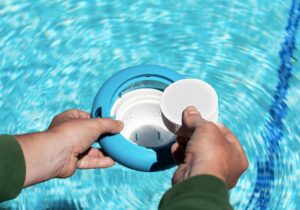
What to do: Test your water weekly and keep free chlorine between 1 and 3 ppm. If eyes sting and the smell is strong, shock the pool rather than backing off the chlorine.
Myth 2: Gunite pools are far more expensive than fiberglass

The reality: Gunite costs more on day one and less over the life of the pool.
Fiberglass pools are pre-made shells, so the upfront price is lower and installation is faster. That is a real advantage. But the sticker price is only half the math.
A fiberglass shell arrives in a manufacturer’s preset shape, usually capped around 16 feet wide because it has to travel down a road on a truck. The gel coat can fade or blister over time, and the shell can crack from ground movement or poor installation. Repairs on fiberglass are specialized and expensive.
A gunite pool is reinforced concrete and steel, formed on your property. There is no mold limiting the size, shape, or depth, and a well-maintained gunite pool can last 50 years or more. Spread the investment across that lifespan and the cost per year of ownership tells a very different story than the cost on the contract.
There is a resale angle too. A custom gunite pool built for your yard reads as a long-term asset to premium buyers. A standard fiberglass shell reads as a feature.
What to do: Compare cost per year of ownership, not just installation price. If you want a pool quickly and cheaply, fiberglass does that. If you want a pool shaped around your yard that is still there in 40 years, gunite is the better investment.
Read the full breakdown: gunite pools vs. fiberglass pools.
Myth 3: You need to drain your pool every season
The reality: Most pools go 5 to 7 years or longer between drains.
Draining a pool every year wastes thousands of gallons of water, costs money to refill and rebalance, and puts real stress on the structure. With a gunite pool, draining without a professional can cause the shell to shift or crack from hydrostatic pressure in the surrounding soil.
What actually keeps water healthy is far less dramatic: consistent testing, balanced chemistry, and a filter that runs every day.
What to do: Stick to weekly testing and daily filtration. Only drain when a professional identifies a specific problem, like total dissolved solids that cannot be corrected chemically. Never drain a gunite pool yourself.
Myth 4: Salt water pools are chlorine-free
The reality: Salt water pools make their own chlorine.
A salt system uses a chlorine generator, called a salt cell, to convert dissolved salt into chlorine. The chlorine is still there. It is just being produced continuously and automatically instead of being added by hand.
What people actually notice with salt pools is steadier chlorine levels and softer-feeling water, because levels do not spike and crash the way they can with manual dosing. That is a genuine benefit. It is just not the same as being chlorine-free.
What to do: Choose a salt system if you want hands-off chlorine delivery and gentler water. Do not choose one expecting to eliminate chlorine, because every sanitized pool needs a sanitizer.
Myth 5: A pool is too much maintenance to be worth it
The reality: A properly built modern pool takes about 15 minutes a week.
This myth usually comes from someone who inherited a neglected pool with outdated equipment. That is a genuinely miserable experience, and it is not what current pool ownership looks like.
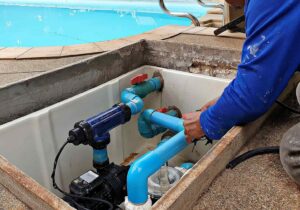
Modern aggregate finishes resist algae. Variable-speed pumps filter more efficiently for less money. In-floor cleaning systems, automatic chemical dispensers, and app-based controls handle most of the routine work without you touching anything.
The weekly reality for most of our customers is testing the water, emptying a basket, and running a brush along the walls.
What to do: If maintenance is your hesitation, ask specifically about automation options during design. Building them in from the start costs far less than retrofitting later.
Myth 6: You have to wait 30 minutes after eating to swim
The reality: There is no evidence behind this one.
The theory was that digestion diverts blood from your muscles and causes cramps severe enough to make you sink. Decades of data have not supported it. There is no meaningful link between eating and drowning risk.
What to do: Eat, then swim. Skip the cannonball on a full stomach if it feels bad, but the timer is unnecessary.
Common pool myths: frequently asked questions
Why does my pool smell so strongly of chlorine?
A strong chlorine smell means chloramines, which form when chlorine reacts with contaminants. It signals that your pool needs more chlorine, not less. Shock the pool and retest.
How often should I really test my pool water?
Once a week during swim season, and again after heavy use, heavy rain, or extreme heat. Test pH, free chlorine, and total alkalinity every time.
Are gunite pools worth the extra cost over fiberglass?
If you plan to stay in your home long-term, usually yes. Gunite lasts 50 or more years, fits any shape or depth your yard allows, and holds value better at resale. Fiberglass makes more sense when speed and upfront budget are the priorities.
How long does a gunite pool last?
Fifty years or more with proper maintenance. Interior finishes are refreshed periodically, but the reinforced concrete and steel structure is built to outlast the people who install it.
Do salt water pools have chlorine in them?
Yes. A salt cell converts salt into chlorine continuously. Salt pools automate chlorine rather than remove it.
Do I need to drain my pool every year?
No. Most pools go 5 to 7 years or longer between drains. Annual draining wastes water and can damage the structure.
What actually matters

Almost every common pool myth traces back to one bad experience that got repeated until it sounded like fact. Real pool problems come from neglected chemistry and outdated equipment, not from swimming after lunch or picking a dark interior finish.
Test weekly. Run the filter daily. Fix small things before they become big ones. And if you are building new, choose the pool that still makes sense in year 30, not just the one with the lowest number on the contract.
We design gunite pools built around your yard, your family, and how you actually plan to use the space. If you are thinking about building or upgrading, talk to a Bluehaven pool builder. See Bluehaven pool designs or browse our Pinterest for more swimming pool inspo.
Weekly pool maintenance checklist
- Test pH, free chlorine, and total alkalinity
- Run the filter 8 to 12 hours a day
- Skim floating debris
- Brush walls, steps, and floor
- Empty the pump and skimmer baskets
- Check equipment for leaks or unusual noise
That is the whole job. Do this consistently and most pool myths never become your problem.