
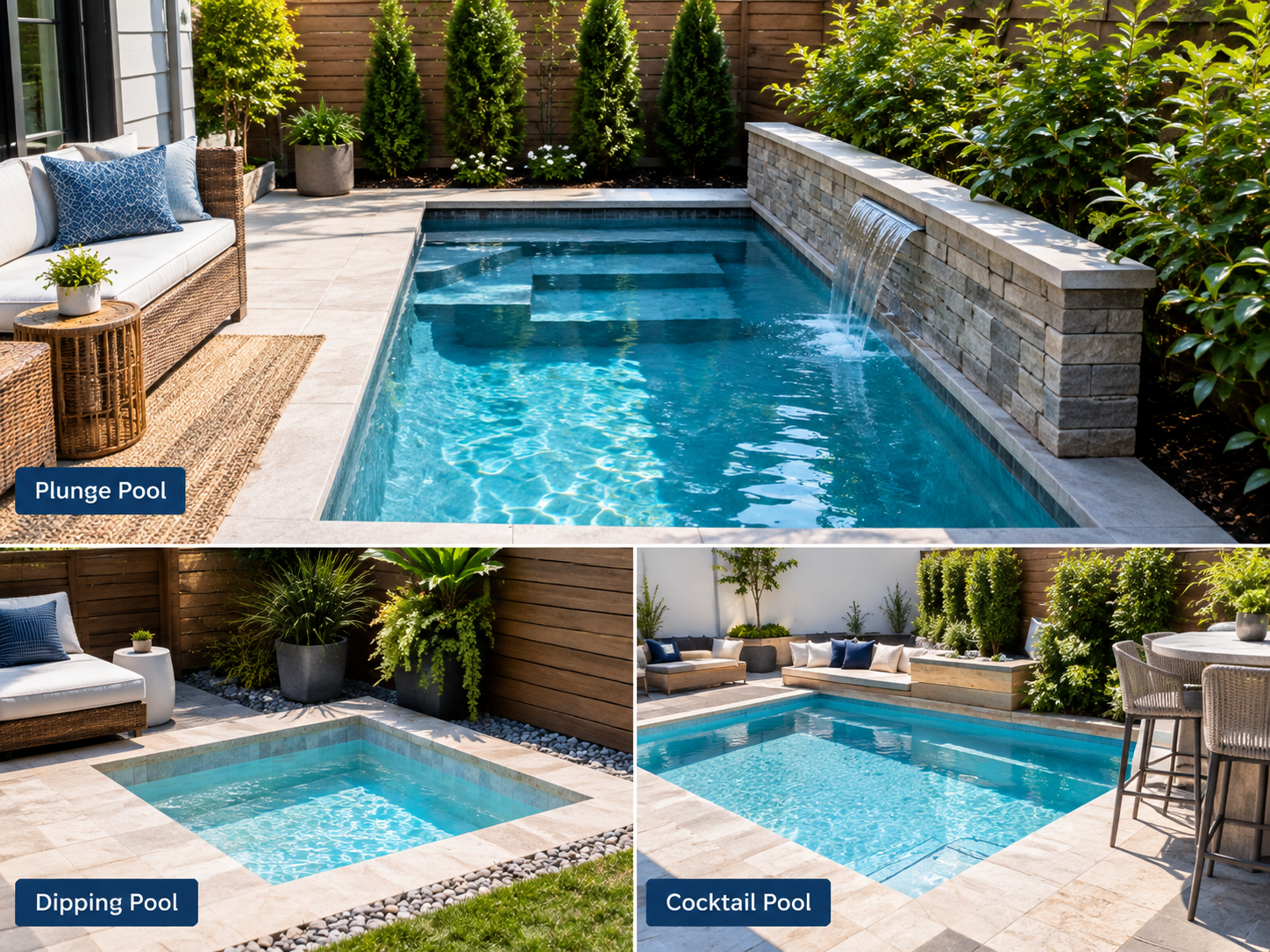
A plunge pool is small and deep (roughly 4 to 7.5 feet) and built for cooling off. A dipping pool is shallow (about 2 to 3 feet) and built for wading and lounging. A cocktail pool sits in the middle (about 3 to 4 feet) with built-in seating, made for entertaining. All three fit yards where a full-size pool will not. For a custom gunite version, plan on roughly $30,000 to $75,000 for the pool alone, before decking, fencing and landscaping. Prefab fiberglass and vinyl can come in lower. We checked the numbers below, because a lot of the prices floating around online don’t hold up.
If your yard is tight, narrow, sloped or just plain awkward, you probably figured a pool was off the table. It usually isn’t. Small pools are one of the fastest growing ways to get real water into a real backyard, and the three names you keep seeing (plunge, dipping and cocktail) all point to the same idea with different personalities.
This guide explains the differences in plain language, shows what each one costs (and whether those costs are actually fair), and helps you pick the one that fits your yard, your budget and how you plan to use it.
What You’ll Learn in This Guide
- What a plunge pool, dipping pool, cocktail pool and spool really are
- How deep, how long and how heated each one usually is
- How much yard space you need (and what quietly eats it)
- What small pools cost in 2026, and a technical check on those numbers
- What it costs to own one after the build
- Gunite vs fiberglass vs vinyl for tight spaces
- Design tricks that make a small pool feel bigger
- Quick answers to the questions people search most
- How Blue Haven designs and builds compact pools
What Counts as a Small Pool?
There is no official rulebook. The pool industry doesn’t rigidly define “compact,” and one builder’s dipping pool is another builder’s plunge pool. As a working rule, most small pools run about 8 to 20 feet long and 6 to 10 feet wide. Anything in that zone is a good candidate for a tight yard.
Here’s the thing most articles skip: the names matter less than two numbers. Depth and water temperature are what you’ll feel every single time you get in. So when you compare designs, ask about those two first.
Plunge Pool vs. Dipping Pool vs. Cocktail Pool vs. Spool
The quick comparison
| Pool type | Typical size | Typical depth | Heated? | Best for | Laps? |
|---|---|---|---|---|---|
| Plunge pool | 8 to 12 ft long | 4 to 7.5 ft | Rarely, sometimes chilled | Cooling off fast, soaking, light water exercise, cold plunge | No |
| Dipping pool | 12 to 20 ft long | 2 to 3 ft | Usually | Wading, kids, tanning, quiet soaking | No |
| Cocktail pool | 10 to 16 ft long | 3 to 4 ft | Usually | Entertaining, sitting, drinks with friends | No |
| Spool | 10 to 16 ft long | 3 to 4 ft | Yes | Jets, hydrotherapy, swimming in place | Swim in place only |
Sizes and depths come from Blue Haven’s own design experience and from published guides. Other sources give slightly different ranges, which is normal for this category.
Rule of thumb: the deeper it is, the colder it stays. The shallower it is, the longer you’ll sit in it.
What is a plunge pool?
A plunge pool is a small, deep pool made for a quick, refreshing dip. You get in, you gasp a little, you feel great, you get out. Most are deep enough to stand in up to your neck, which is why they’re popular for cooling off and for gentle, low-impact exercise like water walking.
Most plunge pools skip the heater. Some go the other way and add a chiller that holds the water around 40 to 60 degrees Fahrenheit, which is why the cold plunge crowd has claimed this style. You can’t swim laps in one, and diving is never a good idea in a pool this size.
What is a dipping pool?
A dipping pool is the shallow cousin. Same idea, less depth. You’re wading, not submerging. At about 2 to 3 feet deep, toddlers can stand, grandparents can step in without a whole ladder situation, and the dog will claim it as his within minutes.
Dipping pools are often heated and pair really well with a tanning ledge, which turns the whole thing into an outdoor daybed that happens to be full of water. A square or rectangle uses a tight yard most efficiently, though freeform shapes work fine if your yard has curves to work around.
What is a cocktail pool?
A cocktail pool is shallow water with a built-in seating plan. Think 3 to 4 feet deep, bench seating, a drink within arm’s reach. A plunge pool is for cooling off. A cocktail pool is for staying put.
This is the style where looks matter most. Cocktail pools tend to get the water features, the interesting tile, the integrated landscaping and the lighting. Put one next to your grill and the patio stops being a place people walk through on the way to the house. For a deeper dive, read our guide: What Is a Cocktail Pool? Size, Depth, Real Costs, and Whether It Is Worth It.
What is a spool?
“Spool” is a mash-up of “spa” and “pool.” It’s about the size of a cocktail pool, with spa-style jets, a heater and often a swim jet that creates a current you can swim against. You get hydrotherapy for a sore back, or a real workout in a pool that’s shorter than your car. Some have both jets, though most pick a lane.
A spool is also small enough that heating it through the cooler months won’t wreck your utility bill, which can’t be said for a full-size pool.
A note on the names
Plunge, dipping, cocktail and spool get used interchangeably online, even by pros. Don’t get stuck on the label. Tell your designer how you want to use the water, how deep you want it and whether you want it warm or cold, and let the design follow. You can also read our side-by-side breakdown here: Plunge Pool vs. Cocktail Pool vs. Dipping Pool vs. Spool.
Which Small Pool Fits You? A Simple Decision Table
| If this sounds like you | Lean toward |
|---|---|
| “I want a cold dip after a hot day or a workout.” | Plunge pool |
| “I want a chilled cold plunge at home.” | Plunge pool with a chiller |
| “I have toddlers or older family members.” | Dipping pool |
| “I want to sit with friends and a drink.” | Cocktail pool |
| “I want warm water, jets and a spa feel.” | Spool or cocktail pool with an inside spa |
| “I want something resembling exercise in a small space.” | Spool with a swim jet, or a narrow lap pool |
| “I want the lowest cost and don’t care about shape.” | Prefab fiberglass or vinyl (we’ll be honest about this below) |
| “My yard is oddly shaped, sloped or hard to access.” | Custom gunite design |
Not sure yet? Take the 2-minute pool style quiz or try the pool design tool to see a pool in your own yard.
How Much Yard Do You Actually Need?
Less than you think, but more than the pool itself. A small pool needs room for four things: the water, a deck around it, the equipment pad, and the legal setbacks.
The three limits that decide if your yard works
1. Setbacks
Setbacks are the minimum distances a pool must sit from property lines and your house. They vary by town. One New Jersey township, for example, requires inground pools to sit at least 7 feet from property lines and 5 feet from the main building. Yours may be stricter or looser, so never assume. Check.
2. Equipment access
Excavators, dump trucks and gunite rigs need a way in. A gate around 10 feet wide is a common comfortable minimum. Narrower side yards, AC units and gas meters can be worked around, but expect smaller machines and more hand labor, and that adds cost. Access is the biggest hidden factor in small yard pricing.
3. Deck and safety space
A pool with no room to walk, sit or set a towel down isn’t much fun. Plan at least a few feet of deck on the sides you’ll actually use, plus space for a safety barrier if your local code requires one.
Sizing guide for compact yards
| Pool style | Typical size | Water surface | Footprint with a 4 ft deck on all sides |
|---|---|---|---|
| Small plunge pool | 8 x 12 ft | 96 sq ft | 16 x 20 ft, or 320 sq ft |
| Cocktail pool or spool | 10 x 16 ft | 160 sq ft | 18 x 24 ft, or 432 sq ft |
| Compact family pool | 10 x 20 ft | 200 sq ft | 18 x 28 ft, or 504 sq ft |
| Largest typical “small yard” pool | 12 x 24 ft | 288 sq ft | 20 x 32 ft, or 640 sq ft |
A good guideline is to keep the pool to roughly one third of your usable yard so you still have room for the deck, equipment and setbacks. Blue Haven’s own backyard guidance puts the rough minimum usable space for an inground pool around 500 square feet, but your lot shape changes that. Read more in our backyard space considerations FAQ and our guide to inground pools for small backyards.
How much water are we talking about?
A 10 x 16 cocktail pool at 3.5 feet average depth holds about 4,200 gallons. A full-size 16 x 32 pool at 5 feet average depth holds about 19,000. That’s roughly a fifth of the water, which is why small pools need fewer chemicals, heat faster and clean up quicker.
How Much Does a Small Pool Cost in 2026?
This is the part most articles get wrong, so we slowed down here.
Blue Haven doesn’t publish one national “average price” for a custom pool, and that’s on purpose. Soil, access, labor, permits and your local market all change the number. The ranges below come from third-party sources and our own planning math. They’re for budgeting only, not a quote. The only way to get a real number is a site visit, which we cover at the end.
What other sources say (and what each probably covers)
| Source | What it reports | What it likely covers | Our technical read |
|---|---|---|---|
| Bob Vila (built on Angi and HomeAdvisor data, published 2022) | $10,000 to $50,000, average $20,000. Concrete $20,000 to $35,000+, vinyl $10,000 to $18,000, fiberglass $10,000 to $22,000 | Mostly prefab and vinyl, basic installs | Useful structure, but the data is four years old. Costs have risen since, so treat it as a floor, not a target. |
| Aiper plunge pool guide | Average about $28,000, most between $10,000 and $40,000 | Mix of prefab, vinyl and small concrete | Plausible for prefab and vinyl. Not a gunite number. |
| Latham Pool | Inground pools “typically start around $35,000” | Fiberglass and vinyl from a manufacturer | A realistic starting point for those materials, but “starts at” is not “typical,” and it isn’t specific to plunge pools. |
| Yardzen | $25,000 to $70,000+. Prefab shells $20,000 to $50,000, then $10,000 to $40,000 more for installation. Custom concrete up to $80,000 to $100,000 | Landscape projects with real installs | Best source for showing that the shell is only part of the bill. |
| HomeAdvisor figures (via Blue Haven’s cocktail pool guide) | $5,500 to $50,000, average about $22,650 | Everything from kits and stock tanks to gunite | The average blends cheap kits with real builds, so it’s too low for a finished custom gunite pool. |
Is that cost actually good? A technical check
Let’s think about these numbers like an engineer, not a marketer.
Check 1: “Starts at $10,000” usually means a shell or a kit
A pool shell isn’t a pool. Add the crane or excavator, grading, plumbing, electrical bonding, equipment, permit, startup and decking, and the total jumps. Yardzen says it plainly: installation can add $10,000 to $40,000 on top of a prefab shell. If a quote looks too good, ask exactly what’s included.
Check 2: The per square foot trap
Some guides quote gunite at about $82 to $120 per square foot. Do the math on a 10 x 16 cocktail pool (160 square feet) and you get $13,120 to $19,200. That is far below what a finished, permitted gunite pool costs, because a big chunk of pool cost is fixed. Permits, engineering, excavation setup, plumbing, electrical and equipment don’t shrink just because the pool does.
Check 3: The labor numbers don’t always agree
Some cost guides say labor is 25 to 50 percent of a pool project. But one widely used table shows $1,650 of labor on a $22,650 average, which is only about 7 percent. Both can’t be right. This is exactly why you want a line-by-line estimate and not a single total.
Check 4: “Cheaper than a full-size pool” is only half true
In total dollars, yes. Per square foot, usually no. Here’s the math using planning ranges:
| Pool | Water surface | Pool-only cost | Cost per sq ft |
|---|---|---|---|
| 8 x 12 plunge | 96 sq ft | $30,000 | about $313 |
| 8 x 12 plunge | 96 sq ft | $50,000 | about $521 |
| 10 x 16 cocktail | 160 sq ft | $30,000 | about $188 |
| 10 x 16 cocktail | 160 sq ft | $50,000 | about $313 |
| 10 x 16 cocktail | 160 sq ft | $75,000 | about $469 |
| 16 x 32 full-size | 512 sq ft | $60,000 | about $117 |
| 16 x 32 full-size | 512 sq ft | $100,000 | about $195 |
Planning ranges, not quotes. The full-size range reflects the $60,000 to $100,000+ that most inground gunite pools run, per Blue Haven.
So you’re buying a smaller pool and a smaller bill, but you’re paying more for every square foot of water. That’s not a reason to skip a small pool. It’s a reason to spend your budget on the features you’ll use.
Check 5: Old numbers age badly
If an article quotes figures from 2022 or earlier and calls them current, that’s a flag. Labor, concrete, steel and equipment have all moved since then.
So what’s a fair price?
Here are our planning ranges by build type, built from the sources above. Pool only, before decking, fencing and landscaping.
| Build type | Published or planning range | Reality check |
|---|---|---|
| DIY kit or stock tank | About $600 to $5,000 | Shell only. Not a permanent inground pool. Plumbing, power, permits and safety are extra. |
| Vinyl liner plunge or dipping pool | $10,000 to $18,000 in older data | Lowest upfront cost, but the liner is replaced every 5 to 15 years at about $3,000 to $7,500. |
| Prefab fiberglass | $20,000 to $50,000 for the contractor estimate, plus installation extras | Fast install, but fixed shapes and a width cap near 16 feet. Needs crane access. |
| Custom gunite or concrete | About $30,000 to $75,000 pool only. Top-of-the-line builds reach $80,000 to $100,000 | Any shape, depth or feature. Built on site, so it fits odd and sloped yards. |
Our verdict: A $35,000 to $50,000 quote for a small inground pool can be a good deal if the scope is clear and includes the permit, excavation, equipment, finish and startup. It’s a red flag if major items are missing or the builder can’t explain the gap. In many markets, a custom gunite pool well under about $30,000 deserves extra questions. And a $60,000 to $75,000 quote that clearly includes everything can easily be the better value than a cheap quote with a long list of add-ons later.
What add-ons cost
These figures were published in 2022 (heater figures are from a 2026 guide), so use them as a floor.
| Add-on | Published cost |
|---|---|
| Inside spa (built within the pool) | $3,500 to $15,000 for a spa system |
| LED pool light | $800 to $1,200 each |
| Deck jets or bubblers | $800 to $1,200 |
| Gas heater | $1,500 to $5,000 installed |
| Electric heat pump | $3,000 to $8,000 installed |
| Automation system | $1,500 to $2,600 |
| Swim jet (swim in place) | From about $2,000 |
| Pool cover | $100 to $2,400 |
| Permit | $200 to $1,800, depending on city and county |
| Excavation and site prep | $400 to $5,000, much more with poor access |
| Infinity edge upgrade | $25,000 to $50,000 |
Tip: an inside spa built within your pool’s footprint is usually the most economical way to add a spa, compared to a freestanding one.
What it costs to own a small pool
| Ongoing cost | Planning range | Notes |
|---|---|---|
| Chemicals | About $175 to $750 per year | Less water means less chemicals, but not none. |
| Professional service | About $80 to $150 per month | Many owners do it themselves. |
| Heating with a heat pump | About $50 to $150 per month | Small volume heats faster. |
| Heating with gas | About $150 to $400 per month | Heavily depends on use and climate. |
| Resurfacing a small gunite pool | About $6,000 to $10,000 every 10 to 15 years | Longer-lasting finishes cut this. |
| Insurance increase | About $50 to $100 per year | Varies by carrier. |
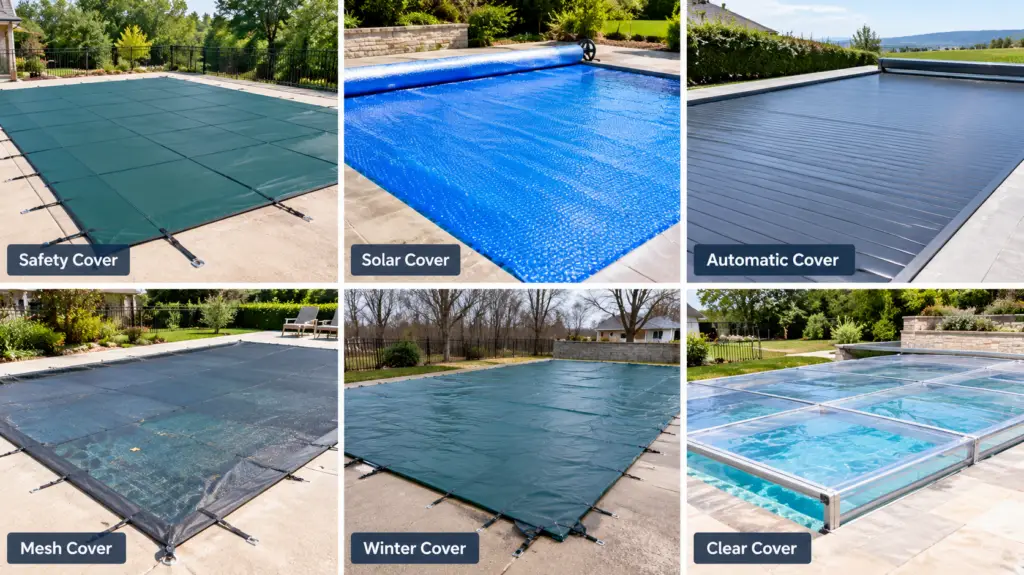
Variable-speed pumps, LED lighting, heat pumps and an automatic cover make a real difference. Our SmartFeatures pool equipment page shows what’s available, and these guides help stretch your swim season: keeping your pool warm in winter, the most efficient pool temperature and types of pool covers.
Questions to ask before you sign any quote
- Is this price turn-key? What’s not included?
- Who handles permits and inspections?
- Are excavation, crane and site prep in the number?
- What do the finish and deck cost, and when will they need replacing?
- What are the warranties on the structure, the finish and the equipment, in writing?
- Can I see a similar pool you built ten or more years ago?
- How do you handle my soil, slope and water table?
A builder who answers these clearly usually stands behind the work. Want a deeper look at what drives price? See our inground pool pricing guide.
Gunite vs. Fiberglass vs. Vinyl for a Small Yard
Honestly, there’s no single winner. Here’s how each one behaves in a tight space.
| Factor | Gunite (concrete) | Fiberglass | Vinyl liner |
|---|---|---|---|
| Shape freedom | Any shape, size or depth | Set by manufacturer molds | Fairly flexible |
| Odd or sloped lots | Excellent | Limited | Good |
| Delivery | Built on site, no giant shell to lift in | Shell arrives whole, often needs a crane and a clear path | Panels and liner built on site |
| Width limit | None | Typically around 16 ft | None |
| Typical build time | About 8 to 16 weeks | About 2 to 4 weeks | About 3 to 6 weeks |
| Upfront cost | Higher | Mid-range | Lowest |
| Lifespan | 50+ years for the structure, with care | 20 to 30+ years | 20 to 25 years, with liner replacements |
Our honest take: If your yard is a clean rectangle with easy access, and you want a simple pool fast and cheap, fiberglass or vinyl can make sense. We build gunite, but we’ll say so when something else fits better. If your yard has an odd shape, a slope, tight access, or you want a built-in ledge, spa, bench or water wall, gunite is usually the better fit because the pool is built around your yard instead of the other way around. Compare in detail here: Gunite vs. Fiberglass Pools, Fiberglass vs. Concrete Pools and what a gunite pool is.
Design Tricks That Make a Small Pool Feel Bigger
Compact doesn’t mean basic. A few moves do most of the heavy lifting.
- Keep the geometry clean. Line one pool edge up with a fence, wall or patio. This avoids awkward leftover strips of lawn. Browse rectangle pools and geometric pools.
- Build in, don’t add on. Tanning ledges, benches and loveseats and sun shelves give you lounging space without eating yard.
- Go vertical with water. Waterfall cascades, bubblers and deck jets add sound and movement in about two feet of space.
- Light it up. Pool lighting and color-changing LEDs are the cheapest way to make a small pool look intentional after dark. Add fire bowls for a resort feel.
- Add an inside spa. Yes, it fits in a cocktail or dipping pool. See interior spas and gunite spas.
- Plan privacy early. Hedges, screens, pergolas and raised planters help a small pool feel like a private retreat.
- Pick only two or three features. Too many in a tiny pool gets crowded fast.
- Make the deck work. In a small yard, the deck can cost almost as much as the pool. Get ideas from our unique pool deck designs.
Blue Haven’s Courtyard pool style is built for exactly this: walled gardens, urban lots and homes where every square foot counts.
Heating, Cold Plunging and Year-Round Use
Water volume is the whole story here. Less water means less energy to warm it, which is why shallow pools like dipping and cocktail designs are so often heated. A spool with spa jets can be enjoyed in cooler months, and the right cover helps keep heat in.
Plunge pool vs. cold plunge tub
These get mixed up constantly. A plunge pool is a permanent, built-in pool, usually unheated or lightly chilled, for cooling off. A cold plunge tub is a small vessel designed to hold water at very low temperatures for recovery routines. If you want true cold therapy, a plunge pool with a chiller that holds 40 to 60 degrees is the permanent upgrade to the stock tank in your garage. If you’re managing a health condition, check with your doctor before cold or hot water routines.
Want warm water too? A spool or a pool with an attached spa gives you both options in one footprint. Here’s how hydrotherapy works: 5 physical benefits of warm water. And for low-impact movement in a small pool, try these swimming pool exercises.
Permits, Safety and Timeline
Do you need a permit for a small pool?
Almost always, yes. Even small inground pools need permits, inspections and code compliance. At Blue Haven, your local team handles permitting, inspections and code compliance for you.
Safety comes first
Shallow doesn’t mean risk-free. Most areas require a barrier around inground pools, and the details differ by town. Self-closing, self-latching gates, covers and slip-resistant decking all help. Never dive into a small pool. If you have kids or pets, read our dog pool safety tips and talk to your builder about layered protection.
How long does it take?
- Design, permitting and site prep: varies by town and season
- Construction: Blue Haven pools are typically completed in 8 to 14 weeks once construction begins, some in as little as 70 days
- Fiberglass comparison: the shell can go in within days, but the full project (deck, equipment, landscaping) still takes several weeks
People Also Ask: Quick Answers About Small Pools
What is the difference between a plunge pool, a dipping pool and a cocktail pool?
Depth and purpose. A plunge pool is deep (about 4 to 7.5 feet) and made for cooling off. A dipping pool is shallow (about 2 to 3 feet) for wading and tanning. A cocktail pool is in between (about 3 to 4 feet) and made for sitting and socializing. Names overlap in the industry, so describe how you want to use it.
Can you swim in a plunge pool?
Not laps. A plunge pool is too small for real swimming, but you can tread water, cool off, and do gentle water exercises. If you want to swim in place, add a swim jet or look at a spool or narrow lap pool.
How deep should a plunge pool be?
Most plunge pools run about 4 to 7.5 feet deep, depending on the source. About 4 to 5 feet works for sitting and standing, while 6 feet or more suits full submersion and exercise. Local code, soil and your height all play a part.
Is a plunge pool worth it?
If you’ll use it often and your yard can’t fit a full pool, usually yes. It costs less in total and less to run. It’s not worth it if you want laps, games or a big family swim space. A small pool still has real fixed costs, so choose the features you’ll actually use.
Does a small pool add value to your home?
It can, but there’s no universal figure. A well-designed custom pool is often seen as a premium feature, and a low-maintenance one appeals to practical buyers. Your market matters most, so ask a local real estate professional.
How many people fit in a cocktail pool?
A common planning rule is about 15 square feet of water per person. A 10 x 16 pool has 160 square feet, so around 10 people standing and socializing, and fewer for real swimming.
Plunge pool vs. hot tub: which is better?
A hot tub is a heated, jetted soak for a few people. A plunge pool is a cooler, deeper dip. If you want both in one, a spool or a pool with an attached spa gives you hot and cool in the same footprint. Hot tubs usually cost less upfront, while a built-in pool or spa is a permanent part of your backyard design.
Can you use a plunge pool in winter?
Yes, if it’s heated or has a spa attached. An unheated plunge pool is meant to be cold. Heat pumps, covers and a smaller water volume all help extend your season.
How Blue Haven Helps You Build the Right Small Pool
Reading comparisons is useful. But the right answer depends on your yard, your family and your budget, and that’s where an experienced builder earns the job. Here’s what Blue Haven brings to a compact pool project.
Experience you can count on
- Founded in 1954. More than 70 years of building pools in America.
- 300,000+ custom inground pools built nationwide.
- 60+ offices in 30+ states, so you get a local team that knows your soil, your climate and your permitting rules.
- 4.8 out of 5 stars from more than 10,000 verified reviews across Google, Yelp and Trustpilot.
- America’s #1-ranked pool builder, a position we’re proud of, backed by recognition like the PSN Top 50 Builders list, a BBB Trust badge and PHTA membership. See more on our About page.
Custom gunite construction for tight and tricky yards
Because gunite is built on site over a steel-reinforced frame, we can fit virtually any shape, depth or layout to your yard. That includes slopes, odd corners, narrow side yards and spaces between a fence, a house and a patio. Small yards often need a custom shape to work, and that flexibility is the whole point.
Design built around how you live
Every project starts with how you want to use your backyard. Pick the style that fits, whether that’s Courtyard for tight spaces, Retreat for quiet soaking, Entertain for hosting, Family, Active or Estate. Explore all of our new pool styles, or browse real projects in the Inspiration Gallery.
Space-saving features, built right in
We design ledges, benches, interior spas and vertical water features so you get a full backyard experience without needing a full backyard.
A clear process, step by step
- Free in-home design consultation. A local designer visits, studies your yard and talks through your goals and budget. No pressure, no obligation.
- Custom 3D design. You see your pool before any digging starts. You can also visualize a pool in your own yard in under 60 seconds with the address tool on our home page.
- Permits and approvals. We manage applications, inspections and code compliance.
- Construction. Our crews build the pool and keep you updated at each milestone.
- Final walkthrough and first swim. We go through every feature before handing over the keys.
Pro tip for small yards
Ask your designer to show two layouts: one with a deck on a single side, and one with a full wrap-around deck. The difference in how the yard feels (and what it costs) is often surprising.
Smart equipment that lowers running costs
Our SmartFeatures line includes SmartControls automation, SmartLight LED lighting and SmartPure sanitizing, plus SmartBrite ColorQuartz finishes built to resist chipping, etching and staining. Smart equipment keeps small pool upkeep simple.
Honest pricing
We don’t guess a price from a website. A designer visits your home, reviews your goals and budget, and gives you a written estimate based on your actual yard. That’s the only way to account for access, soil, grade and local costs. Read how it works on our pool pricing page.
Financing that fits
Financing is available for qualified buyers, with flexible options and unsecured choices in many states, subject to credit approval. Explore financing your pool, use the pool loan calculator or start a loan pre-approval.
Already have a small pool or spa?
Our remodel team handles resurfacing, tile and coping, decks, equipment upgrades, water features and full redesigns. See our pool remodeling services and why fall is a great time to remodel.
What homeowners say
Families across the country have shared their Blue Haven stories, from the Reyes family in Tampa to Christine in Charleston. Read their words on our About page. Every yard is different, so your result will be its own.
Ready to see what fits your yard?
- Get a free estimate and 3D design
- Find your local Blue Haven team
- Take the 2-minute pool style quiz
- Order a free pool brochure
- Contact us or call 1-800-BLUE-HAVEN
Frequently Asked Questions
How much does a plunge pool cost?
Published ranges run from about $10,000 to $70,000+, depending on material, size and features. Prefab vinyl and fiberglass sit at the lower end. A custom gunite plunge pool is more often $30,000 to $75,000 for the pool alone, before decking and fencing. A written estimate after a site visit is the most accurate way to know your number.
What is the cheapest type of small inground pool?
Vinyl liner is usually lowest upfront, then fiberglass, then gunite. But the liner needs replacing every 5 to 15 years, so the cheapest option on day one isn’t always cheapest over time.
What is the smallest inground pool you can build?
Plunge and cocktail pools can be as small as about 8 x 12 feet. Many builders consider 10 x 16 or 10 x 20 feet the smallest practical size for a pool you’ll really use. With gunite, the size is flexible and can be adjusted to fit your lot.
Can you put an inground pool in a small backyard?
Yes, if your yard meets local setback rules and equipment can get in. Gunite is especially flexible because it’s built on site and can be shaped to tight or odd spaces.
Do I need a permit for a plunge or cocktail pool?
In most areas, yes. Permits and inspections are usually required even for small inground pools. A builder with local experience can handle the paperwork.
Do small pools need a fence?
Most places require a code-compliant barrier around inground pools, regardless of size. Details vary by town, so check local rules or ask your builder.
Are plunge pools safe for kids?
They can be, with the right depth, a shallow ledge and proper barriers. Shallow water still carries risk, so supervision, covers and self-latching gates matter.
How long does it take to build a small pool?
Blue Haven pools are typically completed in 8 to 14 weeks once construction begins, with some finished in as little as 70 days. Design, permitting and site prep come first. Fiberglass shells install faster but the whole project still takes several weeks.
Can I add a spa to a small pool?
Yes. An inside spa built within the pool footprint is often more affordable than a separate freestanding spa, and it saves yard space.
Can I do a plunge pool as a DIY project?
Above-ground kits and stock tanks are common DIY projects, but an inground pool is rarely a good DIY job. Leaks, poor structure and electrical safety problems can cost far more to fix than you saved up front.
Is a small pool cheaper to maintain?
Generally yes. Less water means fewer chemicals, faster heating and quicker cleaning. Smart equipment such as variable-speed pumps and LED lighting lowers costs further. You still need regular testing and seasonal care.
Gunite or fiberglass for a small yard?
Fiberglass is quicker and fine for simple shapes with easy access. Gunite is better for odd shapes, slopes, tight access and built-in features like ledges and spas.
Can I finance a small pool?
Yes, many homeowners do. Blue Haven offers financing for qualified buyers, subject to credit approval. Use the pool loan calculator to estimate payments.
Does Blue Haven build small or compact pools?
Yes. Blue Haven builds custom gunite pools in many sizes, including plunge pools, cocktail pools and Courtyard designs for smaller yards. Contact your local team to see what fits your space.
Final Thoughts
A small backyard isn’t a dead end. It just means every inch has to earn its place, and that’s where good design really shows. Know your setbacks, be honest about access, compare quotes by scope and not just price, and pick a builder who can show you the pool in 3D before a shovel hits the dirt.
Ready to see what your yard can become? Start your free design consultation with Blue Haven.
Cost figures were reviewed in October 2026. Ranges are for planning only and are not a Blue Haven quote. Final costs depend on site conditions, design and local market, so always review a written estimate from a licensed builder.