
Yes, you can build an inground pool on a sloped or hilly lot. Most sloped projects need a mix of grading, a retaining wall or terracing, and a proper drainage plan. In our working estimates, a gentle slope adds roughly $3,000 to $12,000, a moderate slope adds roughly $12,000 to $50,000, and a steep hillside can add $45,000 to $120,000 or more on top of the pool itself. Gunite (custom concrete) is usually the most flexible pool type for hills because it is built in place and shaped to the land.
A slope scares a lot of homeowners off. They look at the yard, see the grade falling away from the deck, and assume a pool is out of the question. It usually isn’t. Sloped lots are some of the most dramatic pool sites out there, with views, layered decks and sometimes a vanishing edge that just works.
But a slope does change the job. It changes the engineering, the budget and the order of construction. This guide walks through all of it in plain language, including a cost reality check of what other articles claim, so you can tell a fair quote from a padded one.
Key Takeaways
- A slope is a site condition, not a deal breaker. The real question is how much dirt has to move and what has to hold it back.
- The retaining wall is normally the biggest single cost variable on a sloped lot.
- Drainage matters more on a hill than on flat ground. Water coming downhill is the enemy of walls, decks and pool shells.
- Walls over about 4 feet usually need a structural engineer’s stamp in many jurisdictions, so plan for it early.
- Many cost guides online are wrong or misleading for slopes. We checked the numbers below.
- The cheapest design on paper is not always the cheapest once you add soil testing, compaction and settlement risk.
Can You Build an Inground Pool on a Slope or Hill?
Yes. Builders put pools on slopes every day. The slope just decides how the pool gets built, not whether it can be.
There are four basic ways to handle a grade change:
- Cut into the hill so the pool sits in the ground.
- Fill the low side to build up a level pad.
- Balance cut and fill, using the dirt you dig out to build the pad.
- Terrace the yard into levels, usually with retaining walls.
Most real projects use two or three of these together. Which mix makes sense depends on slope steepness, soil, drainage, access for equipment, and where you want the pool relative to the house.
How Steep Is Too Steep for an Inground Pool?
There isn’t one magic number, and anyone who gives you a single percentage without seeing your yard is guessing. Soil type, rock, water table and local code matter as much as the angle. Still, this table gives you a useful starting frame.
| Slope type | Approx. drop across the pool area | What it usually means | Retaining wall needed? |
|---|---|---|---|
| Gentle | Up to about 3 feet | Regrade, small fill pad, swale or drain | Often no, sometimes a low wall |
| Moderate | About 4 to 8 feet | Cut and fill, one or two walls, engineered drainage | Usually yes |
| Steep | More than 8 feet | Tall engineered walls, shoring, soil report, terracing | Yes, engineered |
These are planning guidelines, not code. Some builders say a drop over roughly 2 feet is where walls start entering the conversation, and over 4 feet it becomes a serious structural project.
How do you measure your slope? Stake a string level between the highest and lowest points of the future pool area, then measure the vertical drop from the string to the ground at the low end. That drop, in feet, is the number your designer cares about most. Don’t worry about being exact, an on-site visit will confirm it.
Which Direction Does Your Slope Run? It Changes the Plan
Not every slope is the same. Where the hill sits compared to your house changes the cost and the design more than most people expect.
Pool on the High Side (Yard Slopes Down and Away From the House)
This is often the easier setup. The ground falls away, so you can usually build the pool up on the downhill edge, sometimes with the pool wall itself acting as part of the retaining system. One homeowner on a popular pool forum noted that neighbors on the top of a hill skipped the retaining wall entirely because the slope fell away from their home. It isn’t a rule, but it shows how direction matters.
Pool at the Bottom of a Hill (Yard Slopes Down Toward the House)
This is the tougher one. Now the hill above the pool pushes soil and water toward it. You need to hold the hill back and manage runoff carefully. Builders call the extra push from the hillside a “surcharge load,” and it can mean the pool shell and walls must be designed to take that pressure.
Side Slope (Ground Falls Left to Right)
Common on lots that follow a hillside road. You often end up with a wall on one side and open drop-off on the other, which also affects fencing and safety barriers.
Design Options for a Pool on a Sloped Lot
Option 1: Cut Into the Hill
You excavate the high side so the pool sits in the slope. This keeps the pool on undisturbed native soil, which is generally the most stable base. The tradeoff is that you create a wall of exposed earth on the uphill side that must be retained, and you have a lot of excess dirt to deal with.
Option 2: Build Up With Fill
You bring in or reuse soil to raise the low side into a level pad. It can be cheaper than a tall wall, and one homeowner reported that fill cost about a quarter of what retaining walls would have, while also giving more usable yard. But fill under or next to a heavy, rigid concrete pool is a real engineering issue. It has to be placed in controlled layers and compacted, and your engineer may want soil testing. Loose fill settles, and settling pools crack.
Option 3: Cut and Fill Balance
The classic approach. Dirt from the cut side builds the fill side, which trims hauling costs. It works best when the soil is good and the site is large enough to manage. Honestly, it’s where an experienced crew earns its money.
Option 4: Retaining Walls
A retaining wall holds back the grade and creates a flat pad for the pool, patio and seating. It’s the most common solution on moderate and steep slopes.
Common Retaining Wall Materials
| Material | Typical installed cost per sq ft of wall face | Good for | Watch out for |
|---|---|---|---|
| Pressure-treated timber | About $10 to $25 | Low walls, tight budgets | Shorter lifespan, not ideal for tall walls |
| Interlocking concrete block | About $12 to $30 | Walls under roughly 4 feet, curved layouts | Taller walls need reinforcement and engineering |
| Poured concrete | About $16 to $60 | Tall and structural walls, clean modern look | Skilled forming, cure time, drainage still required |
| Natural stone | About $20 to $55 (higher for premium stone) | Premium appearance | Slow, skilled labor |
| Engineered structural walls | About $40 to $100+ | Steep sites, tall walls, heavy loads | Needs engineering, footings, often soil report |
Sources disagree on exact numbers, so the ranges above overlap what several 2026 cost guides publish. Always ask whether a quote is per square foot of wall face or per linear foot.
Why a Poured Concrete Wall Often Pairs Well With a Pool
A concrete wall can be poured together with the pool deck, which can lower cost compared to a separate block wall and gives you a cleaner finished edge.
Quick Math You Can Do Yourself
Wall length times wall height gives you square feet. A wall 50 feet long and 5 feet tall is 250 square feet. At $25 per square foot that’s $6,250, and at $60 per square foot it’s $15,000. That’s before drainage, footings, engineering and finishing, so treat it as a floor, not a total.
Option 5: Terraced, Multi-Level Design
Instead of one big wall, you step the yard down in levels. Terraces can look beautiful and use shorter walls, which are easier to build and often cheaper per wall. A spa can sit on an upper terrace and spill into the pool, with seating or a fire feature below. For ideas on layered decks and surfaces, see our post on unique swimming pool deck ideas and designs.
Option 6: Raised Pool With a Built-In Wall
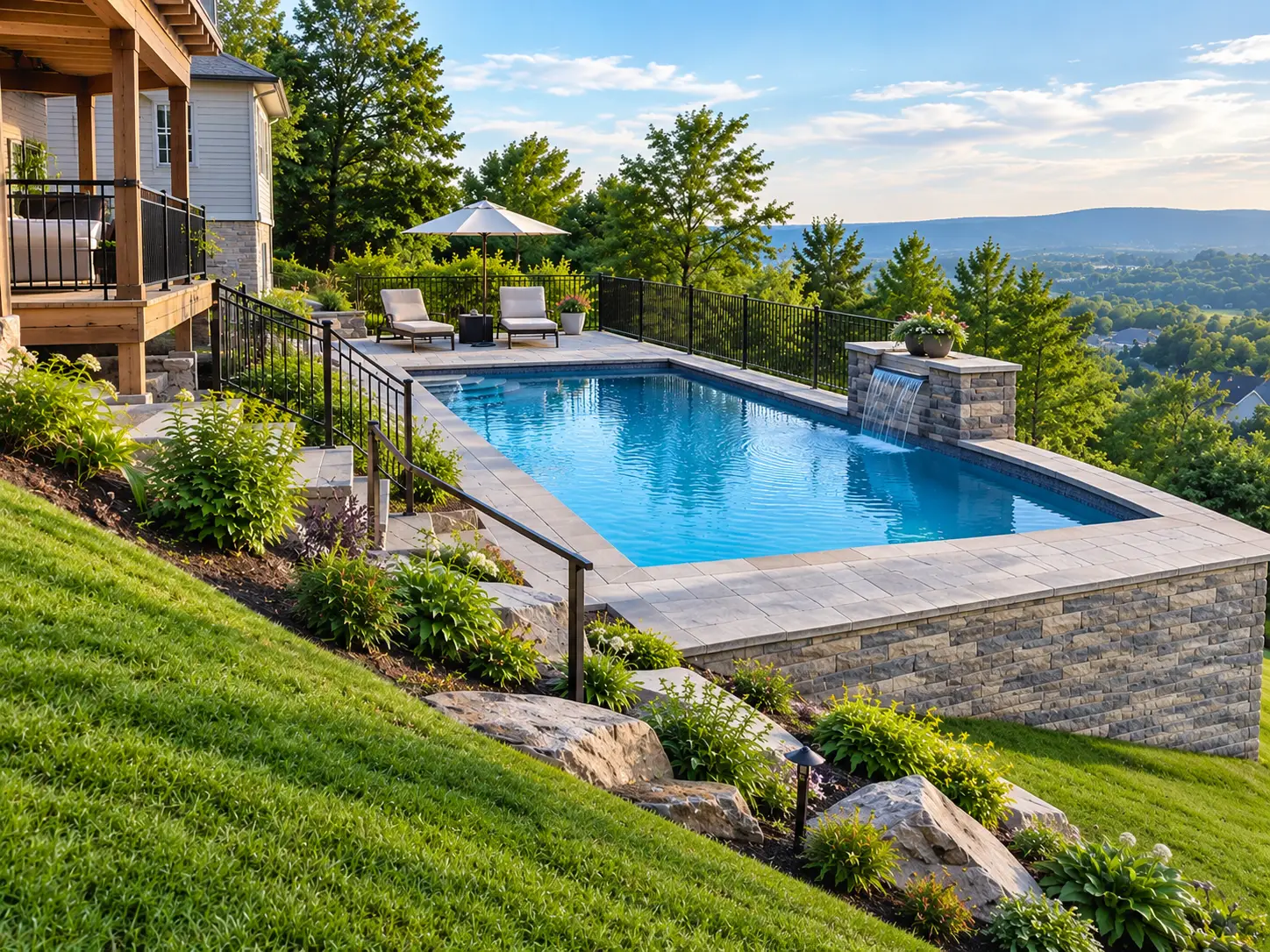
On the downhill side, the pool wall can be built up so the pool sits partly above grade. The pool structure itself becomes part of the retaining system, and you can face it with stone or tile for a finished look. This is a good fit for homes where the pool is on the low side of the deck and you want a view over the edge.
Option 7: Vanishing Edge (Infinity) Design
If your lot falls away to a view, a vanishing edge can turn the slope into a feature instead of a problem. It does add structural and plumbing complexity, since there’s a catch basin and extra equipment. Take a look at our Estate pool designs for the kind of high-end, architectural look this approach delivers.
The Engineering Side: What Happens Below the Surface
This is the part most glossy articles skip, and it’s the part that decides whether your pool is still in one piece in 15 years.
Soil and Geotechnical Testing
On slopes, soil isn’t just “dirt.” Clay, sand, rock and fill all behave differently. A soil report tells the engineer how strong the ground is, how it drains, and whether the hillside itself is stable. If the whole slope above your wall is unstable, even a perfect wall can slide with it.
Hydrostatic Pressure and Surcharge
Two forces matter. Hydrostatic pressure is water in the soil pushing on walls and the pool shell. Surcharge is the extra weight and push from the hillside above. Good design accounts for both, and good drainage reduces the first one a lot.
Drainage Is Not Optional
Water running over the top of a retaining wall, or sitting in the soil behind it, is one of the most common reasons walls fail. A solid drainage plan usually includes:
- Gravel backfill behind walls
- Perforated drain pipe that leads water away
- Swales or surface drains to redirect runoff from above
- Area or trench drains around the deck
- Downspouts and roof runoff routed away from the pool zone
Groundwater and Draining Your Pool
On hillsides, groundwater can build up around a pool. An empty pool can be pushed upward by that water, so don’t drain a sloped-site pool without talking to your builder first.
Setbacks, Permits and Engineer Stamps
Many local codes limit how close you can build to the top or bottom of a slope, and many require an engineer’s seal for walls over 4 feet. Rules vary city by city and county by county. Your builder should handle permitting and inspections for you. If a builder shrugs this off, that’s a red flag.
Equipment Access
Excavators and concrete trucks need a way in. On steep or narrow lots, access can force smaller equipment, hand work, or pumping materials over long distances. All of that costs more. It’s worth walking the route with your designer before you sign.
Safety Barriers on Grade Changes
Most codes require a barrier at least 4 feet high around a pool. Barrier height is measured on the side where people walk, and a drop-off can quietly make a fence effectively shorter. A good designer plans walls, fences and gates together so the finished yard is both beautiful and safe.
How Much Does It Cost to Build an Inground Pool on a Slope?
Let’s be straight with you. Anyone who gives you one exact price for a sloped-yard pool without seeing your property is guessing. Even our own pool pricing page explains that site conditions like slope, soil and access can only be priced accurately in person. What we can do is give you honest, math-checked ranges so you know what to expect.
Where the Baseline Starts
On our site, we note that most inground gunite pools range from about $60,000 to $100,000 or more, depending on size, materials, features and site conditions. Independent 2026 guides land in a similar neighborhood, with many putting standard inground pools around $45,000 to $100,000 and custom concrete higher. Per-square-foot figures from This Old House run about $180 to $350 per square foot of pool area, which for a typical 12 by 24 foot pool (288 square feet) works out to roughly $52,000 to $101,000. The numbers agree with each other, which is a good sign.
Cost Reality Check: Do Other Articles Get Slope Costs Right?
We read what the top-ranking pages say about sloped yards, then checked the math against unit prices and basic construction logic. Here’s what held up and what didn’t.
| Claim you’ll see online | Does it hold up? | Why |
|---|---|---|
| “A slope adds only a few hundred to a few thousand dollars.” | Only for gentle slopes | True if you only regrade. Once a real retaining wall is needed, a 200 square foot wall alone is $5,000 to $12,000 at $25 to $60 per square foot. |
| “An inground pool costs $30 to $100 per square foot.” | No, far too low | A 12 by 24 foot pool at $30 to $100 would be $8,640 to $28,800, which is below what builders actually charge. This Old House cites $180 to $350. |
| “A retaining wall adds $7,000 to $20,000.” | Reasonable | Matches 4 to 6 foot walls of 100 to 300 square feet at normal 2026 unit prices, but can run light for tall engineered walls. |
| “Fill dirt and patio adjustments cost $1,000 to $4,000.” | Reasonable for gentle slopes | Fits small grade corrections where no wall is needed. |
| “Building on a slope adds $20,000 to $50,000.” | Misapplied | That figure comes from home construction, not pools. Our moderate tier overlaps it, but it shouldn’t be treated as a universal pool number. |
| “Drainage can eat 20 to 30 percent of the whole project.” | Overstated | On a $100,000 job that’s $20,000 to $30,000 for drainage alone. Typical grading and drainage runs about $2,000 to $10,000, with larger French drain and re-leveling jobs reaching $5,000 to $8,000 or more. Very wet, clay-heavy hillsides are the exception. |
| “Fill is a quarter the cost of retaining walls.” | Can be true, but incomplete | It ignores soil testing, compaction, engineering and the settlement risk of putting a rigid concrete shell on or near fill. |
The takeaway: the cheapest-looking number online is often the one that leaves out the expensive parts. Judge any figure by asking what it excludes.
Realistic Slope Add-On Costs by Severity
These are working estimates built from the unit prices above, not Blue Haven quotes. We derived them from wall length, height, per-square-foot pricing, excavation and drainage ranges, and engineering allowances.
| Slope tier | What’s typically involved | Slope-related add-on | Rough total with a $60,000 to $100,000 pool |
|---|---|---|---|
| Gentle (about 2 to 4 ft of fall) | Regrading, small fill pad or low wall, swale or drain | $3,000 to $12,000 | $63,000 to $112,000 |
| Moderate (about 4 to 8 ft) | Walls 4 to 6 ft tall, extra excavation and hauling, drainage, engineering | $12,000 to $50,000 | $72,000 to $150,000 |
| Steep (8 ft and up) | Tall engineered walls, shoring or piers, soil report, heavy drainage | $45,000 to $120,000+ | $105,000 to $220,000+ |
How we got the moderate tier: a wall from 4 ft by 40 ft (160 sq ft) up to 6 ft by 60 ft (360 sq ft) at $25 to $60 per square foot is about $4,000 to $21,600. Add drainage ($2,000 to $10,000), extra excavation and hauling (a few thousand up to roughly $15,000), and engineering (a few thousand dollars). That lands near $11,000 to $52,000, which we round to $12,000 to $50,000.
At the steep end, a published example puts a 60-foot, 6-foot-tall engineered poured wall around $25,000 to $55,000, and taller walls cost more. At that point it’s smart to ask whether a different pool location or a terraced layout makes more sense.
Where Hidden Costs Hide on a Slope
- Spoils removal: Digging into a hill produces a mountain of dirt that has to go somewhere, or be reused.
- Difficult excavation: Rocky or hard ground can push excavation from the typical $5,000 to $15,000 range to $15,000 to $30,000 or more. Ask about the “rock clause” in your contract.
- Tree removal: Roughly $385 to $1,070 per tree, and slopes often have trees that anchor the soil.
- Yard restoration: Heavy equipment leaves compacted clay subsoil. Few contracts include final landscaping, so budget for it.
- Erosion control: Silt fence, matting and seeding during construction.
- Fencing on grade changes: Barriers cost more when they have to step with the terrain.
- Soil and engineering reports: Small compared to the project, large compared to the surprise they prevent.
Is the Price You Were Quoted Actually Good?
A good price isn’t the lowest price. It’s the one where you can see exactly what you’re paying for. When you compare quotes, check these:
- Is the retaining wall priced by square foot of face or linear foot, and what height was assumed?
- Does the wall price include footings, drain pipe, gravel backfill, geogrid and engineering?
- Is excavation and spoils hauling included, and who pays if rock is hit?
- Is a soil or geotechnical report included or excluded?
- Who handles permits and inspections?
- Does the quote include final grading, drainage and yard restoration, or just rough grade?
- Is the fence or barrier included, and does it account for the slope?
If two quotes differ by $25,000 and one has no wall line item, the cheaper one isn’t cheaper. It’s just incomplete.
Smart Ways to Reduce Cost Without Cutting Corners
- Move the pool. Sometimes shifting it 15 or 20 feet to a flatter spot saves more than any material swap.
- Use shorter walls. Two 3-foot walls in terraces are often easier and cheaper than one 6-foot wall.
- Let the pool wall do double duty as part of the retaining system where engineering allows.
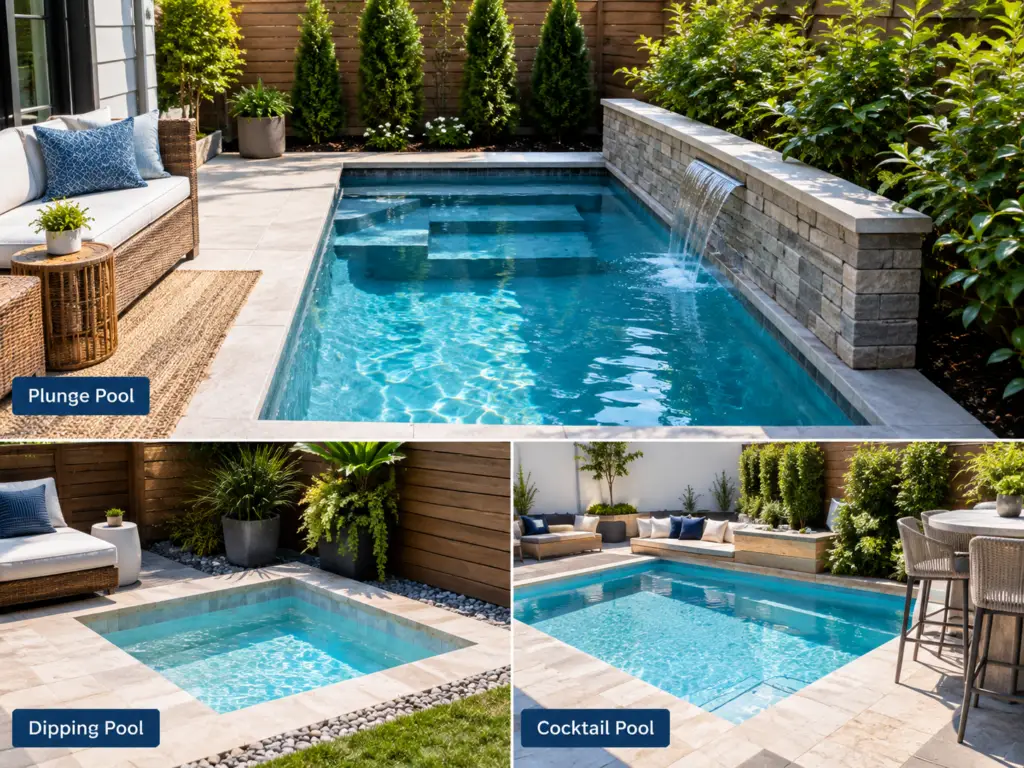
- Pick a simpler shape. A clean rectangle can reduce excavation complexity. For compact layouts, see our guides on small pool options and cocktail pools.
- Phase the extras. Build the pool and structural work now, add outdoor kitchen or fire features later.
- Ask about financing. We offer financing options for qualified buyers, and our pool loan calculator can show what a monthly payment might look like.
Which Pool Type Works Best on a Slope?
| Pool type | Slope-friendliness | Why | Watch-outs |
|---|---|---|---|
| Gunite (custom concrete) | Highest | Built in place over a steel frame, so shape, depth and levels can follow the land | Longer build, needs skilled crews |
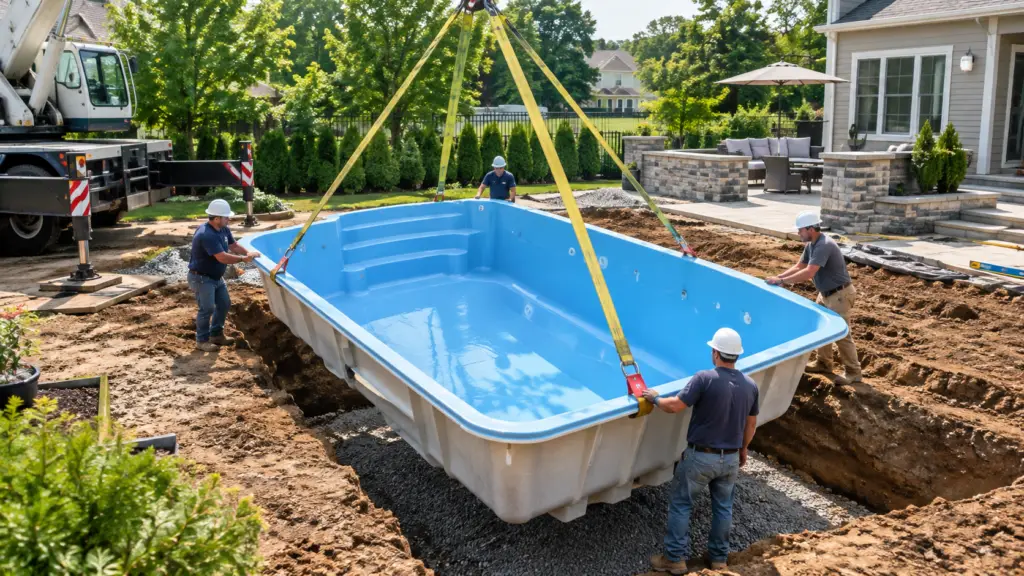
| Fiberglass | Moderate | Factory-made shell, faster install | Needs a level, compacted pad, a crane path and fixed shell shapes, which can be hard on a hillside |
| Vinyl liner | Moderate | Lower upfront cost | Needs stable backfill and wall support, and walls on slopes still need engineering |
| Semi-inground | Situational | Sometimes used to avoid tall walls | Part of the pool sits above grade, and it’s a different product category |
Gunite gives the greatest design flexibility, including multilevel designs and sloped or irregular lots, which is why we specialize in it. If you’re weighing options, read our breakdowns of gunite vs fiberglass pools and fiberglass vs concrete pools.
How a Sloped-Lot Pool Build Actually Unfolds
- On-site consultation. Your designer walks the slope, checks access, notes drainage and discusses how you want to use the yard.
- Survey and soil testing. Topography and soil data tell the engineer what’s possible.
- Design and engineering. The pool, walls, drainage and decks are designed together, ideally with a 3D rendering so you can see the grade changes.
- Permits and approvals. Slopes often trigger extra review, so allow time.
- Site prep and erosion control. Clearing, staking, access routes and silt control.
- Excavation and wall construction. Cut, fill and walls go in, with drainage installed behind them as they rise.
- Pool shell, plumbing and electrical. Steel, gunite application, plumbing and equipment.
- Decking, finishes and landscaping. Surface, steps, rails, planting and final grading.
- Final inspections and walkthrough. Then the first swim.
How long will it take? On our site we note that most pools are completed in about 8 to 14 weeks once construction begins, and that this doesn’t include design, permitting or site prep. On a slope, walls and drainage add working time, and concrete walls need to cure. Ask your builder for a separate schedule for the wall work, it’s a fair question.
Mistakes That Cost Sloped-Lot Owners the Most
- Skipping the soil report and assuming the ground is fine.
- Ignoring drainage from the hill above.
- Building on loose fill without compaction and engineering.
- Using an undersized or DIY wall for something over a few feet tall. In many places that wall isn’t legal without a permit, and a failed wall costs far more than one built right.
- Comparing quotes with different scopes, like one with a wall and one without.
- Forgetting access. The best design in the world doesn’t help if equipment can’t reach the yard.
- Draining the pool without checking groundwater risk.
- Hiring on price alone. Hillside work rewards experience.
How Blue Haven Helps With Sloped and Hillside Pool Projects
Sloped lots are exactly where experience shows. Here’s what we bring to the job.
Seven Decades of Pool Building
We’ve been building custom inground pools since 1954 and have completed more than 300,000 pools across the country. That kind of history means we’ve seen slopes, clay, rock, tight access and tricky drainage before, and we know what usually works. We describe ourselves as America’s #1 pool builder, and our homeowners rate us 4.8 out of 5 across more than 10,000 verified reviews. You can read more about us on our About page.
Gunite Specialists Who Design Around Your Land
Our focus is custom gunite construction, which lets us shape the pool’s depth, levels and footprint to your yard instead of forcing your yard to fit a pre-made shell. Gunite offers more flexibility for sloped and irregular lots than fiberglass or vinyl. Explore what we build on our new pools page.
Local Teams Who Know Your Soil, Climate and Codes
With 60+ offices serving more than 30 states, you get a local team that understands your soil conditions, your climate and your permitting environment, backed by a national company. Find your local Blue Haven.
A Free, In-Home Consultation and 3D Design
Slope can’t be priced from a website, so we come to you. Your designer assesses your grade, soil, access and drainage, then builds a custom design with a 3D rendering so you can see the result before the first shovel hits the ground. Start with a free estimate and 3D design or contact us.
Design, Engineering, Permitting and Construction in One Process
We manage the full project: design, engineering, permits, inspections and construction. During design we evaluate your site’s grading, soil conditions and drainage patterns, so a drainage plan is part of the pool plan from day one instead of an afterthought.
Designs That Turn the Slope Into a Feature
A grade change can become the best part of your backyard. Browse our photo gallery for layered decks, raised spas, vanishing edges and stone-faced walls. A few starting points:
- Estate pools for vanishing edges and architectural statements
- Retreat pools for private, landscaped hillside settings
- Courtyard pools for compact or tight sites
- Entertain pools with built-in seating and outdoor kitchens
- Family pools with sun shelves and safe layouts
- Active pools for lap swimming and fitness
Not sure where to start? Take our two-minute pool style quiz.
Smart Equipment and Efficiency
Our SmartFeatures options, along with variable-speed pumps, efficient heating, LED lighting and automation, help keep running costs down once the pool is built.
Financing That Fits the Whole Project
We offer financing for qualified buyers, including options designed to fit a monthly budget. Learn more on our financing page, or ask your designer how site work fits into your project scope.
Already Have a Pool on a Hill?
If your existing pool needs updating, our remodeling and renovation team can help with resurfacing, features and equipment upgrades.
People Also Ask: Quick Answers About Pools on Slopes
Can you put an inground pool on a hill?
Yes. With the right combination of grading, retaining walls, terracing and drainage, inground pools can be built on gentle slopes and steep hillsides. The steeper the slope, the more engineering is involved and the higher the added cost.
How much extra does a sloped lot cost for a pool?
As a working estimate, a gentle slope adds roughly $3,000 to $12,000, a moderate slope roughly $12,000 to $50,000, and a steep hillside $45,000 to $120,000 or more. Your actual number depends on wall size, soil, drainage and access.
Do you need a retaining wall to build a pool on a slope?
Often, yes, especially once the drop across the pool area passes a few feet. Gentle slopes can sometimes be handled with regrading and fill instead. A site visit is the only reliable way to know.
Is it cheaper to dig into a hill or build up the low side?
It depends. Cutting uses stable native soil but creates a wall of exposed earth and extra dirt to haul. Building up can look cheaper but needs engineered, compacted fill. Many projects balance the two.
How steep is too steep for an inground pool?
There’s no single limit. Very steep sites can still work, but costs climb fast because of tall engineered walls and shoring. If the price is extreme, moving the pool or terracing the design may be wiser.
Can you build a pool at the bottom of a hill?
Yes, but it takes more planning. The hill above pushes soil and water toward the pool, so you need strong walls, good drainage and sometimes a pool shell designed to handle the extra load.
What type of pool is best for a sloped yard?
Gunite is generally the most flexible because it’s built in place and shaped to the terrain. Other types can work, but fixed shapes and installation access can be limits on a hillside.
Can a fiberglass pool be installed on a slope?
Often with a retaining wall and good drainage, since the shell needs a level, stable pad. Crane access can also be a challenge on a hill.
Do you need an engineer for a pool retaining wall?
Many jurisdictions require an engineer’s stamp for walls over about 4 feet, and engineering is smart even below that on steep or wet sites. Your builder should coordinate it.
Can you build an infinity pool on a slope?
Yes. A downhill slope is actually a great setting for a vanishing edge, since the land already falls away. It adds structural and plumbing complexity, so budget accordingly.
How long does it take to build a pool on a slope?
Pool construction itself often runs 8 to 14 weeks, but design, permits and site prep come before that, and wall and drainage work add time on slopes. Ask for a separate schedule for the site work.
Frequently Asked Questions
Will a sloped yard make my pool leak or crack?
Not if it’s designed and built correctly. Problems usually come from poor drainage, unstable or uncompacted fill, or ignored soil conditions. A pool on solid, well-drained ground with proper structure performs just like one on flat land.
What’s the difference between a retaining wall and a terrace?
A retaining wall holds back one big change in grade. A terrace splits the grade into several smaller steps, each held by a shorter wall. Terraces can look great and spread out the cost, but they take more yard space.
Can I keep my trees on a sloped lot?
Sometimes. Trees help hold soil, so we try to preserve them when we can, but grading and equipment access sometimes force selective removal. Tree removal typically runs a few hundred to about a thousand dollars each.
Can I build the retaining wall myself?
Short garden walls can be DIY, but a wall that supports a pool deck or sits near a pool shell is a structural element. In most places walls over about 4 feet need permits and engineering, and a failed wall is far more expensive than one built right.
Does a pool on a hill cost more to maintain?
Not much. Running costs depend mostly on equipment, covers, heating and water chemistry. You might spend a bit more on drainage upkeep and landscaping on the slope. Our guide to types of pool covers can help with efficiency.
Is a semi-inground pool a good way to avoid a retaining wall?
It can lower the upfront cost on some slopes, because part of the pool sits above grade. But it’s a different product with different looks and tradeoffs, and decks and structure still need planning. A full inground gunite pool offers more design freedom.
Can I get a price over the phone or online?
You can get a general conversation going, but an accurate price for a sloped lot really needs an in-person visit, since soil, access, grade and drainage can’t be judged remotely. Our pricing page explains why.
What questions should I ask a pool builder about my slope?
Ask who handles engineering and permits, how drainage will be managed, what wall type and height they plan, what’s excluded from the quote, how rock or unexpected soil is handled, and how they’ll protect your yard from erosion during construction.
Will a sloped-lot pool hold its value?
A well-designed pool that uses the grade as a feature, with solid walls and landscaping, can be a standout selling point. Poor drainage or a visibly stressed wall is what hurts value.
Ready to Plan Your Hillside Pool?
A slope isn’t a reason to give up on a pool. It’s a reason to work with a team that has done it before. The best sloped-lot projects start with the land, not against it: walk the site, test the soil, plan the water, then design the pool.
Here are your next steps:
- Get a free estimate and 3D design from a local Blue Haven designer.
- Request a free pool brochure for design ideas.
- Explore financing options for qualified buyers.
- Browse our pool photo gallery for sloped-yard inspiration.
- Find your nearest Blue Haven office or call 1-800-BLUE-HAVEN.
Related Reading From Blue Haven
- Inground Pool Pricing and Cost Guide
- Gunite Pools vs. Fiberglass Pools: Which Is Right for Your Backyard?
- Fiberglass vs Concrete Pools: Cost, Lifespan, and Which One Fits Your Yard
- Small Pools: Plunge, Dipping, and Cocktail Pool Options
- Top 10 Most Unique Swimming Pool Deck Ideas and Designs
- Types of Pool Covers: Which Is Right for You?