
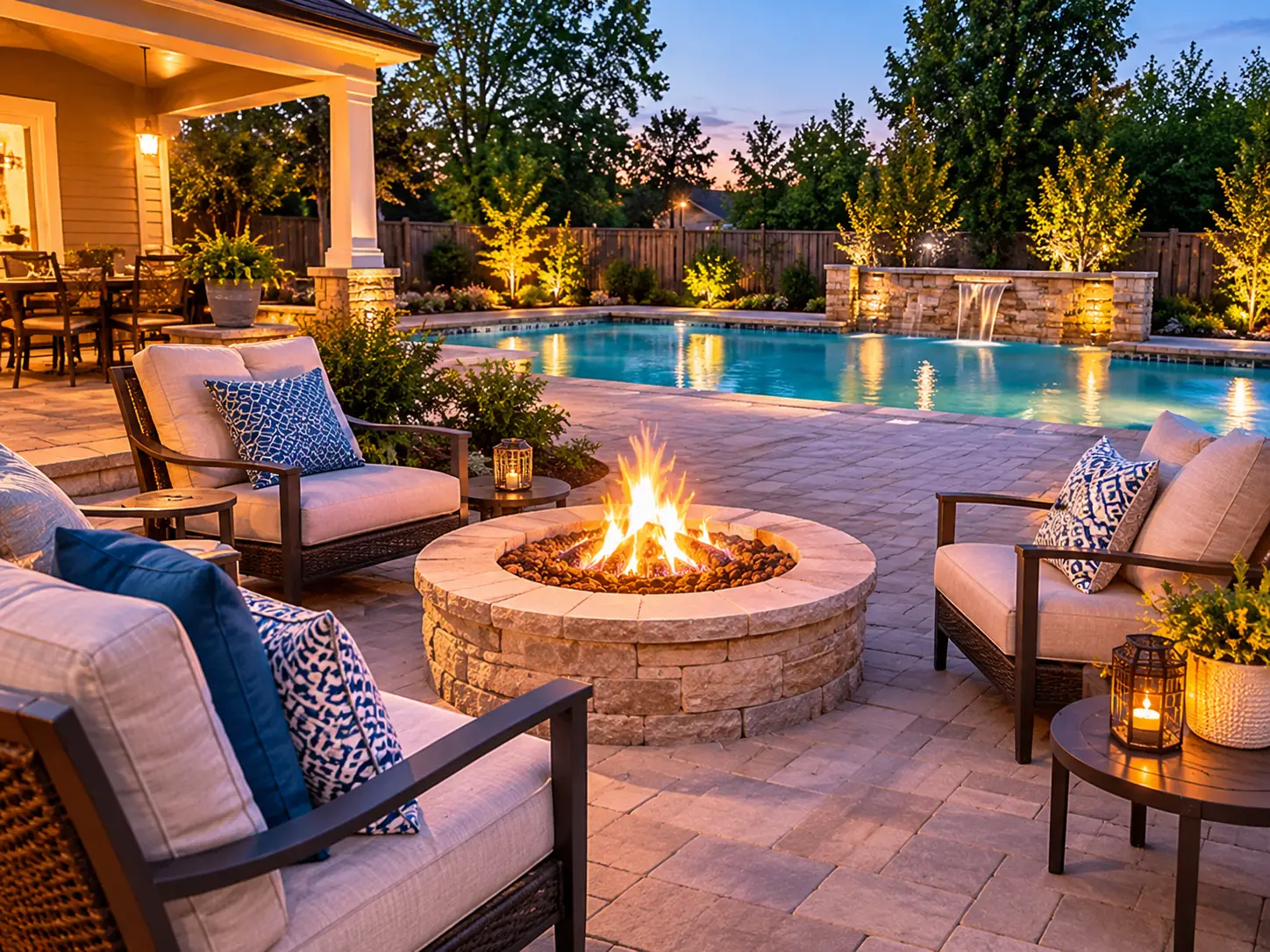
For most homeowners, the best poolside fire pit is a built-in natural gas fire pit with a stone cap that matches the pool coping. It has no smoke, no ash in the water, and it lights with a switch. A realistic installed budget is $4,000 to $12,000, depending on gas line length, stone, and how it ties into your deck.
Here is the short version:
- Cheapest way in: a freestanding fire table, about $300 to $2,500.
- Most popular upgrade: a built-in gas pit or a pair of fire bowls.
- Biggest wow factor: a sunken conversation pit or a fire and water bowl on a raised cascade.
- Best time to add it: during pool construction or a remodel, when trenches are already open and the deck is being poured.
- The number most blogs show you ($850 average) is real, but it is not your number. We explain why below.
In This Article
- Is the $850 fire pit price you see online actually good?
- 10 poolside fire pit ideas
- Technical planning: fuel, ignition, placement, materials
- Full cost breakdown and ways to save
- Questions people ask
- How Blue Haven helps
- FAQ
The 10 Ideas at a Glance
| # | Idea | Best for | Typical fuel | Planning budget (installed) |
|---|---|---|---|---|
| 1 | Freestanding fire table on the patio | Existing pools, renters of their budget | Propane or natural gas | $300 to $2,500 |
| 2 | Built-in round gas pit with matching stone cap | Most backyards | Natural gas | $4,000 to $12,000 |
| 3 | Pit and curved seating wall on the pool edge | Entertaining | Natural gas | $8,000 to $25,000 |
| 4 | Twin fire bowls flanking the pool or spa | Modern and resort looks | Natural gas | $6,000 to $15,000 per bowl |
| 5 | Fire and water bowl on a raised cascade | Waterfall and lagoon pools | Natural gas | $8,000 to $20,000 |
| 6 | Sunken conversation pit with fire | Big yards, hosts | Natural gas | $12,000 to $35,000+ |
| 7 | Linear glass fire box along the pool perimeter | Contemporary designs | Natural gas | $7,000 to $20,000 |
| 8 | Spa-side recessed fire wall | Retreat and wellness pools | Natural gas | $10,000 to $30,000 |
| 9 | Wood-burning masonry pit set back from the pool | Traditional, rustic yards | Wood | $1,500 to $8,000 |
| 10 | Any of the above, run from your pool automation | Smart homes | Varies | Ask for it as its own line item |
These are planning ranges built from published component costs and what we see on real projects. They are not quotes. Your site, soil, region, and design choices move the number, so we explain how we got them in the cost section.
Is the $850 Fire Pit Price You See Online Actually Good?
Search “fire pit cost” and almost every result lands on the same number. HomeAdvisor lists an average of $850 with a typical range of $200 to $3,000. Lawn Love shows nearly the same figure at $830, with most projects between $250 and $2,200.
We checked those numbers instead of just repeating them. Here is what we found.
What those guides are actually measuring
The $850 figure is built mostly from simple projects: a 36-inch wood-burning pit, a prefab kit, or a small above-ground unit sitting on an existing patio. HomeAdvisor’s own size table shows a 36-inch pit at $200 to $900. That is a fair price for that job. It is just not a poolside gas feature.
Where the number breaks down for a pool
A poolside fire feature usually adds things the average does not include:
- A gas line. HomeAdvisor puts this at $15 to $25 per linear foot, and a licensed gas fitter bills $45 to $200 per hour. A 30 foot run is roughly $450 to $750 in pipe work alone, before trenching through pavers or concrete.
- Permits. Typically $20 to $500 each, and electrical or plumbing permits can run up to $500 each.
- Electrical for remote ignition. Many pool fire bowls need a power line for the igniter.
- Stone that matches your deck. A 36-inch stone pit alone runs $350 to $3,000 in HomeAdvisor’s data, and that is for standard materials, not travertine caps cut to match your coping.
- Deck work. HomeAdvisor says a new patio with a built-in pit averages about $6,750, and retrofitting an existing patio can reach $5,000.
Let’s do the math on one realistic poolside build
A 36 to 44 inch built-in natural gas pit, 30 feet from the gas meter, with a stone cap:
| Line item | Low | High |
|---|---|---|
| Stone shell and cap | $1,500 | $3,500 |
| Burner, pan, and fire glass or lava rock | $500 | $2,000 |
| Gas line (30 ft at $15 to $25) plus fitting labor | $900 | $2,500 |
| Permit | $100 | $500 |
| Deck tie-in, base, and finish work | $1,000 | $3,500 |
| Total | $4,000 | $12,000 |
That is where our $4,000 to $12,000 planning range comes from. It sits well above the $850 average, and it should.
Our verdict
- $850 is a good price if you want a simple wood-burning or portable pit on a patio you already have.
- $850 is not a realistic price if you want a built-in gas feature beside the water. If a quote comes in under about $3,000 for a built-in gas pit with a new gas line, ask what is missing. Usually it’s the permit, the ignition system, or the gas line footage.
- Be careful with the opposite claim, too. A few thin pages online say a pool fire feature “starts at $25,000.” That does not match what retail copper fire bowls actually cost (roughly $3,300 to $13,000 for the unit itself) and we could not trace it to a credible source. Treat numbers with no stated scope as noise.
The smarter test: compare quotes line by line, not by total. A good quote lists gas line footage, ignition type, permit, materials, and deck work separately.
Want the same honesty about the pool itself? Read how pool pricing really works on our Pool Pricing page.
10 Poolside Backyard Fire Pit Ideas
1. Freestanding Fire Table on the Patio
The easiest upgrade there is. A manufactured gas fire table sits on your existing patio, and there’s no construction. A square copper or stainless model with black fire glass looks great next to an outdoor kitchen.
Best for
Homeowners with an existing pool who want fire this weekend.
Cost
About $300 to $2,500. Propane units typically run $300 to $950, and premium stainless or copper models cost more.
Watch for
Freestanding units can tip or slide, so keep them on a flat, non-combustible surface. Check the manufacturer’s required clearance from walls and overhead structures.
2. Built-In Round Gas Fire Pit with a Matching Stone Cap
This is the one most people picture. A round, stacked-stone pit with a flat cap cut from the same stone as your deck, so it looks like it was always part of the yard. Natural gas means no wood, no ash, no cleanup.
Best for
Most backyards, and the best balance of looks, safety, and cost.
Cost
Plan on $4,000 to $12,000 installed, depending on gas line length and stone choice.
Watch for
Match the cap material to the coping and deck. A bullnose or eased edge matters, because people lean in close and sharp edges get old fast.
3. Fire Pit with a Curved Seating Wall Built into the Pool Edge
Here the wall around the pit is the seating. The curved stone wall follows the pool’s perimeter, so nobody drags chairs over from the patio. It is one of the best ways to create a “stay awhile” zone at the water.
Best for
Entertaining. Pairs well with an Entertain-style pool design.
Cost
Roughly $8,000 to $25,000, because the seating wall, footing, and stone facing add real labor.
Watch for
This is far easier and cheaper to build while the pool is being built. Adding it later means cutting into finished deck.
4. Twin Fire Bowls Flanking the Pool or Spa
Copper or concrete fire bowls, usually 2 to 3 feet wide, sit on raised pedestals or the pool’s bond beam. Placed in pairs, they frame the water and give you symmetry and light from every seat.
Best for
Modern, resort-style, and estate looks.
Cost
The bowl itself is typically $3,300 to $13,000 retail depending on size and brand. Installed with a pedestal, gas, and ignition, budget $6,000 to $15,000 per bowl. A pair costs less per bowl if the gas line and trench are shared.
Watch for
If the bowls sit far from where you stand, choose remote or automated ignition. Walking to the far side of an infinity edge to light a match gets old quickly.
5. Fire and Water Bowl on a Raised Cascade
Some copper bowls do two jobs. Flames rise from the center while water spills over the rim into the pool. It’s one of the most striking features in a lagoon or waterfall design.
Best for
Waterfall, rock lagoon, and tropical pool styles.
Cost
Units run about $3,800 to $8,000, and installed budgets land around $8,000 to $20,000, because the bowl needs plumbing from the pool pump as well as gas.
Watch for
Manufacturers typically call for a pool or water feature professional to size the pump and plumbing. Do not treat this as a DIY.
6. Sunken Conversation Pit with Fire
A lowered seating area built next to, or even into, the pool, with a fire in the center. You sit surrounded by water and flame. It is the idea people stop and stare at.
Best for
Larger yards and homeowners who host often.
Cost
$12,000 to $35,000 or more. Excavation, drainage, waterproofing, and seating all add up.
Watch for
Drainage. A sunken area collects water, so it needs a proper drain plan before anyone picks stone.
7. Linear Glass Fire Box Along the Pool Perimeter
A long, narrow, glass-enclosed fire feature that runs alongside the water. Clean lines, very little visual clutter, and the glass blocks wind so the flame stays steady.
Best for
Contemporary and geometric pools.
Cost
Roughly $7,000 to $20,000, depending on length and finish.
Watch for
Linear boxes are mostly visual. They give light and ambiance, but less radiant warmth for seating than a round pit does.
8. Spa-Side Recessed Fire Wall
A raised wall with pockets cut into it creates a continuous band of flame behind a spa or built-in bench. It turns the spa into the focal point of the whole yard on a cold night.
Best for
Retreat and wellness-focused backyards. See our Retreat pool designs for inspiration.
Cost
$10,000 to $30,000, since this is a custom masonry and gas project.
Watch for
Heat and water together need careful design. Keep gas valves accessible and away from splash zones.
9. Wood-Burning Masonry Pit Set Back from the Pool
If you love the crackle and smell of real wood, build the pit away from the water and the house. A brick or stone pit on its own patio, a good distance from the pool deck, gives you the campfire feel without ash in your filter.
Best for
Traditional or rustic yards with plenty of space.
Cost
About $1,500 to $8,000, mostly driven by the patio and stone.
Watch for
HomeAdvisor recommends keeping a freestanding pit at least 10 to 15 feet from structures and anything flammable. Wood smoke and floating embers are also the main reason we do not recommend wood right at the water’s edge.
10. Run Your Fire Feature from Your Pool Automation
This one is not a separate design. It is an upgrade to any gas idea above. Instead of lighting a pit by hand, you control it from the same app or remote that runs your pump, spa jets, and lights. One tap, and the whole yard shifts into evening mode.
Best for
Anyone adding smart controls to a new pool or remodel. Learn more about SmartFeatures pool equipment.
Cost
Ask for it as its own line item. The control hardware is usually a small part of the total compared with the fire feature itself.
Watch for
Electronic ignition needs a power line to the feature, so plan the conduit before the deck goes in.
Technical Planning: How to Do It Right
The ideas are the fun part. This is the part that keeps a fire feature safe, legal, and working for years.
Choosing a Fuel
| Fuel | Pros | Cons | Best near a pool? |
|---|---|---|---|
| Natural gas | Clean, no refills, lowest running cost over time | Needs a gas line | Yes, the top pick |
| Propane | No trench needed, works for tables and portable units | Tank refills and storage | Good for freestanding tables |
| Wood | Real fire, crackle, and smell | Smoke, ash, embers, cleanup | Only set back from the water |
| Electric or ethanol-free options | Simple to place | Weaker visual drama | Niche |
For built-in poolside features, natural gas wins on convenience, cleanliness, and long-term cost. Just remember HomeAdvisor’s point that gas pits cost more upfront because the install is more involved.
Choosing an Ignition Type
Most pool fire features use one of three setups:
- Manual (match lit): You light it yourself with a key valve, like a gas fireplace. No wiring. Lowest cost.
- Electronic igniter with remote: Lights from a distance and many include flame monitoring and auto shutoff. Needs a power line, which adds cost.
- Pool automation integration: One app or remote runs fire, lights, and water features together. The best choice when you are already building smart controls into the pool.
Placement and Clearances
Distance from structures
For freestanding wood or gas pits, 10 to 15 feet from buildings, fences, trees, and anything flammable is the commonly cited minimum. Always follow the manufacturer’s instructions and your local code, because built-in gas features can have different rules.
Distance from the water
There is no single national rule for how close a fire feature can sit to the water’s edge. Many pool fire bowls are designed to sit right on the bond beam (the raised pool wall above the waterline) so the flames are visible from across the yard. That is fine when the feature is engineered for it. A random freestanding pit parked at the edge is a different story.
Screen enclosures and covered lanais
Do not put a wood or gas fire feature inside a screened enclosure or under a low roof unless the product is rated for that setup and your building department approves it. Ventilation and heat build-up are real risks.
Materials That Hold Up
- Fire-rated interior: The inner wall must withstand direct flame. Firebrick is common for masonry pits.
- Non-porous stone: HomeAdvisor notes that granite, basalt, quartzite, and soapstone resist trapping moisture. Soft or porous rock can crack or even pop when it heats up.
- Copper and stainless: Great for bowls and fire tables. Copper develops a patina over time, which many people like.
- Fire glass vs lava rock: Glass looks modern and reflects light. Lava rock is cheaper and has a rustic look. Fire bowls often need around 50 to 60 pounds of media to fill the pan.
Seating and Layout
- A 36 to 44 inch pit warms and seats about 6 to 8 people comfortably, according to HomeAdvisor.
- A common design rule is to leave about 3 feet of clear space around seating so guests can walk behind chairs without bumping the fire.
- Keep at least one open side so people can enter and leave easily, especially when wet from swimming.
- Think about wind. Place seating upwind when possible, and use a glass fire box or windscreen where gusts are common.
Permits, Gas, and Electrical
- Gas lines should be installed by a licensed professional. This is not a weekend DIY.
- Permits vary a lot by city and county. Fees of $20 to $500 per permit are common, and some projects need building, gas, and electrical permits.
- A good pool builder pulls permits and schedules inspections for you.
Poolside Safety Checklist
- Install a visible, accessible gas shutoff.
- Use a safety screen if kids or pets are around the fire.
- Keep pool chemicals stored well away from open flame and heat. This one gets overlooked.
- Use non-slip, heat-tolerant surfaces around the fire. Wet feet and hot stone do not mix.
- Never leave a fire unattended, and shut off gas when finished.
- Clean ash after every wood burn, and check gas and electrical connections at least once a season. Cover the unit during harsh weather.
- Ask your insurance agent whether a permanent fire feature changes anything on your policy.
Full Cost Breakdown
Component Costs You Can Verify
| Component | Typical range | Basis |
|---|---|---|
| Gas line | $15 to $25 per linear foot | HomeAdvisor |
| Gas plumber labor | $45 to $200 per hour | HomeAdvisor |
| Mason or handyperson labor | $60 to $125 per hour | HomeAdvisor |
| Permits | $20 to $500 each | HomeAdvisor |
| Stone fire pit, 36 inch, standard | $350 to $3,000 | HomeAdvisor |
| Fire glass | $20 to $100 per 10 lb bag | HomeAdvisor |
| Safety screen | $75 to $300 | HomeAdvisor |
| Fire pit seating | $150 to $3,500 | HomeAdvisor |
| Patio with built-in pit | About $6,750 new, up to $5,000 to retrofit | HomeAdvisor |
| Copper fire bowl, unit only | About $3,300 to $13,000 | Retail listings, several brands |
How Cost Compares With the Generic Averages
| Source | Average | Typical range | What it really covers |
|---|---|---|---|
| HomeAdvisor | $850 | $200 to $3,000 | Mostly simple yard pits |
| Lawn Love | $830 | $250 to $2,200 | Mostly simple yard pits |
| Poolside built-in gas (our planning range) | Not an average | $4,000 to $12,000 | Gas line, permit, stone, deck tie-in |
| Premium custom features | Not an average | $12,000 to $35,000+ | Seating walls, sunken pits, fire walls |
Is a Fire Feature Worth It?
HomeAdvisor reports that many homeowners see a return of roughly 67% to 80% on a fire pit or outdoor fireplace. That is a decent return for a feature you will use year round, though results depend on your market. The bigger payoff is usage: a pool with a fire feature gets used on cool evenings and in shoulder seasons, when an unheated backyard would sit empty.
Ways to Save Without Cutting Corners
- Build it with the pool. Trenches, footings, and deck are already open, so you avoid cutting into finished work.
- Share one gas trench between a pit, a bowl, and a grill or heater.
- Pick standard sizes. Custom dimensions raise stone and labor costs.
- Match the cap to your coping. It looks custom without costing like a one-off.
- Choose manual ignition if you will be standing right next to the feature anyway.
- Phase it. Run the gas line and conduit now, and add the second bowl or seating wall later.
Questions People Ask About Fire Pits Near Pools
Can you put a fire pit next to a swimming pool?
Yes. Fire features are a common pool upgrade, and many are built right into the pool wall. The key is choosing a feature designed for that location and following the manufacturer and local code.
How close can a fire pit be to a pool?
There is no single national distance. Built-in gas features and bond beam fire bowls are engineered to sit at the edge. Freestanding wood pits should stay well back, and at least 10 to 15 feet from structures and flammables per common guidance.
Is a gas or wood fire pit better near a pool?
Gas, in most cases. It gives no smoke, no flying embers, and no ash in the water or filter. Wood is better kept in a separate zone away from the pool deck.
Will a fire pit damage my pool deck?
It can if you ignore heat. Use a non-combustible base, follow the manufacturer’s clearance for the surface, and ask your builder how your deck material (pavers, travertine, concrete, wood) handles heat.
Can I add a fire pit to an existing pool?
Yes. It is a common part of a pool remodel. Expect slightly higher labor than new construction, because the deck has to be opened for gas and electrical.
Do I need a permit?
Often yes, especially for gas lines and permanent installs. Your pool builder should handle permitting and inspections.
What is the best fire feature for a small backyard?
A compact fire bowl, a linear fire box, or a fire table. Smart layouts matter more than size, and our guide to small pools for compact backyards shows how to make tight spaces feel bigger.
How do I keep smoke and ash out of the pool?
Choose gas. If you want wood, place the pit upwind and well away from the water, and consider a pool cover when burning nearby.
How Blue Haven Helps You Add a Fire Feature
A fire feature near water is not a landscaping afterthought. It touches gas, electrical, structure, drainage, and the deck. That is why it makes sense to have one team plan all of it together.
Blue Haven has been building custom pools since 1954. Today that means 70+ years of experience, 300,000+ pools built nationwide, and 60+ local offices across the country. Our customers rate us 4.8 out of 5 stars across 10,000+ verified reviews, and we are proud to be a #1-ranked pool builder in America. Here is what that experience means for your fire pit project.
What We Do
- We design the fire feature into the pool, not next to it. Because we specialize in custom gunite pool construction, pit walls, seating walls, and bond beam fire bowls can be built directly into the pool structure.
- We handle the technical side. Your Blue Haven team manages design, engineering, permitting, inspections, and local code compliance, so you are not chasing gas and electrical approvals yourself.
- We plan ignition and automation early. Manual, remote, or fully integrated with your pool controls through our SmartFeatures options.
- We show you before we build. Get a free in-home consultation, a custom design, and a 3D rendering through our free estimate and 3D design.
- We give you a real number. Pricing depends on your site, so we visit your yard instead of guessing from a website. Learn why on our Pool Pricing page.
- We make the budget workable. Flexible pool financing is available for qualified buyers, and fire features can be included in the project scope.
- We build locally. Our designers know your soil, your climate, and your HOA. Find your nearest Blue Haven location.
- We keep the schedule clear. Most pools are completed in 8 to 14 weeks once construction begins, and many homeowners can dive in as soon as 70 days after that stage starts.
Which Blue Haven Service Fits Your Project?
| Your situation | What we recommend | Where to start |
|---|---|---|
| Planning a brand new pool | Build the fire feature into the design from day one | New Pools |
| You already have a pool | Add a fire feature as part of a remodel | Remodels |
| Want ideas and photos first | Browse real projects by style | Inspiration Gallery |
| Love bowls and fire and water combos | See fire bowl examples | Fire Bowl Gallery |
| Want more landscaping and cost ideas | Read our cost-focused guide | 6 Creative Backyard Pool Landscaping Ideas (With Real Costs) |
| Budgeting a bigger remodel | See what common upgrades cost | 15 Inground Pool Remodel Ideas (With Real Costs) |
| Building on a tricky lot | Understand slope and grading | Building an Inground Pool on a Slope or Hill |
| Deciding on pool type | Compare materials | Gunite vs. Fiberglass Pools |
Keep Exploring Our Fire Feature Content
- Backyard Fire Pit Ideas for Your Pool Area (8 Real Designs)
- Swimming Pool Fire Features: 15 Hot Examples in Photos
- Real backyards by style: Family, Entertain, Retreat, and Courtyard pool galleries
- Learn more about Blue Haven
Ready to Plan Your Poolside Fire Feature?
Start with how you want to use your yard. Cozy evenings for two? Big weekend gatherings? A quiet spa retreat? Your answer decides which of these ten ideas fits.
Get your free estimate and 3D design or talk to your local Blue Haven team. There’s no obligation, and you’ll get a real number for your backyard instead of a national average.
Frequently Asked Questions
How much does a gas fire pit cost with a gas line installed?
For a built-in natural gas pit beside a pool, a realistic planning range is $4,000 to $12,000. The gas line alone runs about $15 to $25 per linear foot, plus licensed labor and permits. Simple freestanding units cost far less.
Is the $850 average fire pit cost accurate?
It is accurate for what it measures, mostly simple yard pits. It is not a good guide for a built-in gas feature near a pool, which includes gas, permits, stone, and deck work.
What is the difference between a fire pit and a fire bowl?
A fire pit is usually wider and lower, often built into the ground or a wall, and designed for sitting around. A fire bowl is a smaller, elevated vessel (often 2 to 3 feet wide) that sits on a pedestal or the pool’s raised wall and works mainly as a visual and ambiance feature.
Do fire pits add value to a home?
HomeAdvisor reports average returns of roughly 67% to 80% on fire pits and outdoor fireplaces. Your actual return depends on your market, quality of build, and how well it fits the yard.
How long does it take to install a poolside fire feature?
A simple freestanding table can be set up the same day. A built-in feature typically takes days to a few weeks depending on masonry, gas, and inspections. When built with a new pool, it is part of the normal construction schedule of 8 to 14 weeks after construction starts.
Can I control a fire feature from my phone?
Yes, with electronic ignition and pool automation, one app or remote can control your fire feature alongside lighting, pumps, and spa jets.
How many people can sit around a poolside fire pit?
A 36 to 44 inch pit comfortably serves about 6 to 8 people. Bigger pits and seating walls can handle larger groups.
Is it safe to use a fire pit with kids around the pool?
It can be, with the right design: a safety screen, accessible shutoff, non-slip surfaces, clear seating zones, and adult supervision. Gas features are generally easier to manage than wood.
What maintenance does a fire pit need?
Clean ash after wood burns, inspect for cracks and rust, check gas and electrical connections each season, and cover the feature during harsh weather.
Can I finance a fire feature with my pool?
Blue Haven offers flexible financing for qualified buyers on new pools and remodels. Talk with your local team about including outdoor living features in your project. Start at our financing page.