
Quick answer: For most backyard pools, 78°F to 82°F (25.5°C to 27.8°C) is the best balance of comfort and cost. 78°F to 80°F is the most efficient range. 80°F to 82°F feels best for relaxed family swimming. Every extra degree can raise heating energy use by roughly 10% to 30%, depending on where you live.
That’s the short version. The rest of this guide explains why, what each degree costs, which pool heater is actually worth the money, and how to keep the water warm without a scary utility bill.
Key Takeaways
- Most efficient setting: 78°F to 80°F for a typical residential pool.
- Most comfortable setting for families: 80°F to 82°F.
- Lap swimming and workouts: 77°F to 80°F, because your body makes its own heat.
- Young kids, older adults, and relaxing swims: 82°F to 86°F, and expect a higher bill.
- Biggest money saver: a pool cover. The U.S. Department of Energy says covers can cut pool heating costs by 50% to 70%.
- Best heater for frequent use in mild climates: an electric heat pump.
- Best heater for fast heat and occasional use: a gas heater.
- Lowest running cost in sunny states: solar heating.
What Is the Ideal Swimming Pool Temperature?
The ideal swimming pool temperature is 78°F to 82°F for most people. Below 78°F, many swimmers feel chilly after a few minutes. Above 82°F, the water starts to feel like bath water to some people, and your energy bill climbs fast.
Here’s the honest part. There is no single number that works for everyone. Comfort depends on three things:
- Who is swimming. A seven-year-old who sits on the steps needs warmer water than a triathlete doing laps.
- What the weather is doing. 80°F water feels great on a 95°F afternoon. The same water feels cold on a breezy 65°F evening.
- How much you want to spend. Heating is usually the biggest ongoing cost of owning a pool after the pump.
So the real question is not “what is the perfect temperature?” It’s “what is the lowest temperature my family will actually enjoy?” Find that number, and you’ve found your efficient setting.
The Most Efficient Pool Temperature
For a typical outdoor residential pool, 78°F to 80°F is the efficient zone. The pool stays swimmable, and the heater doesn’t have to fight evaporation and wind all day.
The National Swimming Pool Foundation recommends 78°F to 80°F for active swimming. That same range happens to be where energy use stays reasonable.
The Most Comfortable Pool Temperature
For relaxed family swimming, 80°F to 82°F is where most people stop complaining. If you’re going to pick one number and move on, 80°F is a strong default.
Best Pool Temperature by Type of Swimmer
Use this table as a starting point, then adjust by a degree or two based on your own family.
| Who or what | Recommended water temperature | Notes |
|---|---|---|
| Competitive swimming | 77°F to 82°F (25°C to 28°C) | Cooler water keeps athletes from overheating during hard sets |
| Lap swimming and fitness | 78°F to 80°F | You generate heat while swimming, so cooler feels better |
| Everyday family swimming | 80°F to 82°F | The best balance for most households |
| Young children | 84°F to 86°F | Small bodies lose heat quickly, limit time in the water |
| Older adults and low-impact exercise | 82°F to 86°F | Warmer water relaxes joints and muscles |
| Aquatic therapy pools | 86°F to 92°F | Usually a dedicated therapy pool, not a standard backyard pool |
| Spa or hot tub | Up to 104°F maximum | Never exceed 104°F. Keep soak times short |
Air temperature matters as much as water temperature
A pool at 84°F can feel cold when the air is under 80°F, especially when you climb out and the wind hits you wet. If you mostly swim in cool evenings, you’ll either need warmer water or a windbreak. Fences, hedges, and a nearby wall can help more than people expect.
A simple comfort test
If people get out within 10 to 15 minutes complaining about the cold, the water is too cool for how you use the pool. If kids are pink in the face and lethargic, it might be too warm. Adjust by one degree at a time.
Why Higher Temperatures Cost So Much More
Pools lose heat in several ways, but evaporation is by far the largest. The Department of Energy and NREL both say evaporation accounts for roughly 70% of pool energy loss. The higher the water temperature, and the windier and drier the air, the faster water evaporates and takes heat with it.
That creates a nasty loop. Warmer water evaporates faster, which makes the heater work harder, which makes the water warmer, and so on.
The Department of Energy says each degree you raise pool temperature can increase energy costs by about 10% to 30%, depending on your location. Some sources quote a lower 10% to 15% range. Either way, the lesson is the same: a couple of degrees matters a lot more than people think.
Other things that drive heat loss:
- Wind across the water surface
- Low humidity
- Cool nights, especially with a clear sky
- Shade (it blocks free solar gain)
- Dark vs light pool finishes (darker interiors absorb more heat)
What Each Degree Costs (Worked Example)
Lets put real numbers on it. The table below is an illustration, not a quote. It assumes a pool where heating costs you $150 per month at 78°F, then applies the DOE’s 10% to 30% per degree range.
| Thermostat setting | Degrees above 78°F | Estimated monthly heating cost | Verdict |
|---|---|---|---|
| 78°F | 0 | $150 | Most efficient |
| 80°F | +2 | $180 to $240 | Best all-around balance |
| 82°F | +4 | $210 to $330 | Comfortable, noticeably pricier |
| 84°F | +6 | $240 to $420 | Worth it only for kids or therapy use |
| 86°F | +8 | $270 to $510 | Pair with a cover and a heat pump |
Technical note: The percentages are not exact for every pool. Your real numbers depend on pool surface area (not just volume), climate, wind, cover use, and heater efficiency. The point is the shape of the curve: each step up costs more than the last in real dollars.
Pool Heater Costs, Reality Checked
A lot of articles list heater prices and stop there. A price means nothing until you ask whether it’s actually good value. So here is what we found when we compared current 2026 pricing guides, and what we think of it.
Installed price and monthly running cost
| Heater type | Typical installed cost (2026) | Typical monthly running cost | Typical lifespan | Our take |
|---|---|---|---|---|
| Gas heater (natural gas or propane) | About $1,500 to $7,000 | $200 to $500 on natural gas, higher on propane in peak season | 5 to 10 years | Lowest price tag, highest bills. Good value for occasional use and spas |
| Electric heat pump | About $2,000 to $8,500 | $50 to $200 | 10 to 20 years | Best value for frequent swimming in mild climates |
| Solar heating | About $2,500 to $9,500 (some quotes run higher) | $10 to $30 for pump electricity | 15 to 20 years | Best long-term value in sunny regions, needs roof or ground space |
| Electric resistance heater | About $1,200 to $6,000 | $175 to $600 | Varies | Only sensible for a small spa |
| Solar blanket or cover | Under $100 to about $200 | Nothing | 3 to 6 years | Cheapest, fastest payback of anything on this list |
Is that pricing actually good? Our technical read
We cross-checked several published guides, and the ranges overlap enough to trust the general picture. A few things need pushback though.
1. Some articles overstate heat pump savings. One popular guide says paying $100 a month on a heat pump instead of $400 on gas saves $3,600 a year. The math only works if you heat the pool 12 months a year. Most U.S. homeowners heat for 5 to 8 months. A more honest number is $1,500 to $2,400 per year in that example. Still a strong return, just not the headline figure.
2. The installed-price range is wide for a reason. A gas heater at $1,500 and one at $7,000 are not the same job. The big swing factors are heater size (BTU or tons), whether you need a new gas line, and whether your electrical panel can handle a heat pump. Electrical upgrades for heat pumps are commonly quoted at $800 to $2,000 extra. If a quote doesn’t separate equipment from install work, ask for it in writing.
3. Heat pump efficiency depends on air temperature. Heat pumps pull heat from the air, so they work best above roughly 50°F. Their efficiency (COP) can be very high in warm weather, often well above 4, but drops when it gets cold. If you want to swim in January in a cold state, a gas heater or a hybrid setup may make more sense.
4. Payback is the number that matters. Where heat pumps run $50 to $100 a month against $200 to $400 for gas, the higher upfront cost can pay itself back in one to three seasons for pools used heavily. If you only swim a few weekends a year, gas wins on total cost.
5. The cheapest upgrade is the best deal. A $50 to $200 solar cover that cuts heating costs 50% or more beats every heater on payback. Nothing else is close.
Bottom line on cost: Gas heater pricing is fair but the running cost is where it hurts. Heat pump pricing is good value for frequent use. Solar pricing is good only if you have sun and space. And a cover is a bargain at any price.
How to Heat Your Pool for Less
You don’t need to give up comfort to cut the bill. These are ranked by how much they usually help.
- Use a pool cover every night and whenever the pool is idle. The DOE reports savings of 50% to 70% because covers cut evaporation, the biggest source of heat loss. A cover only saves energy if you actually use it, so a reel or automatic cover helps a lot.
- Lower the thermostat when you’re not swimming. The EPA says the old idea that reheating costs more than the savings is a myth. If you swim mainly on weekends, drop the setting about 5°F during the week. If you’re gone for days, turn the heater off.
- Plan your heat-up. Heat pumps often need 24 to 48 hours to bring a cold pool up to temperature. Gas heaters can do it in hours. Start early for a Saturday swim.
- Block the wind. Fences, plantings, and walls reduce evaporation without any equipment.
- Run an efficient pump. A variable-speed pump uses much less electricity than a single-speed one, and good circulation helps heaters work properly.
- Maintain your heater. Clean filters, balanced water chemistry, and clear vents all help. Scale and corrosion can wreck a heat exchanger.
- Match the heater to your climate and habits. Sunny state, daily swims, solar or heat pump. Occasional use and cold nights, gas.
One small caution on clear bubble covers
A transparent solar cover still lets most of the sun’s heat in, though the DOE notes it can reduce solar absorption by 5% to 15% compared with no cover. Take it off just before you swim and put it back right after.
How Pool Design Changes Your Heating Bill
Heating cost isn’t only about the thermostat. The pool itself plays a big role, and it’s the part you can’t easily change later.
- Surface area. More surface means more evaporation and more heat loss. A big shallow pool costs more to keep warm than a smaller deep one with the same volume.
- Sun exposure. A pool that gets 8 hours of direct sun needs far less heater runtime.
- Wind exposure. Placement, fencing, and landscaping can shave real dollars off every month.
- Circulation design. Efficient plumbing and pump selection reduce how many hours your equipment has to run.
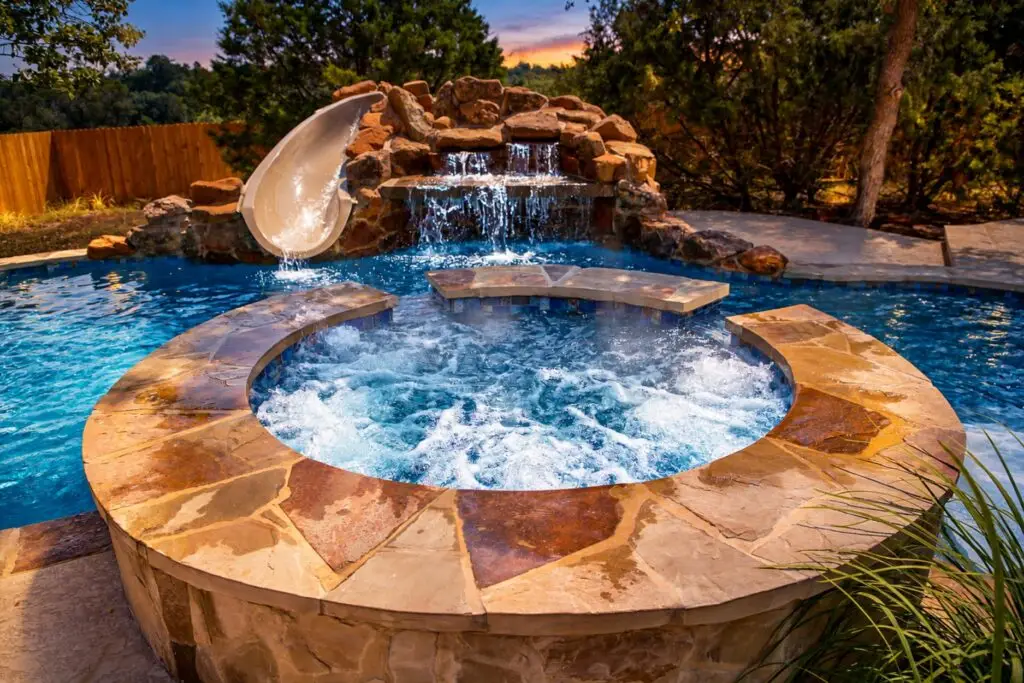
- An interior spa. A spa built inside the pool footprint is generally the most economical way to add a hot soak, and you can heat just the spa on cold nights instead of the whole pool.
- Equipment package. Heater size, automation, and a good cover system all affect long-term running cost.
If you’re planning a new pool, these decisions are cheapest to make at the design stage. If you already have one, a pool remodel can upgrade old equipment and improve efficiency without starting over. Our guide on the best time to remodel a pool covers timing.
How Blue Haven Helps
Choosing a temperature is the easy part. Building a pool that holds that temperature without wrecking your budget is where experience pays off.
Blue Haven has been building pools for more than 70 years, with 300,000+ pools built nationwide and 60+ local offices. Homeowners have left 10,000+ verified reviews, averaging 4.8 out of 5 stars. We specialize in custom inground gunite pools, which means your pool can be shaped, sized, and positioned around your yard’s sun, wind, and layout instead of being forced into a standard mold.
Here’s what that means for your water temperature and your bills:
- Heater guidance based on how you really swim. Your Blue Haven designer helps you choose between gas, heat pump, solar, or a combination, based on your region, your climate, and whether you plan to include a spa. See our SmartTherm heater options for details.
- Efficient equipment packages. Our SmartFeatures include energy-saving variable-speed pumps, automation, and high-efficiency heating choices.
- A circulation system built to cut runtime. On the pools we build, our exclusive circulation system is designed to reduce the number of daily hours your pump and heater need to run.
- Smart spa planning. An interior spa can be the most economical way to add a hot soak, and your designer can plan heating so you’re not warming the whole pool for a short soak.
- Design for your lifestyle. Whether you want a family pool, an active or wellness pool, or a quiet retreat, your layout and depth can be planned around how warm you want the water to feel.
- A clear process. Most pools are completed in 8 to 14 weeks once construction begins, and permits, inspections, and code compliance are handled by your builder. Design, permitting, and site prep are separate from that window.
- Real numbers, not internet guesses. Pool pricing depends on size, finishes, equipment, site conditions, and local costs. That’s why we do a free in-home consultation instead of quoting a “national average.” See our pool pricing guide for what actually drives cost.
- Financing. 100% financing is available for qualified buyers, so efficient equipment doesn’t have to wait.
Want to see what’s possible? Browse our pool inspiration gallery for real backyards, or find your local Blue Haven office.
Ready to plan? Get a free estimate and 3D design or request a free pool brochure.
People Also Ask
Quick answers to the questions homeowners search most.
What is the best temperature for a swimming pool?
78°F to 82°F works for most people. Pick 78°F to 80°F to save money and 80°F to 82°F for comfort.
Is 78 degrees too cold for a pool?
Not for most adults, and it’s ideal for exercise. Kids and older adults often find 78°F too cool for relaxing, so they may prefer 82°F or higher.
Is 85 degrees too hot for a pool?
It’s not unsafe, but it’s warm for exercise and expensive to maintain. It suits young kids, older adults, and relaxed play, especially with a cover.
What is the cheapest pool temperature to maintain?
The lowest temperature your household will still enjoy. For many, that’s 78°F to 80°F.
What temperature is too cold to swim in a pool?
Most people feel uncomfortable below about 75°F, and many feel it below 78°F. Cold tolerance varies, and children chill faster than adults.
How much does it cost to heat a pool per month?
Typically $10 to $30 for solar (pump electricity), $50 to $200 for a heat pump, and $200 to $500 or more for gas. Your pool size, climate, and thermostat setting move these numbers.
Is it cheaper to keep a pool heated all the time or heat it when needed?
If you won’t use the pool for several days, it’s usually cheaper to lower or turn off the heater. The EPA says the reheating-costs-more idea is a myth. If you swim daily, steady heating with a cover often makes sense.
How long does it take to heat a pool?
A gas heater can take a few hours. A heat pump usually takes 24 to 48 hours for a big temperature gain.
What temperature should a pool be for kids?
Around 84°F to 86°F is common for young children, with shorter swim sessions and a warm towel ready.
Should I turn the pool heater off at night?
Not necessarily. A cover at night does much more than turning the heater off and on. Use a cover first, then fine tune the thermostat.
Does pool temperature affect chlorine and algae?
Yes. Warmer water uses up sanitizer faster and encourages algae growth, so you’ll need to test your water more often in hot weather.
Do heat pumps work in cold weather?
They work best when air temperatures are above about 50°F. Below that, efficiency drops, and a gas heater or hybrid may be a better fit.
FAQ
What swimming pool temperature is most efficient and comfortable?
78°F to 82°F. The most efficient end is 78°F to 80°F. The most comfortable end for families is 80°F to 82°F. Choose the lowest setting your swimmers are happy with.
How many degrees should I raise the temperature for kids?
Plan on 84°F to 86°F for toddlers and young children. Expect higher heating costs, and use a cover when the pool is idle to offset it.
Does a pool cover really save money?
Yes. The Department of Energy says covers can save 50% to 70% on heating costs by cutting evaporation. A solar cover is also one of the cheapest upgrades, often under $200.
Which pool heater is the cheapest to run?
Solar is cheapest to run, followed by heat pumps, then gas. Electric resistance heaters are generally the most expensive for pools and are best for spas only.
Is a heat pump worth the extra upfront cost?
For frequent use in mild or warm climates, usually yes. The lower monthly bill can recover the extra purchase price in a few seasons. For occasional use or cold climates, a gas heater may cost less overall.
What is a good setback temperature when I’m away?
Dropping the thermostat 5°F for the week is a common approach for weekend swimmers. For longer trips, turning the heater off is fine.
Can the pool’s design affect how much it costs to heat?
Yes. Surface area, sun exposure, wind, circulation design, and equipment choices all change your heating bill. This is one reason custom design matters.
How do I choose the right heater size?
Heater size depends on surface area, desired temperature rise, and local climate. Your pool builder should size it, because an undersized heater runs constantly and an oversized one wastes money.
What water temperature is best for a hot tub or spa?
Spas are commonly kept at 98°F to 104°F. Do not go above 104°F, and keep soak times short.
How can I get an accurate quote for a new pool or heating upgrade?
Heating and pool costs depend on your site, climate, and equipment. The most accurate way is an in-person consultation. Schedule a free estimate with your local Blue Haven team.
Final Thoughts
If you remember just three things, make them these:
- Set the pool at 78°F to 82°F, and start at 80°F.
- Buy a cover before you buy anything else. It’s the cheapest, fastest way to cut heating costs.
- Match the heater to how you actually swim. Heat pump for frequent use, gas for fast and occasional, solar for sunny regions.
Do those, and you’ll have water that feels great without a surprise on the utility bill. And if you’re planning a new pool or a remodel, talk to a local designer early. Heating costs are mostly decided by design, and Blue Haven has been getting that right for over 70 years.
Next steps:
- Get a free estimate and 3D design
- Explore pool pricing factors
- See financing options
- Read: How to keep your pool warm in winter
- Read: How to winterize an inground pool in 9 easy steps
- Read: Winter hot tub safety tips
- Read: Patio heater guide for fall pool nights
- Read: Gunite vs fiberglass pools
- Browse the pool inspiration gallery