
You cannot filter calcium out of pool water, and chemicals only hide it for a while. To lower high calcium hardness, you partially drain the pool and refill it with softer water (usually 25% to 50%, in stages). To remove calcium scale already stuck on tile or plaster, you use a pumice stone, a stain eraser brush, or a scale remover, and a pro handles the stubborn stuff. Test first, because most “calcium problems” are really a water balance problem.
Key takeaways
- High calcium hardness is dissolved in the water. Calcium scale is the hard white crust it leaves behind. They need different fixes.
- Dilution (partial drain and refill) is the only reliable way to lower calcium hardness.
- Sequestrants, clarifiers and flocculants do not remove dissolved calcium from your water.
- Never fully drain a gunite or plaster pool without a pro. Groundwater can push the shell out of the ground.
- A hose refill is often 5 to 10 times cheaper than a water truck, so check your fill water before you order a delivery.
- If scale keeps coming back, the cause is usually pH, alkalinity or temperature, not just calcium.
What is calcium in a pool?
Calcium is a mineral that gets into your pool from tap water, well water, pool plaster, pool chemicals (like calcium hypochlorite shock) and even the dust and plaster that slowly dissolve from the shell. A little is good for the pool. Water with too little calcium is “hungry” and will pull it out of your plaster, grout and even metal equipment. Water with too much calcium does the opposite and drops it onto surfaces as scale.
So the goal is not zero calcium. The goal is the right amount for your pool surface.
Calcium hardness vs calcium scale
This is where most articles get lazy, and it’s the reason people waste money. There are two separate problems.
Problem 1: High calcium hardness
- It is a water test number, measured in ppm (parts per million).
- You can’t see it in the water. Water can look crystal clear and still be too hard.
- Fix: dilute the water.
Problem 2: Calcium scale (deposits)
- It is a physical crust on tile, plaster, the waterline, heaters, salt cells and filter parts.
- It looks like white, gray or tan flaking or rough buildup.
- Fix: remove it from the surface, then correct the water so it does not return.
Two types of scale (and why it matters)
Not all white crust is the same stuff.
| Scale type | Looks like | Acid test | Difficulty |
|---|---|---|---|
| Calcium carbonate | White or gray crust, often at the waterline | A few drops of muriatic acid fizz | Usually DIY friendly |
| Calcium silicate | Hard, gray, glass-like coating | No fizz | Often needs a professional |
If the crust does not fizz with acid, stop scrubbing. You will only wear yourself out and maybe scratch the surface. Call a pro.
Safety note: Muriatic acid is dangerous. Wear splash goggles and chemical gloves, work outdoors, and add acid to water, never water to acid. For the fizz test, a few drops on a hidden spot is all you need.
What is the ideal calcium hardness level?
The right range depends on your pool surface. Industry sources do not agree exactly, so treat these as a working range and then let your Calcium Saturation Index (CSI) make the final call.
| Pool surface | Typical target range | Notes |
|---|---|---|
| Plaster, gunite, pebble | 250 to 450 ppm (around 300 to 400 is a safe target) | Too low can etch the surface. Too high causes scale |
| Fiberglass | 220 to 350 ppm | Low levels can hurt the gel coat over time |
| Vinyl liner | 150 to 250 ppm | Some warranties set a minimum, check yours |
Some pool experts say plaster pools can run up to 500 ppm without issues, and that is true when pH, alkalinity and temperature are all in check. But if your water is warm and your pH is climbing, 500 ppm is asking for scale. Honestly, the number alone doesn’t tell the full story.
What is the Calcium Saturation Index (CSI)?
CSI is a way of asking one question: “Is my water more likely to deposit calcium or dissolve it?”
- CSI below about -0.3: water is aggressive, it can etch plaster.
- CSI between about -0.3 and +0.3: balanced.
- CSI above about +0.3: scale forming.
It combines pH, calcium hardness, total alkalinity, temperature and dissolved solids. Many pool store testers and free online calculators will work it out for you. This is why two pools with the same 500 ppm reading can behave completely different.
How to test for calcium problems
- Test your pool water with a liquid reagent kit or take a sample to a pool store. Test strips are fine for a rough idea, but they are less accurate at high ranges.
- Test your fill water (the hose bib you use to top off). If your tap water already has 300 ppm calcium, refilling with it will not help much.
- Check pH and total alkalinity at the same time. High pH (7.8 and up) pushes calcium out of the water faster.
- Look at the surfaces. Rough waterline, white film, cloudy water that returns after cleaning, or scale on the heater are all signs.
- Retest monthly (more often in summer or after refills).
How to lower calcium hardness in pool water
There are only a few real options. Dilution is the one that works.
Method 1: Partial drain and refill (best for most pools)
Calcium doesn’t evaporate, break down or get used up. When water evaporates it leaves the calcium behind, which is why levels creep up every year. The only way out is replacing some of the water.
Step 1: Work out how much water to replace
Use this formula:
Percent to replace = (current ppm minus target ppm) divided by (current ppm minus fill water ppm)
Example: Your 20,000 gallon pool tests at 650 ppm. Your target is 400 ppm. Your fill water is 150 ppm.
- (650 – 400) / (650 – 150) = 250 / 500 = 50%
- You need to replace about 10,000 gallons.
Step 2: Do it in stages
Draining half a pool in one go sounds easy but it isn’t always safe (more on that below). A safer plan is two rounds of about 25%.
- Round 1: 650 ppm becomes about 525 ppm.
- Round 2: 525 ppm becomes about 431 ppm.
That’s close enough to the 400 ppm target, and you can retest and decide if a small third round is needed.
Step 3: Drain carefully
- Turn off the pump, heater and any automatic fill.
- Mark the current water level with waterproof tape.
- Use a submersible pump, and place the discharge hose before you plug it in. Direct water where local rules allow (not into a neighbor’s yard, and many areas have rules about where chlorinated water can go).
- Stop at your target mark.
Step 4: Refill, mix and rebalance
- Refill to the normal level.
- Run the pump for 24 hours so the water mixes.
- Retest and rebalance pH, total alkalinity, chlorine and cyanuric acid. Diluting the water lowers all of them, not just calcium.
Why you should not fully drain a gunite or plaster pool
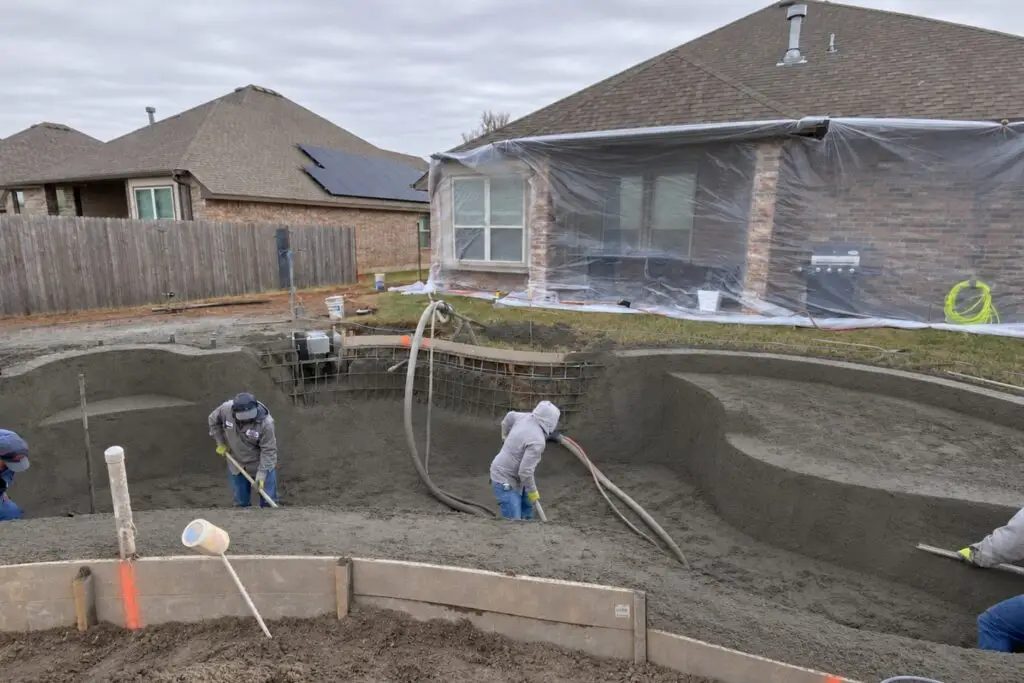
This is the part many DIY articles skip. A gunite (concrete) pool is built to hold water in, but it is also held in place by the water weight. If the ground around it is wet, the groundwater can push up on an empty shell. It can crack the structure, or in extreme cases lift it out of the ground. Vinyl liners can wrinkle or float, and fiberglass shells can pop too.
So a small drain of a foot or two is usually fine, but anything bigger should be planned with a pool pro who knows your soil and water table. This is exactly the type of local knowledge a builder has.
Method 2: Use softer water for the refill
Your refill water is half of the equation. A few ways to improve it:
- Hauled (delivered) water: Water delivery companies can bring about 6,000 gallons per load. Ask for the calcium level of their water first, because some sources are just as hard as your tap.
- Reverse osmosis (RO) service: Some pool companies run mobile RO trucks that remove minerals from your water, and they can drain and treat water on site. Availability and pricing vary a lot by area, so get quotes.
- Softened water: A water softener swaps calcium for sodium. Filling with softened water avoids adding calcium, but it adds sodium. Fine for many pools, especially saltwater, but check with your pool pro first.
Method 3: Avoid adding more calcium
Calcium hypochlorite (“cal-hypo”) shock adds roughly 0.7 ppm of calcium for every 1 ppm of chlorine it produces. If you shock with it often, you are slowly feeding the problem. Liquid chlorine or other non-calcium shock is a better choice if your levels are already high.
How to remove calcium scale from tile, plaster and liners
Lowering hardness stops new scale. It does not remove the crust that’s already there. Here is what works on each surface.
| Surface | What works | What to avoid |
|---|---|---|
| Ceramic or porcelain tile | Wet pumice stone (slow circles), scale remover spray, stain eraser brush | Razor blades, putty knives, hammers |
| Glass tile | Soft brush and a glass-safe scale remover, or professional bead blasting | Pumice stone, harsh scrubbing |
| Plaster or gunite | Stain eraser brush, scale remover, pro acid wash for heavy scale | Aggressive acid on dark or colored plaster without testing |
| Vinyl liner | Soft sponge or brush with a liner-safe stain and scale product | Pumice, stiff brushes, strong acid |
| Fiberglass | Soft cloth and a fiberglass-safe cleaner | Pumice, abrasive pads |
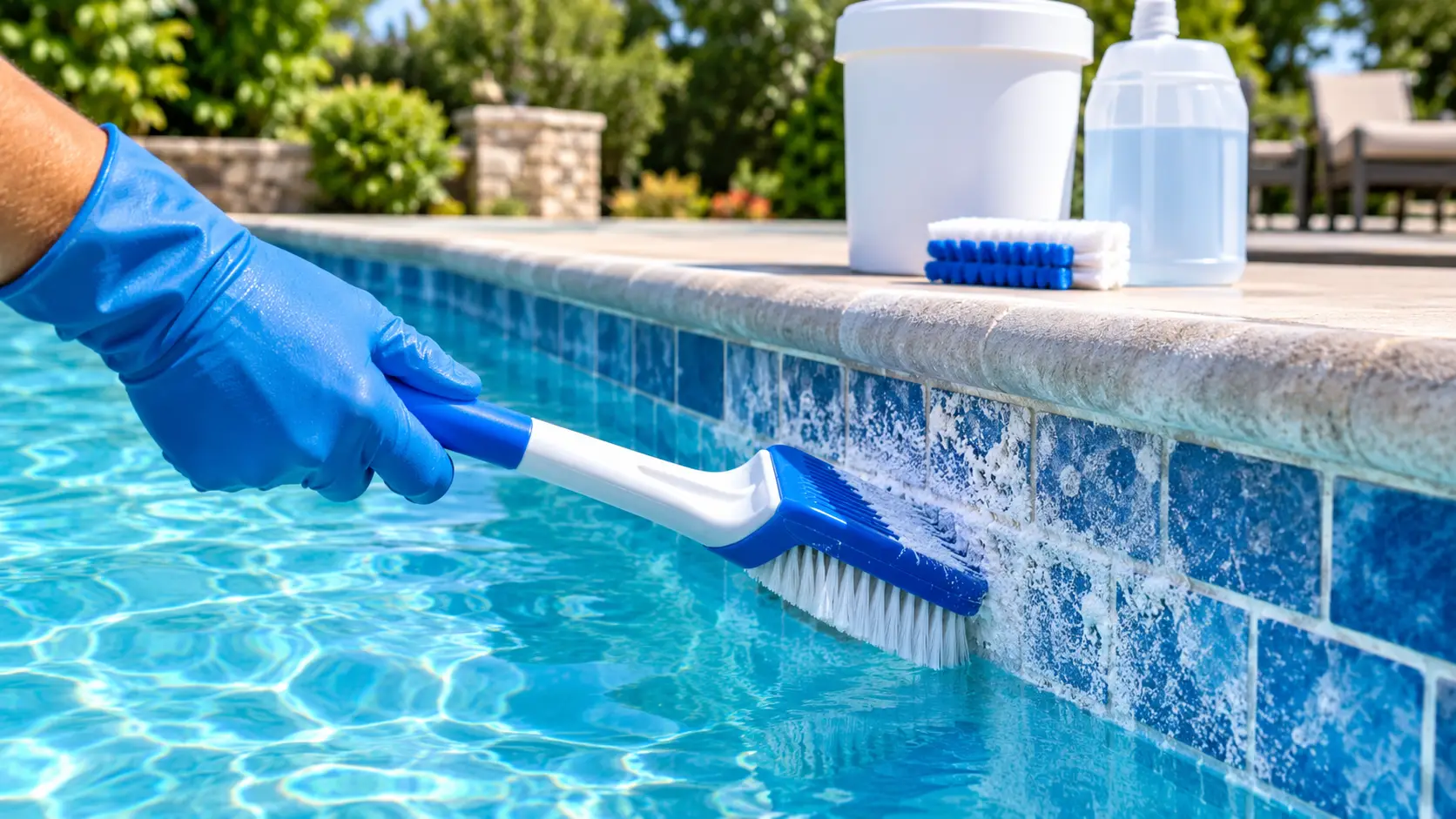
DIY: Pumice stone for tile scale
- Lower the water a few inches below the scale line.
- Keep both the tile and the stone wet the whole time.
- Rub in slow, gentle circles. Do not press hard.
- Rinse, and check progress. Repeat in small sections.
DIY: Scale remover products
Spray-and-soak products soften the scale so a brush can take it off. Some are added to the water and dissolve deposits over a few weeks. Always check that the product matches your sanitizer and surface, and follow the label.
When scale is too heavy for DIY
Call a pro if:
- Acid doesn’t fizz (likely calcium silicate).
- You have glass or mosaic tile that scratches easily.
- The scale is thick, flaking, or on the heater and salt cell.
- You’ve tried twice and it keeps returning.
Professionals often use bead blasting (fine glass media sprayed on the tile) or a pool acid wash on the shell. These are quick and effective, but they need experience to avoid damaging grout or surface.
What does not work
A lot of products and tips online overpromise. Here’s the honest list.
- “Calcium reducer” or sequestrant products: These bind calcium so it stays dissolved, which can slow scale for a few weeks. They do not remove calcium, and tests still show the same number.
- Flocculants and clarifiers: They clump particles so your filter can catch them. Dissolved calcium passes straight through. They can help with cloudy water, not hardness.
- Filtering and vacuuming: Doesn’t touch dissolved calcium.
- Adding more chemicals to “balance” it: Raising or lowering pH with acid and soda ash might change scale risk, but it won’t lower the calcium number.
- Scraping with metal tools: Chips tile and etches plaster. It’s the fastest way to turn a $400 job into a $2,000 one.
How much does calcium removal cost?
Prices below come from published national and contractor rates, and then I checked them for sense against each other. Costs vary by region, pool size and company, so use them as a planning range, not a quote.
| Fix | Typical cost | Does this price make sense? |
|---|---|---|
| Hose refill with city water | About $4 to $10 per 1,000 gallons. A 10,000 gallon partial refill is roughly $40 to $100 | Yes. It lines up with typical municipal water rates, though some areas add sewer fees |
| Hauled water (truck) | About $200 to $600 per load (around 6,000 gallons), or $30 to $100 per 1,000 gallons. A 10,000 gallon refill is roughly $300 to $1,000 | The math holds up (6,000 gallons at $200 to $600 equals $33 to $100 per 1,000), but it is 5 to 10 times the hose price. Worth it only when your tap water is very hard, or you can’t legally or practically use a hose |
| Water delivery extras | Some companies add fees for potable water, rush delivery, hose length or fuel (often $75 to $200 or more per load in one published example) | Always ask for the all-in price. A “cheap” load can turn pricey fast |
| Tile scale removal by a pro | Commonly $4 to $10 per linear foot, about $300 to $900 for a typical job, often with a 40 to 100 foot minimum | Fair for real bead blasting or heavy scale. Poor value if you are paying a minimum charge for a small patch you could pumice yourself |
| Specialized restoration (heavy scale, glass tile) | Roughly $600 to $2,000 | Reasonable if the tile is glass or the scale is severe. Get a second quote above $1,000 |
| DIY pumice, brush and scale remover | Usually a modest amount of money for supplies, plus your time | Best value for light calcium carbonate on ceramic tile |
| Water softener (for fill water) | Installation often $200 to $6,000 | Rarely worth it for the pool alone. Worth it only if you want softer water for the whole house too |
| Full resurfacing or remodel | Varies a lot by size and finish | Only when the surface is damaged or heavily scaled across the board. See below |
Is that cost actually good?
Here is the technical way to think about it.
- Hose dilution is the clear winner on price. A 50% refill on a 20,000 gallon pool costs $40 to $100 in water if your tap isn’t too hard. Compare that with $300 to $1,000 for trucked water. The truck only wins when your tap water is the problem.
- Check your fill water before paying for anything. If your tap measures 400 ppm, diluting with it gets you nowhere, and then RO or hauled soft water starts to make sense.
- Pro tile cleaning is usually priced per foot. The numbers come mostly from contractor listings in warm, high-demand markets, so your area could be lower or higher. A $600 minimum on a 40 foot waterline is steep, a $450 job on 90 feet is fair.
- If you’re paying every year, something else is wrong. Repeated scale usually points to high pH or alkalinity, hot water, or a salt cell throwing pH up. Fixing the chemistry is cheaper than annual scale cleaning.
- Be careful with “calcium remover” subscriptions. Since sequestrants do not remove calcium, paying for them monthly is not a real fix, only a delay.
How to stop calcium from coming back
- Test water at least monthly, and after every refill or heavy rain.
- Keep pH around 7.4 to 7.6 and total alkalinity in your target range.
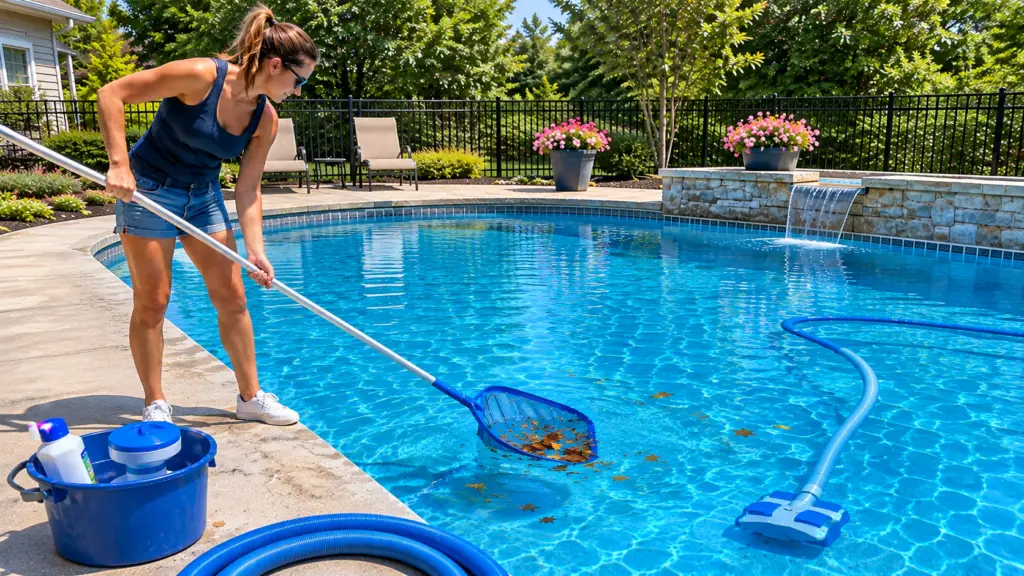
- Brush the waterline weekly. Light scale is much easier before it hardens.
- Use non-calcium shock when your hardness is already high.
- Keep an eye on salt cell and heater health, both can scale up first.
- Top off with the softest water you have, and do not let the pool evaporate to very low levels, since the minerals stay behind.
- Run a CSI check when you change anything big (heat, salt, new finish).
People also ask
Can you remove calcium from pool water with chemicals?
Not really. Chemicals called sequestrants keep calcium dissolved so it doesn’t form scale, but the calcium is still there. The only true fix is replacing some of the water with lower-calcium water.
What happens if calcium hardness is too high in a pool?
Water can turn cloudy, scale forms on tile, plaster, heaters and salt cells, and filters and pipes can clog. Over time it shortens equipment life and makes the surface feel rough.
What happens if calcium hardness is too low?
The water becomes aggressive. It can etch plaster, soften grout, damage heaters and stain surfaces. That’s why you shouldn’t dilute more than you need.
How do you lower calcium hardness without draining the pool?
You can do small partial drains and refills, treat the problem with a sequestrant as a short-term fix, or use mobile RO treatment where it is available. But a total drain isn’t needed in most cases.
Does vinegar remove calcium from pool tile?
Vinegar is a weak acid and can soften very light carbonate scale on tile above the waterline. For real buildup, a purpose-made scale remover or pumice stone works better and faster.
Does baking soda lower calcium in a pool?
No. Baking soda raises total alkalinity. It does not affect calcium, and raising alkalinity can actually increase scaling risk if hardness is already high.
How often should you test calcium hardness?
Monthly during swim season, plus after refills and big weather changes. Test strips are okay for trends, a liquid kit or store test is better when you’re making decisions.
Why does my saltwater pool get calcium scale?
Salt cells raise pH near the plates, and higher pH makes calcium come out of the water. That’s why saltwater pools often scale on the cell first. Keep pH and alkalinity in range and clean the cell as the manufacturer says.
Can calcium damage pool equipment?
Yes. Scale insulates heater elements and heat exchangers (forcing them to work harder), restricts flow in pipes, and coats salt cell plates.
How Blue Haven helps
Calcium trouble is a water chemistry issue first, but it’s also a pool design, surface and equipment issue. That is where an experienced builder makes a real difference. Blue Haven has been building custom inground pools since 1954, with 300,000+ pools built across the country, a 4.8 out of 5 rating from 10,000+ verified reviews, and local teams in more than 50 locations. We’re proud to be one of the most established pool builders in America, and our site is recognized as a top-ranked company in the industry. Here’s how that experience applies to your calcium problem.
1. We build pools that handle water chemistry better
Surface and structure matter. As specialists in custom gunite pool construction, we know how plaster, pebble and other interior finishes react to hard or soft water, and we design around your local conditions. If you’re still deciding between materials, our guide on gunite vs fiberglass pools explains how each one handles upkeep.
2. We can renew a scaled or worn surface
When calcium has etched, stained or roughened your pool for years, cleaning may not be enough. Our pool remodeling and renovation team can help you decide if it’s time for new tile, a fresh interior finish or a bigger refresh. Our article on 15 inground pool remodel ideas with real costs is a good place to start planning.
3. We know local water, soil and rules
Our local teams understand regional soil, groundwater, climate and HOA or permit requirements. That is the knowledge you want before you drain a gunite pool, so you don’t risk the shell. Find your nearest team on our locations page.
4. We help you automate and monitor your pool
Stable chemistry is easier when your equipment does the work. See how SmartFeatures pool equipment can help you control pumps, heating, lighting and more from your phone, so small problems get noticed before they become scale.
5. We make big projects easier to afford
If your pool needs more than a cleaning, you should know the numbers. Visit our inground pool pricing page, check out pool financing options, and use the pool loan calculator to estimate monthly payments.
6. We give you a free, honest estimate
Pricing depends on your yard, finish, equipment and local costs, so the best way to get a real number is a consultation. Request a free inground pool estimate or contact us and our team will walk you through it.
Looking for inspiration for a refresh or a brand new pool? Browse our inspiration gallery and see finished projects in styles like Estate, Family and Retreat. Need testing supplies or chemicals? Visit the Blue Haven pool supplies store.
FAQ
How do I remove calcium from my pool fast?
For scale on tile, a wet pumice stone or a scale remover is the fastest DIY option. For high calcium hardness in the water, a partial drain and refill with lower-calcium water is the fastest real fix. Most pools need two small rounds, not one big one.
What is a safe calcium hardness level for a pool?
For plaster or gunite pools, about 250 to 450 ppm is common, with 300 to 400 ppm a safe target. Fiberglass pools run lower, around 220 to 350 ppm, and vinyl liner pools lower still, around 150 to 250 ppm. Check your warranty and your CSI.
How much water do I need to drain to lower calcium?
Use the formula: (current ppm minus target ppm) divided by (current ppm minus fill water ppm). A pool at 650 ppm with a 400 ppm target and 150 ppm fill water needs about 50% replaced.
Can I drain my pool completely to fix calcium?
You shouldn’t. A full drain is rarely needed, and it can damage gunite, vinyl and fiberglass pools because of groundwater pressure. Ask a pool professional before draining more than a small amount.
How much does it cost to remove calcium from a pool?
A DIY hose dilution can cost under $100 in water for a typical partial refill. Hauled water often runs $300 to $1,000 for 10,000 gallons. Professional tile scale removal is commonly $300 to $900, and heavy restoration can reach $600 to $2,000. These are published ranges, so get local quotes.
Is calcium in a pool harmful to swimmers?
Normal calcium levels are not a health risk. The problems are mainly for your pool: scale, cloudy water, rough surfaces and equipment wear. Very hard water might feel less comfortable on skin and eyes for some swimmers, though.
Do calcium reducer products work?
They bind calcium temporarily, which can slow scale, but they don’t lower the calcium hardness number. Dilution is the real solution.
How do I know if it’s calcium carbonate or calcium silicate?
Put a few drops of muriatic acid on the deposit (with proper safety gear). If it fizzes, it’s calcium carbonate and often DIY friendly. If it does not, it’s probably calcium silicate and you should hire a professional.
Will a new pool surface stop calcium problems?
A new finish gives you a clean start, but it won’t fix the water. Without balanced pH, alkalinity and calcium, scale will return. Pair any resurfacing with a proper water chemistry plan.
When should I call a pool professional?
Call a pro if you have glass tile, a gunite pool that needs a large drain, calcium that doesn’t fizz in acid, heavy scale on your heater or salt cell, or scale that keeps coming back after cleaning.
Final thoughts
Removing calcium from a pool is mostly about knowing which problem you have. If the water is too hard, dilute it in stages with the best water you can get. If the crust is already on the surface, remove it gently and then fix the chemistry so it does not return. And if your pool is old, etched or heavily scaled, a remodel might be the smarter long-term spend than another round of scrubbing.
Ready to talk through your options? Get a free estimate from Blue Haven and let our local team take a look.