
To clean an inground pool, work in this order: skim the surface, empty the skimmer and pump baskets, test the water, brush the walls and floor, vacuum the debris, clean or backwash the filter, then balance the chemistry and shock only if you need to. Skim and empty baskets weekly, brush and vacuum weekly, and test the water at least once a week during swim season.
That’s the short version. Below you’ll find every step explained, a schedule you can actually stick to, the water chemistry numbers that matter for gunite pools, and an honest look at what cleaning costs (including which prices online look fair and which ones don’t add up).
What You Need Before You Start
You don’t need a garage full of gear. A basic kit covers most inground pools.
| Tool | What it does | Notes |
|---|---|---|
| Leaf skimmer net | Removes floating leaves and bugs | Use it first, every time |
| Wall and floor brush | Loosens algae and film | Nylon bristles are the safe starting point |
| Telescopic pole | Holds the brush, net and vacuum head | Long enough to reach the deep end |
| Manual vacuum head and hose | Sucks dirt off the floor | Skip it if you own a robot |
| Test kit or strips | Measures chlorine, pH, alkalinity, hardness, stabilizer | A drop-based kit is more accurate than strips |
| Filter cleaner | Dissolves oils and gunk in cartridges | Optional but helpful |
| Pool chemicals | Chlorine, pH adjusters, alkalinity increaser | Buy only what your test says you need |
You can pick up most of this at Blue Haven’s pool supply shop or your local pool store.
A quick note on brushes
Gunite and plaster pools are tougher than vinyl, but the interior finish still matters. Start with nylon. Stainless steel brushes can scratch some finishes, especially pebble and quartz, so check with your builder before you reach for one.
How to Clean an Inground Pool: 10 Steps
Step 1: Skim the Surface
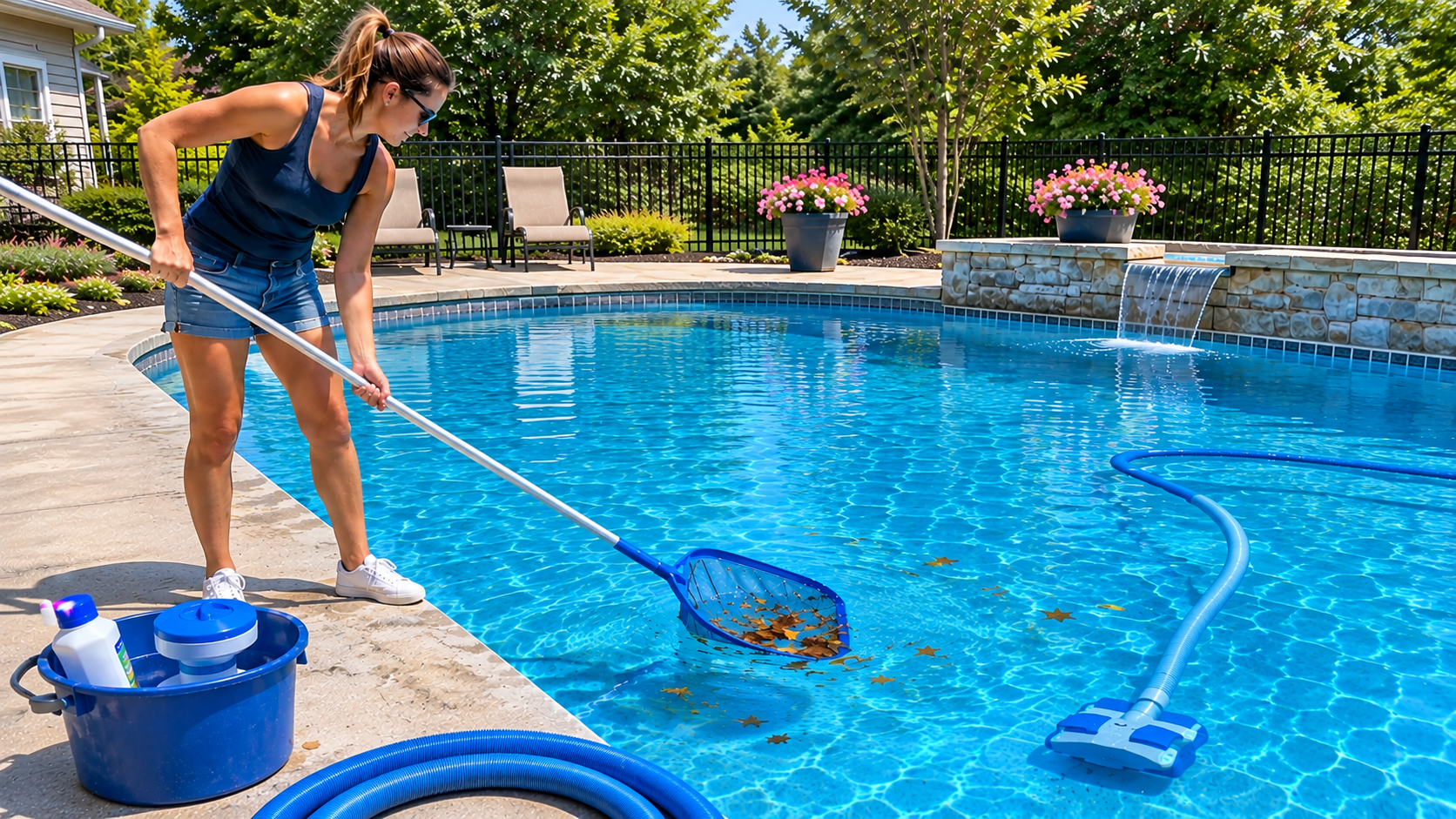
Grab your leaf net and clear everything floating. Leaves that sink break down and feed algae, and floating debris clogs your skimmer basket fast. Do this first so the rest of the job goes smoother.
Step 2: Empty the Skimmer and Pump Baskets
Turn the pump off before you open the pump basket. Pull out the leaves, rinse the basket, and put it back snug. A full basket chokes your water flow, and low flow means a dirtier pool and a harder-working pump.
Step 3: Test the Water First
Test before you add anything. Your numbers tell you if the pool just needs a brush and vacuum, or if you’ve got a chemistry problem hiding underneath. Check free chlorine, pH, total alkalinity, calcium hardness and stabilizer (cyanuric acid). Targets are in the chemistry section below.
Step 4: Brush the Walls, Steps and Floor
Brush everything toward the main drain, working from the shallow end down. Pay extra attention to corners, behind ladders, steps and any spot where water doesn’t circulate well. Brushing knocks algae and film loose so your filter can catch it. Skip this and the vacuum just rolls over a layer of buildup.
Don’t forget the waterline
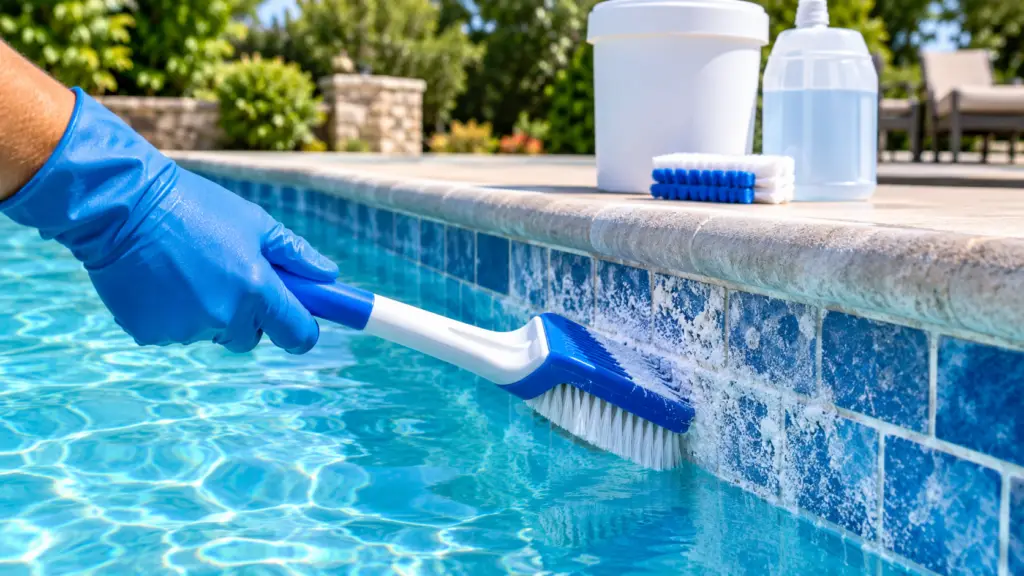
Scrub the tile line with a tile brush or a soft pad and a pool-safe tile cleaner. That greasy ring is sunscreen, body oils and minerals, and it gets harder to remove the longer it sits.
Step 5: Vacuum the Pool
This is where most people get stuck, so here’s the manual process:
- Assemble the vacuum head, pole and hose.
- Lower the head into the water until it sits on the floor.
- Prime the hose by holding the open end against a return jet until all the bubbles stop. Keep it fully underwater.
- Connect the hose to your vacuum plate or the skimmer suction port with the pump running.
- Move slowly in overlapping lines, starting at the shallow end. Rushing stirs dirt back into the water.
- If you lose suction, re-prime the hose and try again.
Using a robotic cleaner? Skip the hose work. Drop it in and let it run its cycle.
Vacuum to waste vs vacuum to filter
If your pool has heavy debris or algae, set a multiport valve to “waste” so the dirt leaves the system instead of loading up your filter. Just watch your water level, because you’re sending water out. For light dirt, normal filter mode is fine.
Step 6: Clean or Backwash the Filter
Watch your pressure gauge. When it climbs about 10 psi above its clean starting pressure, it’s time to clean the filter (check your filter’s manual for its exact number).
- Cartridge filters: Pull the cartridge, hose it down between the pleats, and soak it in a filter cleaner if it’s oily.
- Sand filters: Backwash until the sight glass runs clear, then rinse. Backwash after vacuuming too.
- DE filters: Backwash, then recharge with fresh DE powder.
Step 7: Balance the Water Chemistry
After you’ve cleaned up the physical mess, adjust the chemistry. Fix alkalinity first, then pH, then sanitizer. Change one thing at a time and give the water a few hours of circulation before you retest.
Step 8: Shock the Pool If You Need To
Shocking means raising chlorine well above normal to burn off algae, chloramines and organic waste. You’ll want it after heavy use, a big storm, a pool party, or when the water looks dull. Do it at dusk, because sunlight burns off unstabilized shock quickly. Follow the label for your product and don’t swim until free chlorine drops back to the normal range.
Step 9: Run the Pump Long Enough
Circulation is what actually keeps water clean between visits. Most guidance says to run the filter at least eight hours a day. If you have a variable-speed pump, longer runs at low speed are usually more efficient than short runs at high speed.
Step 10: Check the Deck, Cover and Equipment
Sweep or rinse the deck so dirt doesn’t wash back in. Look at your pool cover, if you use one, and clear standing water off it. Do a quick walk around the equipment pad for leaks, drips or odd noises. Small leaks are sneaky, and they cause a lot of water-quality headaches.
Inground Pool Cleaning Schedule
You don’t have to do everything every day. Here’s a realistic rhythm.
| How often | Task |
|---|---|
| Daily or every other day | Quick skim, check that water is circulating, glance at water clarity |
| 2 to 3 times a week | Test free chlorine and pH (daily in very hot weather or heavy use) |
| Weekly | Empty baskets, brush, vacuum, test full chemistry, check filter pressure |
| Monthly | Test calcium hardness and stabilizer, deep-clean the tile line, inspect equipment |
| Every 3 to 6 months | Deep-clean filter, check pump and seals |
| Seasonally | Open and close the pool properly; inspect the surface and tile |
Hot weather, trees overhead, kids, pets and big storms all push you toward the high end of that schedule. A pool under a mature oak is a different animal than one in an open yard.
Water Chemistry Targets for a Gunite Pool
Clean water isn’t just about what you can see. These are the ranges most pros and health agencies work from.
| Measure | Target | Why it matters |
|---|---|---|
| Free chlorine | 1 to 3 ppm (CDC minimum is 1 ppm; many pros aim for 2 to 3 ppm when using stabilized chlorine) | Kills germs and algae |
| pH | 7.4 to 7.6 ideal (CDC range is 7.0 to 7.8) | Keeps chlorine effective and swimmers comfortable |
| Total alkalinity | 80 to 120 ppm | Stops pH from swinging wildly |
| Calcium hardness | 200 to 400 ppm for gunite and plaster | Protects the surface from etching |
| Cyanuric acid (stabilizer) | 30 to 50 ppm | Shields chlorine from the sun |
A correction on calcium hardness
Some popular how-to articles list calcium hardness as 100 to 300 ppm. For a gunite or plaster pool, that low end is risky. Soft, hungry water can pull calcium out of the plaster itself, which leads to etching and a rough surface. Aim for 200 to 400 ppm, and many pros like the 250 to 350 range for plaster and gunite.
Don’t forget temperature and use
Hot water and heavy bather loads use up chlorine faster. If your numbers keep drifting, look at pump run time, filter health and how often you’re testing before you just keep dumping in chemicals.
Robotic Cleaner vs Manual Vacuum vs Hiring a Pro
There’s no single right answer. It depends on your time, budget and how much you enjoy pool chores.
| Option | Best for | Upside | Downside |
|---|---|---|---|
| Manual vacuum | Tight budgets, spot cleaning, heavy debris | Cheap, powerful suction for dirty areas | Takes your time every week |
| Robotic cleaner | Busy owners who want hands-off floors and walls | Runs on a timer, cleans floor, walls and often the waterline | Upfront cost; doesn’t fix chemistry |
| Pro weekly service | People who travel, hate chemistry, or want it done | Chemistry, skimming, brushing, vacuuming handled | Ongoing monthly cost |
| Built-in cleaning system or automation | New builds and remodels | Cleaning and chemistry assisted by the pool’s own equipment | Best planned during design |
A robotic cleaner is great at the floor and walls, but it won’t balance your water, fix a failing filter or rescue green water. Think of it as a very good helper, not a replacement for testing.
How Much Does It Cost to Clean an Inground Pool?
Let’s talk numbers, and let’s actually check them, because plenty of pool cost articles copy each other or quote prices that don’t match their own math.
Typical Costs at a Glance
| Option | Typical cost (2026) | Is it a fair price? |
|---|---|---|
| Weekly full-service pool cleaning | $120 to $250 per month for a standard residential pool | Yes, this is the range most sources agree on. Over $300 needs a reason like a big pool, salt system, spa or heavy leaf load |
| Chemical-only plan | About $100 to $160 per month | Fair if you’re doing the brushing and vacuuming yourself |
| Biweekly service | About $100 to $180 per month | Fair, but biweekly visits raise the odds of algae in hot weather |
| Premium, large, salt or high-debris pools | $225 to $350 per month | Reasonable when the pool really is bigger or messier |
| DIY chemicals and supplies | About $40 to $100 per month | Realistic for a chlorine pool, higher with heavy use |
| Robotic cleaner | Entry about $150 to $500, mid-range $500 to $900, premium $900 to $1,500, advanced models above $1,500 | Mid-range ($500 to $1,000) is the sweet spot for most inground pools |
| Seasonal opening and closing | About $300 to $700 per year | Fair, and cheaper than fixing freeze damage or green water |
| Electricity (pump and equipment) | About $50 to $150 per month | Varies a lot with pump type and run time |
We Checked the Numbers: Is That Price Actually Good?
We read through the top-ranking cost articles and compared their claims. Here’s what held up and what didn’t.
Professional service: $120 to $250 per month holds up
Several independent 2026 sources land in the same neighborhood for weekly service, including ThePricer, Swimply and Home Gnome. Published plans from local companies also line up, from roughly $125 up to about $195 per month for standard tiers. Our verdict: if a quote falls between $120 and $250 and includes chemicals, that’s a fair deal. Under $100 usually means a stripped-down plan. Above $300, ask why.
Some numbers don’t add up
- One article lists $720 to $1,140 per month for service on a 30,000-gallon pool with six visits. That’s far outside every other source, and it looks like a premium or commercial-style scenario, not a typical backyard pool.
- A popular DIY site lists basic cleaning packages at $30 to $95 per month, while the page’s own description says maintenance runs “$100 to $350 per year.” Those two figures can’t both be right, so we wouldn’t budget off either.
- Per-visit prices don’t always reconcile with monthly ones. One guide says $80 to $150 per week yet also says $120 to $300 per month for weekly visits. Weekly visits mean four or so visits a month, so always ask a company for the monthly total, what’s included, and what costs extra.
Robotic cleaner prices: some older numbers are out of date
An older, widely linked guide (Real Homes, originally published in 2022) says a smart robotic vacuum tops out around $1,000. In 2026, multiple retailer guides show premium units from $900 to $1,500, and advanced multi-function models going past that. If a how-to article quotes a robot price cap that low, it’s probably outdated.
Does a robot pay for itself?
Quick math. A $700 robotic cleaner versus a $150 per month service plan is about five months of service. But the robot only covers cleaning. It doesn’t test or balance your water, so you’d still buy chemicals and test regularly. The real comparison is robot plus DIY chemistry versus full service. If you travel a lot or don’t want to deal with chemistry, service can still be worth every dollar. A pool that goes green and needs resurfacing or heavy treatment can cost far more than a year of regular service.
A note on pricing sources
Many published pool cost ranges come from retailer blogs and local service company pages, which is fine for ballparks but not for firm quotes. Prices swing by region, pool size, debris load and what’s included. Always get a written quote from a local company.
Common Pool Cleaning Problems and Fixes
My Pool Water Is Green
Green means algae. Brush everything, test and balance pH first so chlorine can work, shock the pool at dusk, run the pump around the clock, and clean the filter often until the water clears. If you can’t see the bottom after a day or two, call a pro. A stubborn bloom or a failing filter can drag on for weeks.
My Pool Water Is Cloudy
Cloudy water usually comes from a dirty filter, poor circulation, high pH or alkalinity, or low chlorine. Clean the filter, test the water, fix the numbers, and run the pump longer. Calcium hardness that’s way too high can also cloud things up.
There’s a Ring Around the Waterline
That’s oils, lotions and minerals. Scrub it with a tile-safe cleaner. If it’s rough and white, it may be calcium scale, which needs a different treatment.
My Pool Gets Dirty Right After I Clean It
Check circulation, filter condition, pump run time and chemistry. Also look at your surroundings. Trees, uncovered mulch beds and open dirt near the pool all feed debris into the water. Smart landscaping helps a lot, and our guide to backyard pool landscaping ideas shows low-litter planting options that look great and keep your pool cleaner.
How Blue Haven Helps
Cleaning your pool should be the easy part of owning one. At Blue Haven, we’ve spent more than 70 years building pools that are designed to make that true.
A Pool Designed for Easier Care
The cleanest pool starts with good design. Our local designers plan your layout, circulation and equipment around how you’ll actually use the space. That’s the foundation of a pool that’s simpler to keep clear. Explore our new inground pool options or browse the inspiration gallery to see real backyards.
SmartFeatures® That Cut the Work
Our exclusive SmartFeatures® line is built to automate pool care, save water and energy, and reduce chemical use:
- SmartPure® Systems for cleaner water with virtually no chlorine
- SmartControls™ Pool Automation to manage equipment run times and settings
- SmartBrite® ColorQuartz® Interior Finish, a durable finish built to resist chipping, etching and staining
- SmartLight® Multicolor LED lighting that adds beauty without extra upkeep
Many homeowners also pair these with variable-speed pumps, automatic covers and in-floor cleaning to simplify maintenance even more. What fits your pool gets decided during your design consultation.
Already Have a Pool That’s a Hassle? We Remodel Too
Tired plaster, an old pump or a clunky equipment pad can make cleaning feel like a full-time job. Blue Haven is America’s #1 pool remodeler, and our remodeling and renovation services include pool resurfacing, equipment upgrades, tile and coping, deck renovation, full redesigns and water features. Upgrading from basic plaster to a more advanced finish and replacing aging equipment with modern, efficient systems can make a real difference in how easy your pool is to maintain. Not sure where to begin? Our 15 inground pool remodel ideas with real costs is a good place to start.
Why Homeowners Trust Blue Haven
| Proof point | Detail |
|---|---|
| Experience | 70+ year legacy |
| Pools built | 300,000+ nationwide |
| Reputation | 4.8 out of 5 stars across 10,000+ verified reviews |
| Reach | 60+ locations across the U.S. |
| Specialty | Custom gunite inground pool construction |
| Financing | 100% financing available for qualified buyers |
You can see how real projects turned out in our inspiration gallery, and read more about our approach on the About Us page.
Honest Pricing and Flexible Financing
We don’t believe in made-up website numbers. Every backyard is different, so the most accurate way to understand cost is a free, in-home consultation. Learn more on our pool pricing page, explore financing options, or apply online for a pool loan. Financing is subject to credit approval.
Local Help Near You
Services and maintenance support can vary by location, so ask your local team what they offer. Find your nearest Blue Haven location, get a free estimate and 3D design, or contact us to start the conversation.
People Also Ask: Quick Answers About Cleaning Inground Pools
How often should you clean an inground pool?
Skim and check baskets every few days, then brush, vacuum and test the water at least once a week. Test chlorine and pH two to three times a week in summer. Hot weather, storms, trees and heavy use mean more frequent cleaning.
What is the fastest way to clean an inground pool?
Skim off the surface, run a robotic cleaner or vacuum the floor, then empty the baskets and check your filter. For a quick refresh, skimming plus a robot run and a chemistry check takes a fraction of the time of a full manual clean.
Should you brush or vacuum a pool first?
Brush first. Brushing loosens algae and dirt from the walls and floor so the vacuum or filter can pick it up. Vacuuming first just leaves the loosened debris to settle again.
Should the pump be on when you clean the pool?
Yes. Keep the pump running while you brush so the filter catches the debris you stir up, and the pump must be on for a manual vacuum to work. Turn it off before opening the pump basket.
Can you clean a pool without a vacuum?
Yes, to a point. Brush the surfaces, run the filter so it can catch suspended debris, and keep your chemistry balanced. A robotic cleaner is the easiest hands-off alternative. A vacuum or robot still does the best job on the floor.
Do you have to drain a pool to clean it?
Almost never. Regular brushing, vacuuming, filtering and balanced chemistry keep a pool clean without draining. Draining is a last resort for extreme chemistry problems, and it can damage some pools if done wrong, so talk to a professional before you do it.
How long should you wait to swim after cleaning?
You can swim after brushing and vacuuming once the water is circulating and clear. After shocking, wait until free chlorine drops back into the normal range, typically 1 to 3 ppm, and follow the product label.
Why does my pool get dirty so fast?
The usual suspects are poor circulation, a dirty filter, a short pump run time, unbalanced chemistry, leaks and nearby trees or bare soil. Fix those and cleanliness improves fast.
What’s the best cleaner for a gunite pool?
Most gunite pools do well with a quality robotic cleaner or a manual vacuum, plus a nylon brush. The best choice depends on pool size, shape and debris load, so check with your builder or service team.
How much does it cost to have someone clean your pool?
Most homeowners pay about $120 to $250 per month for weekly full service on a standard inground pool. Chemical-only plans start closer to $100, and larger or high-debris pools can run $225 to $350. See the cost section above for how we checked those numbers.
Frequently Asked Questions (FAQ)
How do I vacuum an inground pool step by step?
Assemble the vacuum head, pole and hose. Lower the head to the floor, prime the hose until the bubbles stop, then connect it to the skimmer or vacuum plate with the pump on. Move slowly in overlapping lines, starting at the shallow end. When you’re done, empty the baskets and clean or backwash the filter.
What’s the difference between cleaning and balancing a pool?
Cleaning removes physical dirt, algae and debris. Balancing adjusts the chemistry, including chlorine, pH, alkalinity, hardness and stabilizer. You need both, because a spotless pool with bad chemistry will still cloud up, and balanced water with debris sitting at the bottom will still grow algae.
How do I clean a pool after winter?
Clear the cover and remove debris, restore the water level, reinstall plugs and equipment, start the pump and filter, brush and vacuum, test and balance the water, then shock if needed. Don’t switch on a salt system until your chemistry is in range.
What chemical levels should an inground pool have?
For a typical gunite pool, aim for free chlorine of 1 to 3 ppm, pH of 7.4 to 7.6, alkalinity of 80 to 120 ppm, calcium hardness of 200 to 400 ppm, and stabilizer of 30 to 50 ppm.
Is a robotic pool cleaner worth it?
For many owners, yes. A mid-range robot at roughly $500 to $1,000 saves hours every week and cleans floors and walls well. It won’t test or balance your water, so you’ll still need to handle chemistry or pay for service.
How long does it take to clean a pool?
A routine weekly clean on a typical pool takes about an hour by hand, and less if a robot does the floors. A neglected or green pool can take days of treatment and filter cleaning to recover.
Can I clean my pool myself or should I hire someone?
You can absolutely do it yourself if you’re consistent and comfortable testing water. Hiring a pro makes sense if you travel, have a large or heavy-debris pool, or simply want your weekends back. Fairly priced service is cheaper than repairing the damage neglect can cause.
How can I make my pool easier to clean in the future?
Good design and equipment make the biggest difference. Efficient pumps, automation, quality sanitation systems, durable finishes, smart landscaping and a well-fitted cover all reduce your workload. Our team can walk you through the options during a free consultation.
Does a saltwater pool need less cleaning?
Not really. A salt system generates chlorine, so you still need to brush, vacuum, test and keep the filter clean. What it can change is how you manage and dose sanitizer. Ask your designer which sanitation system fits your goals.
Final Thoughts
Cleaning an inground pool isn’t hard, but it does reward consistency. Skim, brush, vacuum, check the filter, and test the water on a schedule, and most problems never get a chance to start. If you’re weighing DIY against service, use the cost ranges above as a sanity check, and always get a written quote that spells out what’s included.
And if your current pool feels like a chore, maybe the pool is the problem, not you. The right design, equipment and finish can change how much work your backyard takes. When you’re ready, reach out to your local Blue Haven team for a free consultation.